


Right before the historic Artemis 2 mission, retired astronaut and former Navy captain Scott Kelly and India’s Gaganyaan astronauts, speaking in New Delhi, entertained the concept of a “World Space Organization” to guide humanity’s future beyond Earth. Kelly joked that this could be the start to a Starfleet, in reference to Star Trek’s central spacefaring institution. It’s an inspiring vision. It’s also, at least for now, improbable in the current geopolitical environment.
My recent research explored how to formalize cooperation in outer space and reached a less romantic but more realistic conclusion. Space needs stronger institutions, but a universal one under the United Nations won’t work. What today’s environment demands is an institution built by countries seeking to support free actors and free enterprise to flourish off planet.
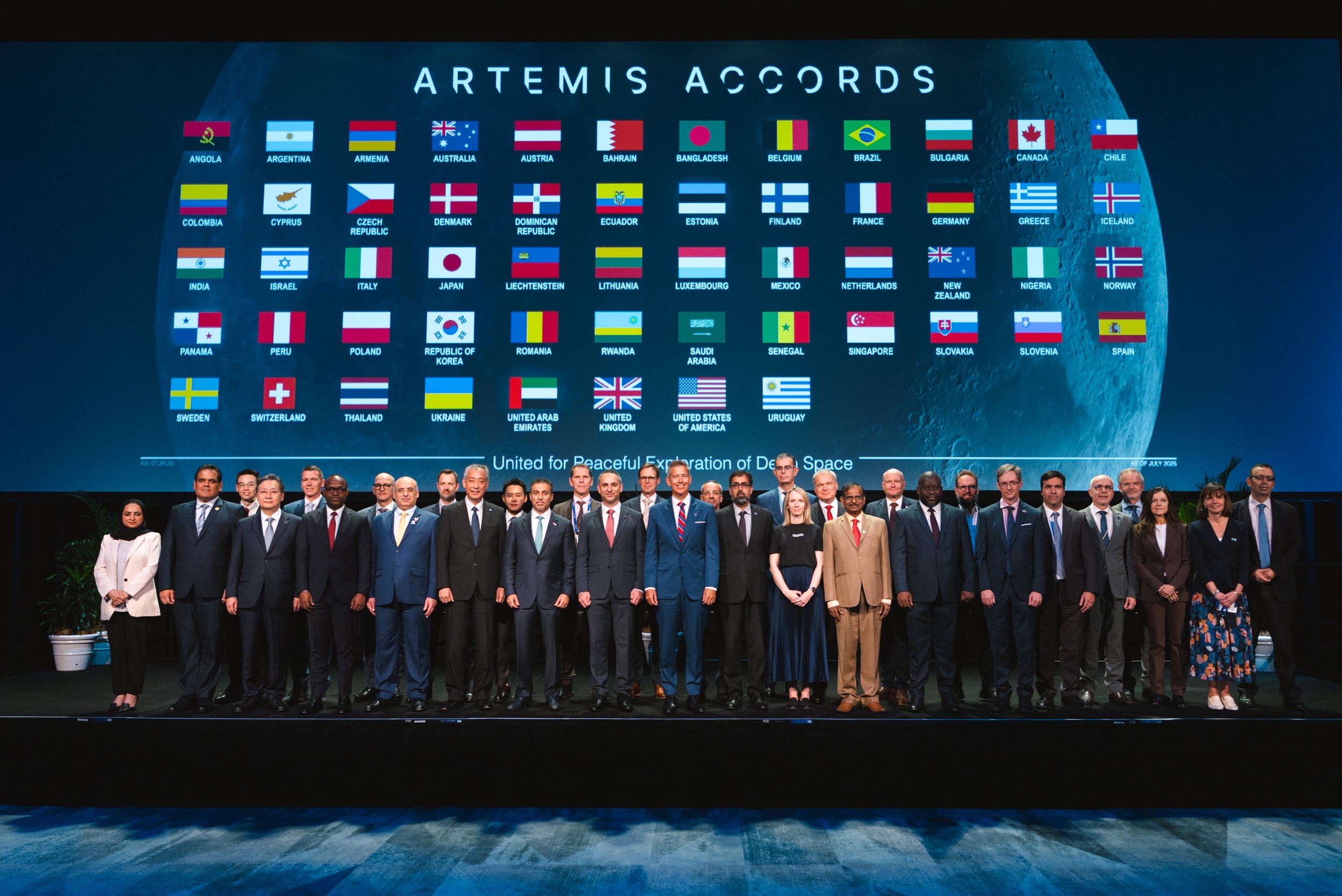
The matter at hand starts with a simple problem. The current system is not built for the world we are entering. The foundational UN space treaties established broad principles, but they did not create a framework for formal coordination on technology sharing, dispute resolution, burden-sharing, or common standards. While agreements like the Artemis Accords have advanced norms such as interoperability and deconfliction, they remain non-binding and lack real mechanisms for implementation and enforcement. The Accords, being bilateral agreements between the United States and individual signatory states, focus on areas such as emergency assistance, registration of space objects, release of scientific data, preservation of outer space heritage, responsible use of space resources, deconfliction of activities and mitigation of orbital debris.
That gap created by the Accords’ non-binding nature matters more now than ever. While space is the domain of dreams, it is also a strategic arena where civil exploration, commercial development and national security increasingly overlap. That geopolitical competition has already produced rival bloc structures: the U.S.-led Artemis framework on one side, and Chinese and Russian-backed efforts such as the Asia-Pacific Space Cooperation Organization and the International Lunar Research Station Collaboration Organization on the other. In other words, the institutional future of space is already being developed by states, not a global movement based in the UN.
That is why a UN-centered “World Space Organization” is unlikely to get off the ground. Some findings from my research note that a world space agency may be difficult to establish because multilateral agreements increasingly form around competing blocs. One expert I interviewed for the study was even more blunt: a global cooperation-first space organization would be almost completely dead-on-arrival in the current geopolitical climate. The recent record of UN diplomacy supports that skepticism.
An institution with member states controlled by dictatorships and totalitarianism working alongside democratic and free societies is unlikely. However, the question is not whether the world needs more cooperation in space. It does. The question is what kind of institution can actually<em> be built.
The best answer is a Space Treaty Organization anchored in the Artemis Accords and modeled not on the UN, but on the practical strengths of frameworks such as North Atlantic Treaty Organization, European Space Agency, the Organization for Economic Co-operation and Development and the International Space Station agreement. The most effective treaty-based systems combine a binding legal structure, clear organizational roles, accountability, transparency and decision-making procedures that allow action instead of paralysis. They also show that weak, ambiguous frameworks tend to fail. ESA and NATO have endured; the Southeast Asia Treaty Organization did not. ESA, as a legal agreement, has remained durable because it translates shared goals into institutions, programs, and financial commitments.
That does not mean the answer is to build another ESA or a “NATO in space.” In fact, folding everything into a security alliance would be counterproductive to the booming commercial space ecosystem and the growing interest in extending to the moon and Mars. The best framework is narrower: formalize cooperation in exploration and economic development, while keeping security cooperation more informal, precisely to reduce the risk of a runaway militarization of the domain. That balance matters. Space cannot be governed as if commerce and civilian exploration are separate from national or allied strategies. But it also should not be structured in a way that turns every space development into a classified national security mission.
This is where the Artemis Accords become helpful. They are a set of principles expanding from the Outer Space Treaty and designed to guide civil space exploration. That makes them an excellent starting point, but not a sufficient endpoint. Their value lies in the fact that they have already gathered a large coalition around shared norms of peaceful, transparent and interoperable activity in space. The next step is to formalize that coalition by creating a treaty-based organization. This institution does not have to be large or expensive to maintain but should give binding life to the principles set out in the Artemis Accords.
A Space Treaty Organization would do exactly that. It could create common standards for interoperability, clearer rules for technology-sharing among trusted partners and coordinated mechanisms for economic development from low Earth orbit to cislunar space and beyond. It could lower legal and political barriers between allies while giving commercial firms more predictable rules of the road. For America, it would fulfill key points of President Trump’s recent executive order on space, namely that of “strengthening ally and partner contributions to United States and collective space security.”
The alternative is drift: a non-binding Artemis system on one side, a rival Chinese-Russian institutional architecture on the other, and no formal mechanism among U.S. allies to coordinate the future of space development at scale. Rival blocs tend to create instability and uncertainty, however, not building upon the foundation of the Artemis Accords towards a binding structure would be a mistake. Doing so would leave countries seeking deeper cooperation to look towards Chinese leadership in outer space.
The discussion in New Delhi was right about one thing: Above all, space needs a better framework for cooperation. But in a world defined less by universal consensus than by strategic competition, the road to order will not run through a global authority under the UN. It will run through free people and free states across the world combining their will to build, invest, and align.
The right institution for this era is not a World Space Organization. It is a Space Treaty Organization led by the free world — a real-life Starfleet, if you will.
Eric Sundby is co-founder and CEO of TerraSpace, a company developing artificial intelligence for exploration and development of critical minerals on Earth and in space. He serves on the board of directors at the Space Force Association. He holds a PhD in Aerospace Sciences and master’s degrees in global management and international security.
SpaceNews is committed to publishing our community’s diverse perspectives. Whether you’re an academic, executive, engineer or even just a concerned citizen of the cosmos, send your arguments and viewpoints to opinion (at) spacenews.com to be considered for publication online or in our next magazine. If you have something to submit, read some of our recent opinion articles and our submission guidelines to get a sense of what we’re looking for. The perspectives shared in these opinion articles are solely those of the authors and do not necessarily represent their employers or professional affiliations.