

KOUROU, French Guiana — The SMILE mission developed jointly by the European Space Agency and China has reached orbit after more than a decade of preparations and cooperation.
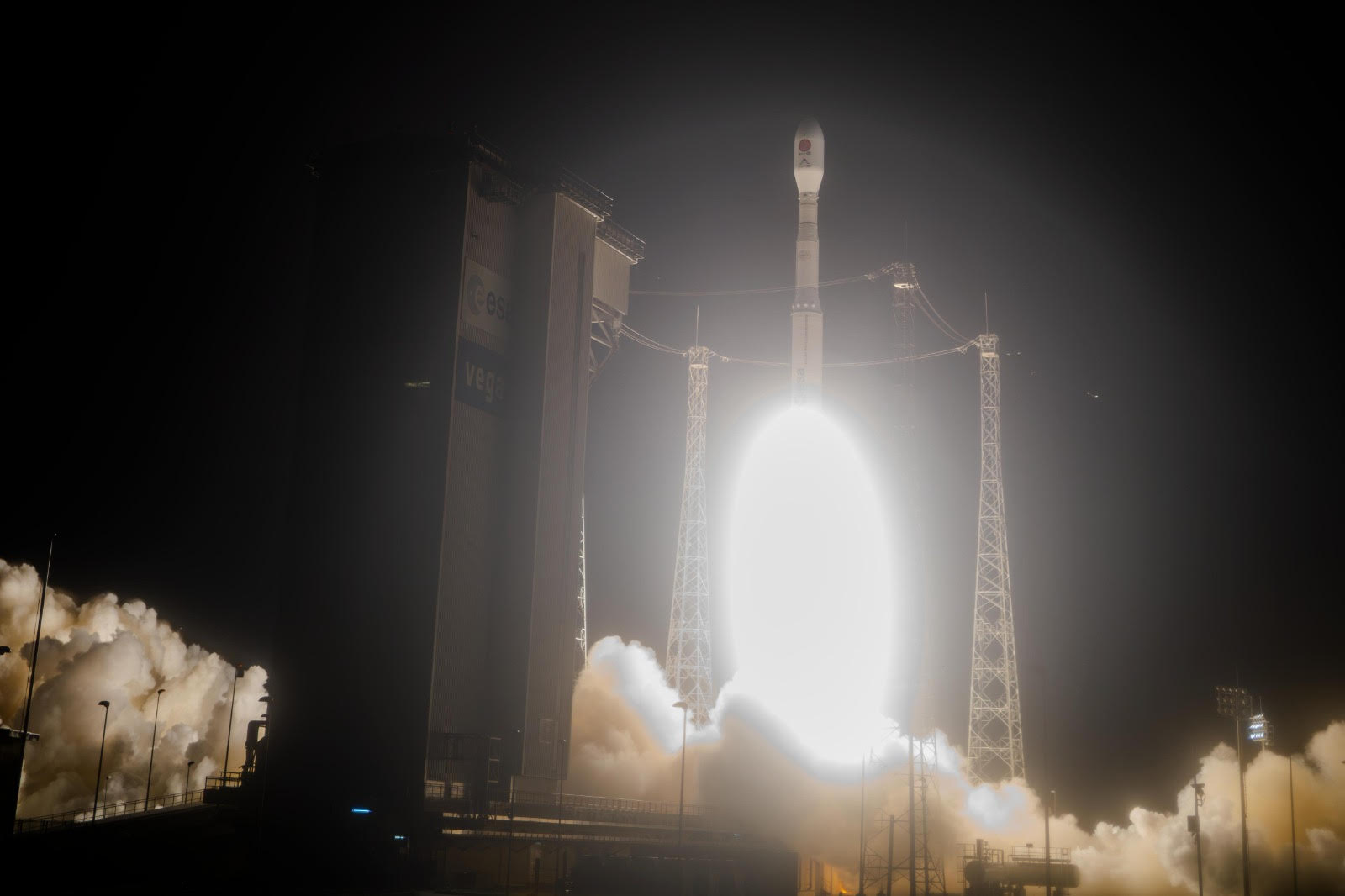
The mission’s Vega C rocket lifted off at 11:52 p.m. Eastern, May 18 (0352 UTC, or 0052 local time, May 19) from Kourou, French Guiana, in South America. SMILE separated from the launch vehicle’s fourth stage nearly 57 minutes after liftoff. The spacecraft’s solar arrays deployed successfully minutes later, prompting celebrations at the Jupiter Mission Control Room.
The Solar wind Magnetosphere Ionosphere Link Explorer (SMILE) mission is designed to spend a planned mission time of three years studying how Earth’s magnetosphere interacts with solar storms and the ability to predict the impacts of space weather.
The 2,200-kilogram Smile spacecraft, including 1,500 kg of propellant, was launched into a roughly 706-kilometer orbit inclined by 70 degrees. From here, Smile will use around 90 percent of its propellant over the next month to reach its highly elliptical science orbit.
Smile will reach an apogee of around 121,000 kilometers above the North Pole, providing the spacecraft a unique, global view of the Earth’s magnetosphere with its wide-angle X-ray SXI and UVI ultraviolet cameras. Smile will use its passes over the South Pole at a perigee of around 5,000 km to downlink data to DLR’s O’Higgins Antarctic ground station. The highly elliptical orbit will also allow Smile to make 45 hours of continuous aurora observations during each of its 51-hour period orbits.
“We have a magnetic field, just like a shell for the Earth, but we have never known what shape this is. But the Smile mission will take the first images of this magneto pulse,” Wang Chi, director general of the National Space Science Center (NSSC), told <em>SpaceNews before the launch, stating that previous space science missions could only deliver local measurements of these dynamics.
“If we succeed with this imaging, as solar activity varies, we can study the movement of this magnetic pulse, and how mass and energy is transported from the solar wind,” Wang said. “I think this is very important to predict space weather.”
Geomagnetic storms have previously brought down power grids and disrupted global communications, with a repeat of the most intense storm on record—the Carrington Event in 1859 which damaged telegraph networks—estimated to cost trillions of dollars in damage today.
Smile was jointly developed by the European Space Agency and Chinese Academy of Sciences (CAS). The mission was selected competitively in 2015 from among 13 proposals made by joint ESA-CAS teams spanning in astrophysics, heliophysics and fundamental physics.
Smile’s four scientific instruments include the soft X-ray (SXI) and ultraviolet (UVI) imagers, and in-situ ion analyzer and magnetometer instruments. The largest is SXI, developed by the UK’s Leicester University, and uses lobster-eye optics and some of the largest CCDs ever flown in space, cooled to minus 120 degrees Celsius. X-ray imaging of the magnetosphere focuses on solar wind charge exchange emission, produced when highly charged solar wind ions interact with neutral atoms. The combination of imagers and in-situ payloads will deliver views of global response while simultaneously measuring the particles driving it.
“For the first time ever, we will be able to understand cause and effect,” ESA science director Carole Mundell said during a pre-launch press conference. “This is critically important scientifically, but even more importantly, because nowadays modern life depends very much on our space infrastructure.”
The mission faced years of delays, including a change of components following an export control assessment in 2020 and disruption from the COVID-19 pandemic. Both sides however hailed the results of the partnership.
“Not only have we learned to speak one another’s languages, we’ve also learned to speak different languages of engineering, different ways of doing science, and we’ve learned from one another along the way,” Mundell said.
The launch was the seventh of the Vega C, and the first in which Italian company Avio took on the launch operator role.