• Home
  • About
  • FAQ
  • Feeds
  • Glossary
  • Contact
Tours In Space
  • Home
  • Start Here
    • Intro to Commercial Spaceflight
    • How to Book a Space Tour
    • Is Space Tourism Safe?
    • Space Travel FAQs
    • View Earth from the Edge
    • What to Pack
  • Preparing for Your Trip
    • Insurance and Legal Waivers
    • Physical and Medical Requirements
    • Training Programs
    • What to Expect
  • Space Tourism Companies
    • Axiom Space
    • Blue Origin
    • SpaceX
    • Virgin Galactic
    • World View (stratospheric balloon flights)
    • Blue Origin vs Virgin Galactic
    • Comparison Chart: Features, Pricing, Booking
  • Space Tours
    • Custom & Luxury Packages
    • Duration, Training, Costs
    • Experiences
    • Future Moon/Mars Options
    • Orbital Flights
    • Parabolic Flight Experiences
    • Private Missions
    • Stratospheric Balloon Flights
    • Suborbital Flights
    • Zero-Gravity Flights
  • Spaceflight Technologies
    • Space Tourism Balloon
No Result
View All Result
  • Home
  • Start Here
    • Intro to Commercial Spaceflight
    • How to Book a Space Tour
    • Is Space Tourism Safe?
    • Space Travel FAQs
    • View Earth from the Edge
    • What to Pack
  • Preparing for Your Trip
    • Insurance and Legal Waivers
    • Physical and Medical Requirements
    • Training Programs
    • What to Expect
  • Space Tourism Companies
    • Axiom Space
    • Blue Origin
    • SpaceX
    • Virgin Galactic
    • World View (stratospheric balloon flights)
    • Blue Origin vs Virgin Galactic
    • Comparison Chart: Features, Pricing, Booking
  • Space Tours
    • Custom & Luxury Packages
    • Duration, Training, Costs
    • Experiences
    • Future Moon/Mars Options
    • Orbital Flights
    • Parabolic Flight Experiences
    • Private Missions
    • Stratospheric Balloon Flights
    • Suborbital Flights
    • Zero-Gravity Flights
  • Spaceflight Technologies
    • Space Tourism Balloon
No Result
View All Result
Tours In Space
No Result
View All Result
Home Space News

Lasers in moon craters could create a lunar GPS system

Ensign by Ensign
May 20, 2026
in Space News
0
Lasers in moon craters could create a lunar GPS system
189
SHARES
1.5k
VIEWS
Share on FacebookShare on Twitter

Placing ultrastable lasers inside some of the coldest, darkest lunar craters could help scientists establish a GPS-like navigation system on the moon, allowing future Artemis astronauts and spacecraft to navigate the lunar surface more easily.

Researchers at the National Institute of Standards and Technology (NIST) have proposed that permanently shadowed craters near the moon’s south pole may offer the perfect natural environment for extraordinarily precise laser systems. Those lasers could one day provide the timing backbone needed for future astronauts, rovers and spacecraft to navigate the moon without relying so heavily on Earth-based tracking systems, according to a statement from the NIST.

Lunar GPS (which stands for Global Positioning System) concepts have gained increasing attention as NASA prepares for long-term Artemis missions and future lunar bases. Scientists and space agencies have spent years developing ideas for moon-based positioning, navigation and timing systems, with proposed concepts including navigation satellites orbiting the moon, radio beacons and atomic clocks similar to the technology behind Earth’s GPS network.


You may like

The new study builds on those broader efforts, adding an unusual twist: ultrastable lasers housed inside the moon’s permanently shadowed craters. A highly stable laser produces light with an almost perfectly constant frequency, allowing multiple lasers to precisely measure distances between objects — a capability that could eventually support navigation systems across the lunar surface.

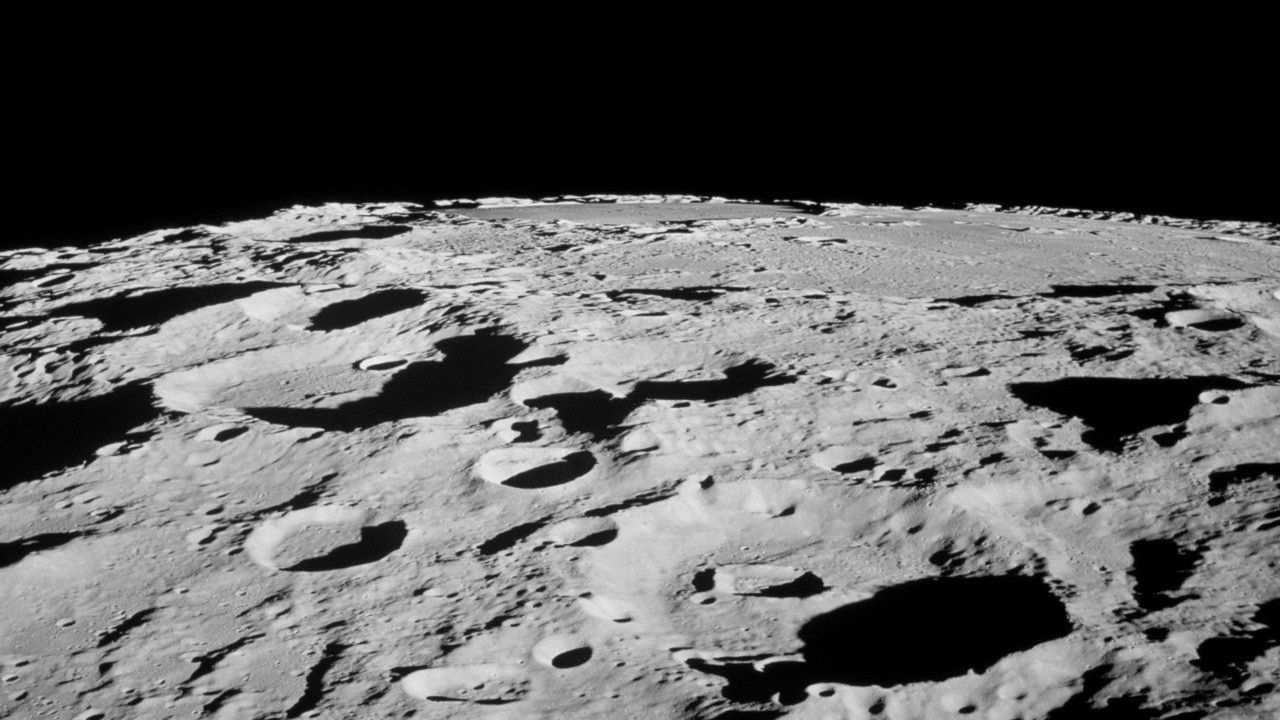
Permanently shadowed craters never receive direct sunlight because of the moon’s low axial tilt. Hidden in perpetual darkness, these craters remain colder than Pluto, with temperatures dipping to around minus 370 degrees Fahrenheit (minus 223 degrees Celsius). Scientists have long targeted them as potential reservoirs of frozen water that could support future lunar settlements.

Now researchers think those same harsh conditions could make the craters ideal natural laboratories for precision laser systems. The study suggests using a silicon optical cavity — a device that stabilizes laser light by reflecting it between mirrors separated by an incredibly precise distance.

On Earth, these systems require complex cryogenic cooling and vibration isolation because even tiny temperature shifts can destabilize the laser. However, inside a permanently shadowed lunar crater, nature may do much of that work for free.

Space

The frigid temperatures inside the craters, combined with the moon’s naturally high-vacuum environment and relatively low levels of vibration compared to Earth, could allow silicon optical cavities to operate with almost no thermal expansion — providing the stability needed for navigation systems that rely on precise laser frequencies to calculate positions and track spacecraft movement across the lunar surface, according to the statement.

“As soon as I understood what the permanently shadowed regions can offer, I felt that this would be the most ideal environment for a super-stable laser,” Jun Ye, lead author of the study, said in the statement.

Today, Earth’s GPS satellites continuously broadcast timing signals generated by onboard atomic clocks. Receivers calculate their position by measuring how long those signals take to arrive from multiple satellites.

What to read next

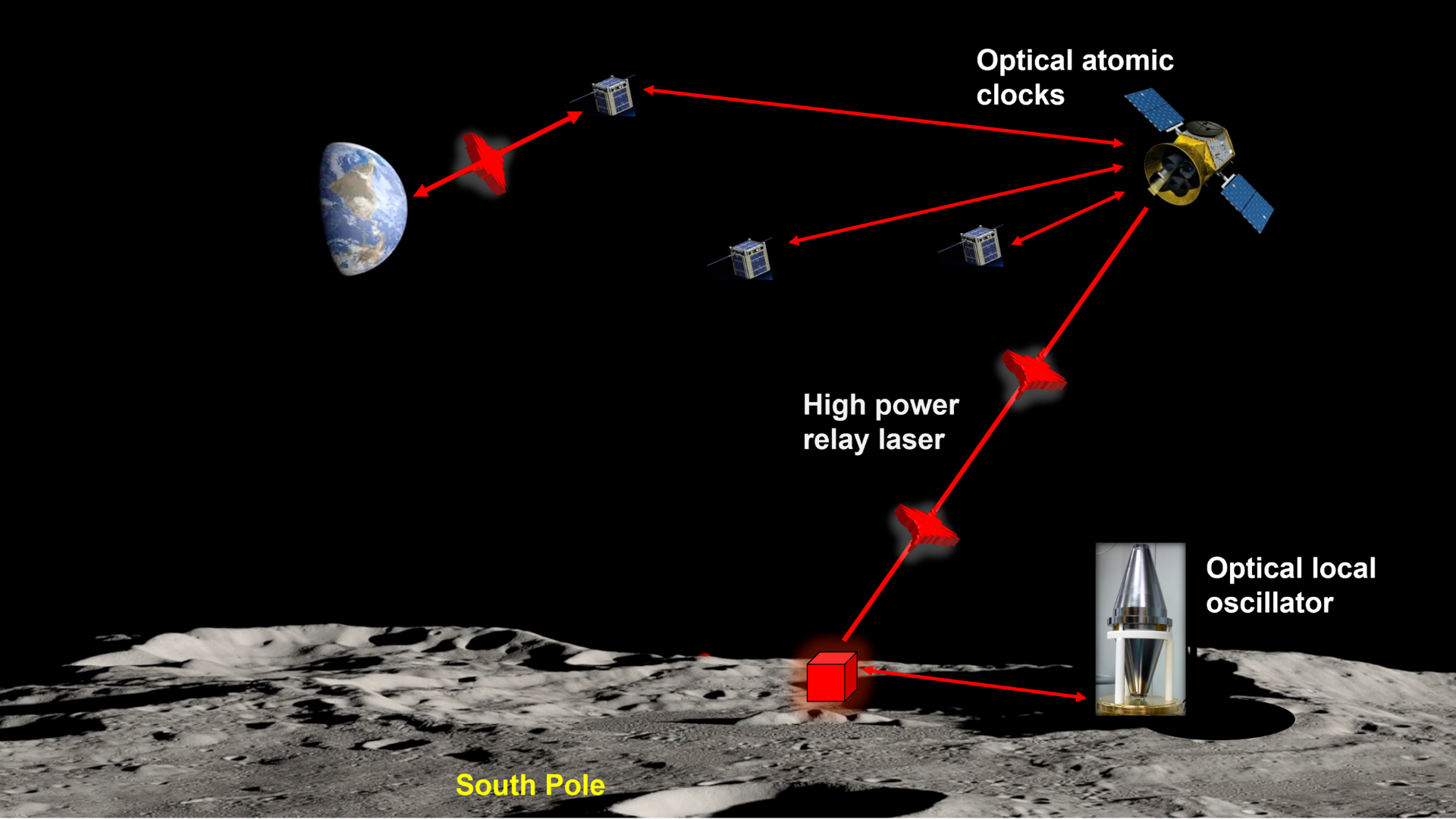
A diagram showing how a laser in a crater could work.

A lunar laser locked to an ultrastable silicon cavity in a permanently shadowed crater could serve as a precision reference for a future lunar GPS-like navigation network. (Image credit: J. Ye/NIST with lunar background image produced by NASA’s Visualization Studio)

Spacecraft around the moon still rely heavily on Earth-based tracking systems, but as lunar activity ramps up, that approach may no longer be practical — especially around the rugged lunar south pole, where difficult lighting conditions complicate navigation for both astronauts and robotic explorers.

Instead, the researchers suggest ultrastable lasers housed inside permanently shadowed craters could serve as master timing references for future lunar satellites and communication networks, effectively acting as part of a lunar GPS infrastructure.

Once deployed inside or near a permanently shadowed lunar crater, the optical cavity would stabilize a nearby laser by locking its light to a single, highly precise frequency. Researchers say the resulting signal could function like a GPS beacon for lunar spacecraft, while also linking with satellite-based atomic clocks to help form the “backbone of the first optical atomic clock on an extraterrestrial surface,” officials said in the statement.

Their findings were published May 8 in the journal Proceedings of the National Academy of Sciences.

No Result
View All Result

Recent Posts

  • Lasers in moon craters could create a lunar GPS system
  • Worker dies at SpaceX’s Starbase in leadup to Starship V3 megarocket launch
  • ‘The Mandalorian and Grogu’ clip reveals how Mando gets his Razor Crest spaceship back (video)
  • Vast, builder of private space stations, launches line of high-power satellites
  • See Jupiter glow beside the waxing moon after sunset on May 20

Categories

  • Excursions
  • Kepler Mission
  • NASA
  • NASA Breaking News
  • Physical Preparation
  • Preparation
  • Space News
  • Space Station News
  • Spacewalks
  • Tours
  • Uncategorized
  • Weightlessness Training
  • What Not to Pack
  • What to Pack

Meta

  • Log in
  • Entries feed
  • Comments feed
  • WordPress.org
  • Home
  • Start Here
  • Preparing for Your Trip
  • Space Tourism Companies
  • Space Tours
  • Contact

© 2026 JNews - Premium WordPress news & magazine theme by Jegtheme.

No Result
View All Result
  • About
  • Contact
  • Feeds
  • Frequently Asked Questions
  • Preparing for Your Trip
    • Insurance and Legal Waivers
    • Physical and Medical Requirements
    • Training Programs
    • What to Expect
  • Privacy Policy
  • Space Tourism Companies
    • Axiom Space
    • Blue Origin
    • Blue Origin vs Virgin Galactic
    • Comparison Chart: Features, Pricing, Booking
    • SpaceX
    • Virgin Galactic
    • World View (stratospheric balloon flights)
  • Space Tours
    • Custom & Luxury Packages
    • Duration, Training, Costs
    • Experiences
    • Future Moon/Mars Options
    • Orbital Flights
    • Parabolic Flight Experiences
    • Private Missions
    • Stratospheric Balloon Flights
    • Suborbital Flights
    • Zero-Gravity Flights
  • Spaceflight Technologies
    • Space Tourism Balloon
  • Start Here
    • How to Book a Space Tour
    • Intro to Commercial Spaceflight
    • Is Space Tourism Safe?
    • Space Travel FAQs
    • View Earth from the Edge
    • What to Pack
  • Tours in Space is your launchpad to the world of space tourism

© 2026 JNews - Premium WordPress news & magazine theme by Jegtheme.