• Home
  • About
  • FAQ
  • Feeds
  • Glossary
  • Contact
Tours In Space
  • Home
  • Start Here
    • Intro to Commercial Spaceflight
    • How to Book a Space Tour
    • Is Space Tourism Safe?
    • Space Travel FAQs
    • View Earth from the Edge
    • What to Pack
  • Preparing for Your Trip
    • Insurance and Legal Waivers
    • Physical and Medical Requirements
    • Training Programs
    • What to Expect
  • Space Tourism Companies
    • Axiom Space
    • Blue Origin
    • SpaceX
    • Virgin Galactic
    • World View (stratospheric balloon flights)
    • Blue Origin vs Virgin Galactic
    • Comparison Chart: Features, Pricing, Booking
  • Space Tours
    • Custom & Luxury Packages
    • Duration, Training, Costs
    • Experiences
    • Future Moon/Mars Options
    • Orbital Flights
    • Parabolic Flight Experiences
    • Private Missions
    • Stratospheric Balloon Flights
    • Suborbital Flights
    • Zero-Gravity Flights
  • Spaceflight Technologies
    • Space Tourism Balloon
No Result
View All Result
  • Home
  • Start Here
    • Intro to Commercial Spaceflight
    • How to Book a Space Tour
    • Is Space Tourism Safe?
    • Space Travel FAQs
    • View Earth from the Edge
    • What to Pack
  • Preparing for Your Trip
    • Insurance and Legal Waivers
    • Physical and Medical Requirements
    • Training Programs
    • What to Expect
  • Space Tourism Companies
    • Axiom Space
    • Blue Origin
    • SpaceX
    • Virgin Galactic
    • World View (stratospheric balloon flights)
    • Blue Origin vs Virgin Galactic
    • Comparison Chart: Features, Pricing, Booking
  • Space Tours
    • Custom & Luxury Packages
    • Duration, Training, Costs
    • Experiences
    • Future Moon/Mars Options
    • Orbital Flights
    • Parabolic Flight Experiences
    • Private Missions
    • Stratospheric Balloon Flights
    • Suborbital Flights
    • Zero-Gravity Flights
  • Spaceflight Technologies
    • Space Tourism Balloon
No Result
View All Result
Tours In Space
No Result
View All Result
Home Space News

Scientists find a hidden route to the moon that saves fuel

Ensign by Ensign
May 21, 2026
in Space News
0
Landing astronauts on the moon ‘is absolutely doable, and it’s doable soon,’ NASA’s Artemis 2 commander says
189
SHARES
1.5k
VIEWS
Share on FacebookShare on Twitter

A lot of time and effort goes into planning routes for space missions. Researchers look for the most efficient path between planets and moons because spaceflight is expensive. Even small gains in efficiency can save millions.

An international team of researchers say they’ve found a method of calculating a more efficient route between Earth and the moon using advanced computer modeling.

The new method is based on the theory of functional connections, which helps to reduce the compute that’s needed to run complex models. The researchers used this method to simulate 30 million different routes to the moon, and 280,000 simulations are referenced in their newly published study.


You may like

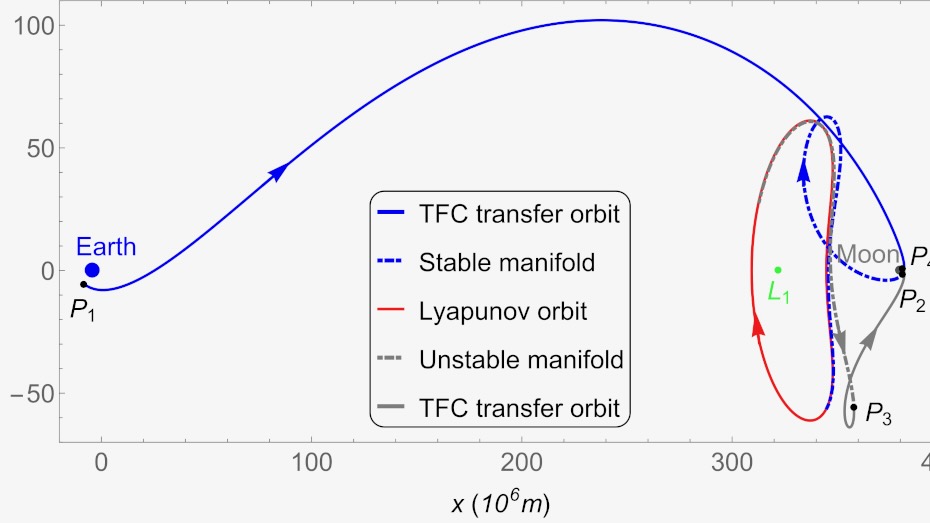
A newly calculated fuel-efficient trajectory between the orbits of Earth and the moon.

A newly calculated fuel-efficient trajectory between the orbits of Earth and the moon. (Image credit: Allan Kardec de Almeida Júnior et al. / Astrodynamics)

The cheaper route to the moon that the team found was actually hidden. Spacecraft that journey through our solar system only use fuel only part of the time. Gravity is often the preferred method of propulsion, because it’s free. There are gravity-determined routes throughout our solar system, which are often referred to as the Interplanetary Transportation Network.

So finding a cheap route to the moon has a lot to do with gravity, specifically the gravitational pulls of both Earth and the moon. In spaceflight, “variate” refers to a natural trajectory leading to a certain orbit. The researchers found that, instead of using the branch of the lunar-orbit variate closest to Earth, it’s better to enter that variate from the opposite side.

“Instead of assuming it’s easier to choose the part of the variate closest to Earth, we can use systematic analysis with faster methods to try to find nontrivial solutions,” study co-author Vitor Martins de Oliveira, a postdoctoral researcher at the University of São Paulo in Brazil, said in a statement.

Essentially, the team found that free gravity-based propulsion is more plentiful when taking the hidden path. This newly reported route uses 58.80 meters per second (m/s) less fuel consumption than the previous cheapest known route. Again, even this little efficiency gain would help reduce the cost of traveling to the moon.

Space

Another benefit for the route the researchers found is that it won’t cause interruptions in communication with Earth. “The Artemis 2 mission, for example, lost communication with Earth for a while because it was directly behind the moon,” Oliveira said. “The orbit we propose is a solution that maintains uninterrupted communication.”

But the newfound route is not the last word in cheap Earth-moon travel, the researchers noted. Their modeling work factored in gravity from just Earth and the moon; future research could include additional variables, like gravity from the sun, potentially leading to even more cost-effective trajectories..

“The systematic analysis we applied in our work is something that could be adopted more widely going forward,” study lead author Allan Kardec de Almeida Júnior, a researcher at the University of Coimbra in Portugal, said in the same statement.

The study was published April 10 in the journal Astrodynamics.

Tags: space mission
No Result
View All Result

Recent Posts

  • Space debris is forcing satellites to dodge more often — costing us vital science. ‘Things will get worse before they get better’
  • Scientists find a hidden route to the moon that saves fuel
  • SpaceX stacks Starship V3 rocket, completes major fueling test ahead of debut launch
  • US military test-launches nuclear-capable ICBM from California (photos)
  • Where did Neptune’s mysterious moon Nereid come from? It may be the only survivor of the planet’s violent history

Categories

  • Excursions
  • Kepler Mission
  • NASA
  • NASA Breaking News
  • Physical Preparation
  • Preparation
  • Space News
  • Space Station News
  • Spacewalks
  • Tours
  • Uncategorized
  • Weightlessness Training
  • What Not to Pack
  • What to Pack

Meta

  • Log in
  • Entries feed
  • Comments feed
  • WordPress.org
  • Home
  • Start Here
  • Preparing for Your Trip
  • Space Tourism Companies
  • Space Tours
  • Contact

© 2026 JNews - Premium WordPress news & magazine theme by Jegtheme.

No Result
View All Result
  • About
  • Contact
  • Feeds
  • Frequently Asked Questions
  • Preparing for Your Trip
    • Insurance and Legal Waivers
    • Physical and Medical Requirements
    • Training Programs
    • What to Expect
  • Privacy Policy
  • Space Tourism Companies
    • Axiom Space
    • Blue Origin
    • Blue Origin vs Virgin Galactic
    • Comparison Chart: Features, Pricing, Booking
    • SpaceX
    • Virgin Galactic
    • World View (stratospheric balloon flights)
  • Space Tours
    • Custom & Luxury Packages
    • Duration, Training, Costs
    • Experiences
    • Future Moon/Mars Options
    • Orbital Flights
    • Parabolic Flight Experiences
    • Private Missions
    • Stratospheric Balloon Flights
    • Suborbital Flights
    • Zero-Gravity Flights
  • Spaceflight Technologies
    • Space Tourism Balloon
  • Start Here
    • How to Book a Space Tour
    • Intro to Commercial Spaceflight
    • Is Space Tourism Safe?
    • Space Travel FAQs
    • View Earth from the Edge
    • What to Pack
  • Tours in Space is your launchpad to the world of space tourism

© 2026 JNews - Premium WordPress news & magazine theme by Jegtheme.