

A team of astronauts, engineers and geologists is travelling to Spain’s Canary Islands, one of Europe’s volcanic hot spots, to learn how to best explore the Moon and Mars during ESA’s Pangaea geological training course.
This edition’s participants are ESA astronaut Andreas Mogensen, ESA engineer Robin Eccleston and NASA astronaut Kathleen Rubins, who is part of the group of NASA astronauts selected to potentially land on the Moon for the Artemis missions, where research on lunar geology will be crucial.
The crew learned how to identify interesting rock samples and traces of life during field trips to the Italian Dolomites and the Ries crater in Germany in September.
Thanks to lessons by leading European scientists, “by now we are able to listen to and better understand the geologic heartbeat of the planet. Some rocks are like open books telling you the story of our Solar System,” says Andreas.
Volcanic universe
Lanzarote’s volcanic landscapes are exceptionally well-preserved, and recent geological activity makes it a unique open-air museum.
Here, basaltic lava flows resemble vast plains on the lunar maria and volcanoes are similar to those in some regions of Mars.
“In Lanzarote we can really look into the geological interactions between volcanic activity and water – two key factors in the search for life,” explains Samuel Payler, Pangaea training coordinator. Surprisingly microorganisms can thrive inside the rocks despite the apparently barren soil.
Volcanism is not exclusive to Earth. Our Moon had extensive volcanic activity until less than two billion years ago. Mars is currently a cold, dry desert, but in the past most of the planet’s surface was shaped by water and volcanoes in a very Earth-like fashion. The Red Planet has the largest known volcano in our planetary neighbourhood – the 22 km high Mount Olympus.
Preparing for other planets
Pangaea – named after the ancient supercontinent – prepares the astronauts for expeditions to other planets. Trainees acquire skills and knowledge both in the field and in the classroom tailored towards the needs of future planetary explorers.
Participants analyse the chemistry and mineralogy of the soil, choose their own exploration routes and rely on technology in constant communication with the science and training teams.
“We instruct astronauts on reading and describing landscapes and running efficient sampling taking into account the environment around them, such as dust and volcanic rocks,” says Francesco Sauro, Pangaea’s technical course director.
“From selecting a landing site to describing samples with the right scientific vocabulary, this is the basic geological education they will need in future field trips for lunar missions,” adds the geologist.
Related Links
Human and Robotic Exploration at ESA
Mars News and Information at MarsDaily.com
Lunar Dreams and more
|
We need your help. The SpaceDaily news network continues to grow but revenues have never been harder to maintain. With the rise of Ad Blockers, and Facebook – our traditional revenue sources via quality network advertising continues to decline. And unlike so many other news sites, we don’t have a paywall – with those annoying usernames and passwords. Our news coverage takes time and effort to publish 365 days a year. If you find our news sites informative and useful then please consider becoming a regular supporter or for now make a one off contribution. |
||
|
SpaceDaily Contributor $5 Billed Once credit card or paypal |
 |
SpaceDaily Monthly Supporter $5 Billed Monthly paypal only |

UNI Bremen involved in AMADEE-20 Mars Simulation
Bremen, Germany (SPX) Nov 04, 2021
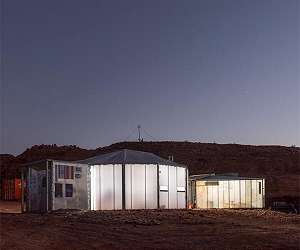
AMADEE-20: That is the name of the simulated Mars mission of the Austrian Space Forum, which was carried out in the Israeli Negev Desert. More than 25 experiments were carried out there. Two projects from the University of Bremen, namely INTERTEAM and MarsLock, were also involved in the research.
b>What are team processes like when the crew is on Mars? br> /b>
The INTERTEAM project addresses exactly this question. It is a cooperation at the University of Bremen between the Chair of Business Psyc … read more