

Science at NASA is becoming a hitchhiker. After decades in the driver’s seat, where dedicated science missions made historic discoveries such as alien oceans, the accelerating universe and potential biosignatures on Mars, the agency now asks science to stand with its thumb out, waiting for rides on spacecraft designed for other purposes. This is not how the next breakthrough discoveries will be made.
If this is to be a true golden age of science and discovery, NASA can’t rely on serendipity; the agency must make active investments in dedicated science projects that address the highest priority questions facing humanity. That means shepherding existing missions through development, maximizing the scientific return of our existing fleet and increasing the rate of new mission starts. Congress has repeatedly demonstrated a bipartisan willingness to fund space science, and the American public consistently ranks scientific activities as NASA’s top priorities. The budget available to science need not be an obstacle. The draconian 46% cut to science — now proposed for a second year in a row — profoundly misreads both the political reality and the core responsibilities of the U.S. space program.
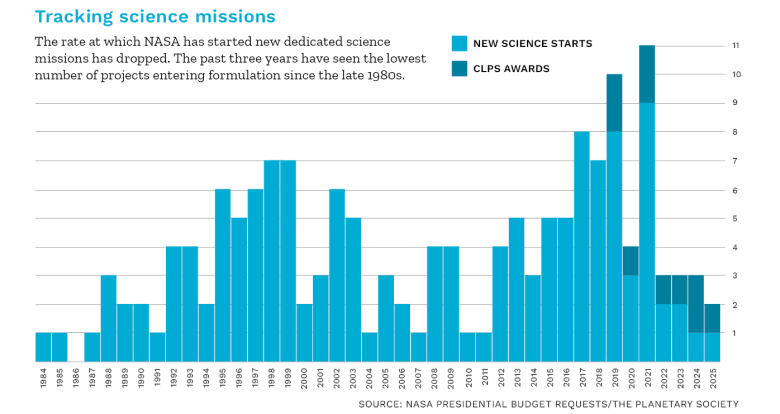
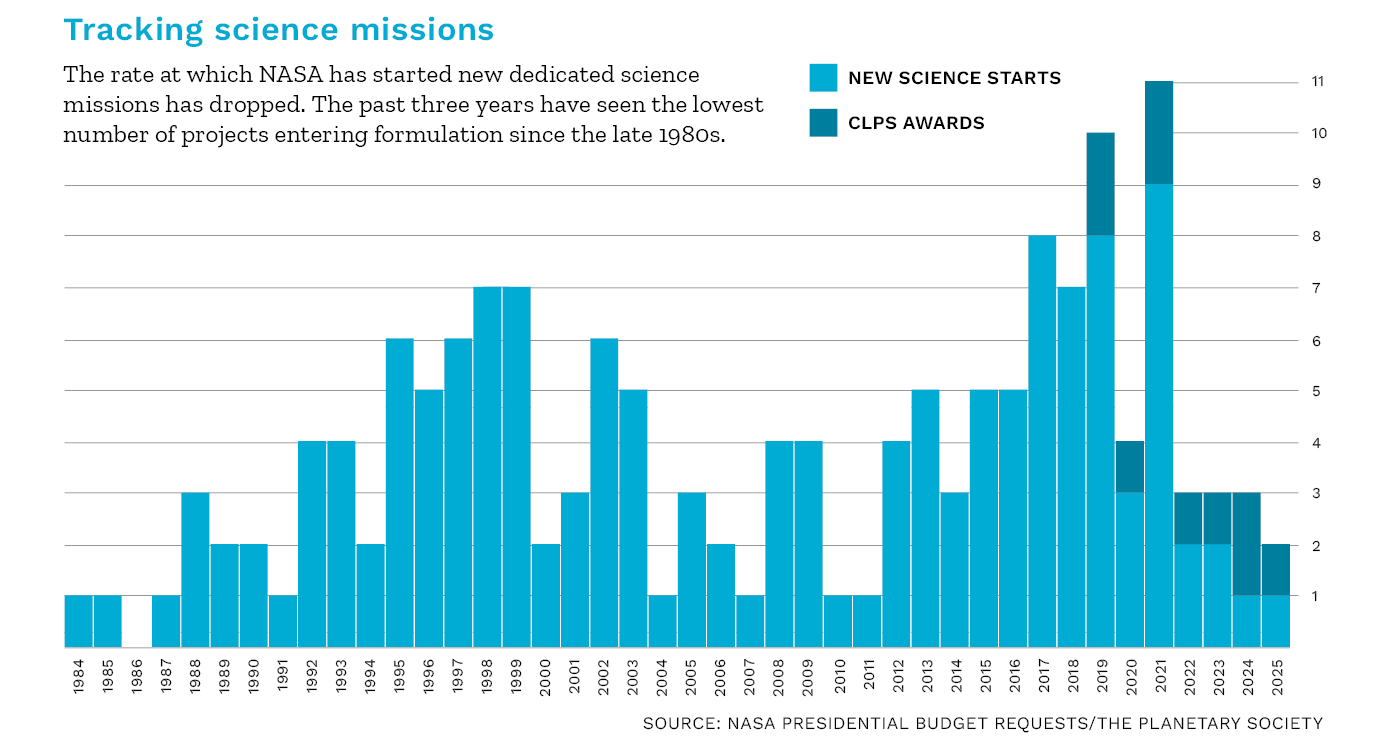
The NASA Act of 1958 established the agency’s statutory responsibility to pursue fundamental science and to preserve the United States as a leader in space science. It has done so, admirably, by working closely with the scientific community to define scientific goals and then to design the missions necessary to achieve them. This is a multi-year process that, due to the variety of questions, techniques and types of environments necessary to access, requires unique engineering and hardware. Drilling rock cores on the dusty, cold surface of Mars presents a different engineering challenge than a space telescope capable of capturing photons from the early days of the cosmos. Alarmingly, the rate at which NASA has started new dedicated science missions has cratered. The past three years have seen the lowest number of projects entering formulation since the late 1980s.
The excessive science cuts proposed in 2026 and 2027 by the White House’s Office of Management and Budget exacerbate the crisis facing space science. If implemented, half of all dedicated science projects in development would be terminated.
In their place is a rising tide of “ride-along” science opportunities: instruments or smallsats that share a ride on a spacecraft designed for other purposes. The Commercial Lunar Payload Services (CLPS) is a prominent example. NASA signs a delivery order for a lander, and then assigns a handful of scientific instruments selected through an independent process. While science is certainly an outcome of a successful CLPS delivery, it is not the primary objective. CLPS’s goal is to create “affordable commercial operations on and near the moon.” CLPS was moved out of science and into NASA’s exploration directorate last year, with the intent to provide payload deliveries for a lunar base. NASA is now asking for “destination agnostic” science (instrumentation not tuned to any particular destination), existing off-the-shelf instrumentation and even free equipment (and scientists) provided by academic or philanthropic institutions. Science gets a ride, but no longer has much of a say in its destination.
This is an inversion of the past model. At the beginning of any dedicated science mission lies a big question (“Was Mars ever habitable?”). The big questions are prioritized by the National Academies’ decadal survey process. A strategy is created to answer the question (“We can look for rocks formed in water.”). This drives the engineering design of the spacecraft (“We need a spacecraft that can drive around the martian surface with tools necessary to assess rocks for signs of formation in water.”). Ride-along efforts, structurally, cannot replace this approach to science. A modest instrumentation suite catching a ride on a lunar construction delivery will not discover biosignatures in exoplanetary atmospheres, reveal the inner workings of the Sun or map the moons of Uranus.
Ride-along missions have a place. Their low cost can help spur innovation, expand leadership opportunities for scientists and provide novel data. They help make the most of human exploration and technology demonstration efforts. But ride-along science is a supplement, not a replacement, for dedicated science missions.
China provides a helpful contrast. Over the past two decades, Chinese space science efforts have grown increasingly ambitious and complex, with major projects now en route to an asteroid, preparing for Mars Sample Return and designed to reach the outer solar system. The average mass of their science missions has doubled in the past decade. They are going big in all areas of space science. Tellingly, leaders of China’s space efforts have published their insights on how to best pursue space science. They highlight the importance of long term planning, scientific prioritization and the careful selection of instrumentation to enable progress on the big questions in space science — principles explicitly modeled on the American decadal survey process.
Political leadership in the U.S. and the scientific community both need to recognize this distinction. We must keep science in the driver’s seat. Hitchhiking is not enough.
Without a dedicated science program, without intentionality, without actively attempting to answer the big questions, future breakthroughs in space science are a function of serendipity. Hitchhiking, after all, rarely takes you exactly where you need to go.
<em>Casey Dreier is chief of space policy at The Planetary Society, where he leads the organization’s policy and advocacy efforts to advance science-driven space exploration.
SpaceNews is committed to publishing our community’s diverse perspectives. Whether you’re an academic, executive, engineer or even just a concerned citizen of the cosmos, send your arguments and viewpoints to opinion (at) spacenews.com to be considered for publication online or in our next magazine. If you have something to submit, read some of our recent opinion articles and our submission guidelines to get a sense of what we’re looking for. The perspectives shared in these opinion articles are solely those of the authors and do not necessarily represent their employers or professional affiliations.