• Home
  • About
  • FAQ
  • Feeds
  • Glossary
  • Contact
Tours In Space
  • Home
  • Start Here
    • Intro to Commercial Spaceflight
    • How to Book a Space Tour
    • Is Space Tourism Safe?
    • Space Travel FAQs
    • View Earth from the Edge
    • What to Pack
  • Preparing for Your Trip
    • Insurance and Legal Waivers
    • Physical and Medical Requirements
    • Training Programs
    • What to Expect
  • Space Tourism Companies
    • Axiom Space
    • Blue Origin
    • SpaceX
    • Virgin Galactic
    • World View (stratospheric balloon flights)
    • Blue Origin vs Virgin Galactic
    • Comparison Chart: Features, Pricing, Booking
  • Space Tours
    • Custom & Luxury Packages
    • Duration, Training, Costs
    • Experiences
    • Future Moon/Mars Options
    • Orbital Flights
    • Parabolic Flight Experiences
    • Private Missions
    • Stratospheric Balloon Flights
    • Suborbital Flights
    • Zero-Gravity Flights
  • Spaceflight Technologies
    • Space Tourism Balloon
No Result
View All Result
  • Home
  • Start Here
    • Intro to Commercial Spaceflight
    • How to Book a Space Tour
    • Is Space Tourism Safe?
    • Space Travel FAQs
    • View Earth from the Edge
    • What to Pack
  • Preparing for Your Trip
    • Insurance and Legal Waivers
    • Physical and Medical Requirements
    • Training Programs
    • What to Expect
  • Space Tourism Companies
    • Axiom Space
    • Blue Origin
    • SpaceX
    • Virgin Galactic
    • World View (stratospheric balloon flights)
    • Blue Origin vs Virgin Galactic
    • Comparison Chart: Features, Pricing, Booking
  • Space Tours
    • Custom & Luxury Packages
    • Duration, Training, Costs
    • Experiences
    • Future Moon/Mars Options
    • Orbital Flights
    • Parabolic Flight Experiences
    • Private Missions
    • Stratospheric Balloon Flights
    • Suborbital Flights
    • Zero-Gravity Flights
  • Spaceflight Technologies
    • Space Tourism Balloon
No Result
View All Result
Tours In Space
No Result
View All Result
Home Uncategorized

White House releases space nuclear policy

Ensign by Ensign
April 15, 2026
in Uncategorized
0
White House releases space nuclear policy
189
SHARES
1.5k
VIEWS
Share on FacebookShare on Twitter
image

COLORADO SPRINGS — The White House released a policy April 14 directing NASA, the Pentagon and the Department of Energy to develop space nuclear power systems that could launch as soon as 2028.

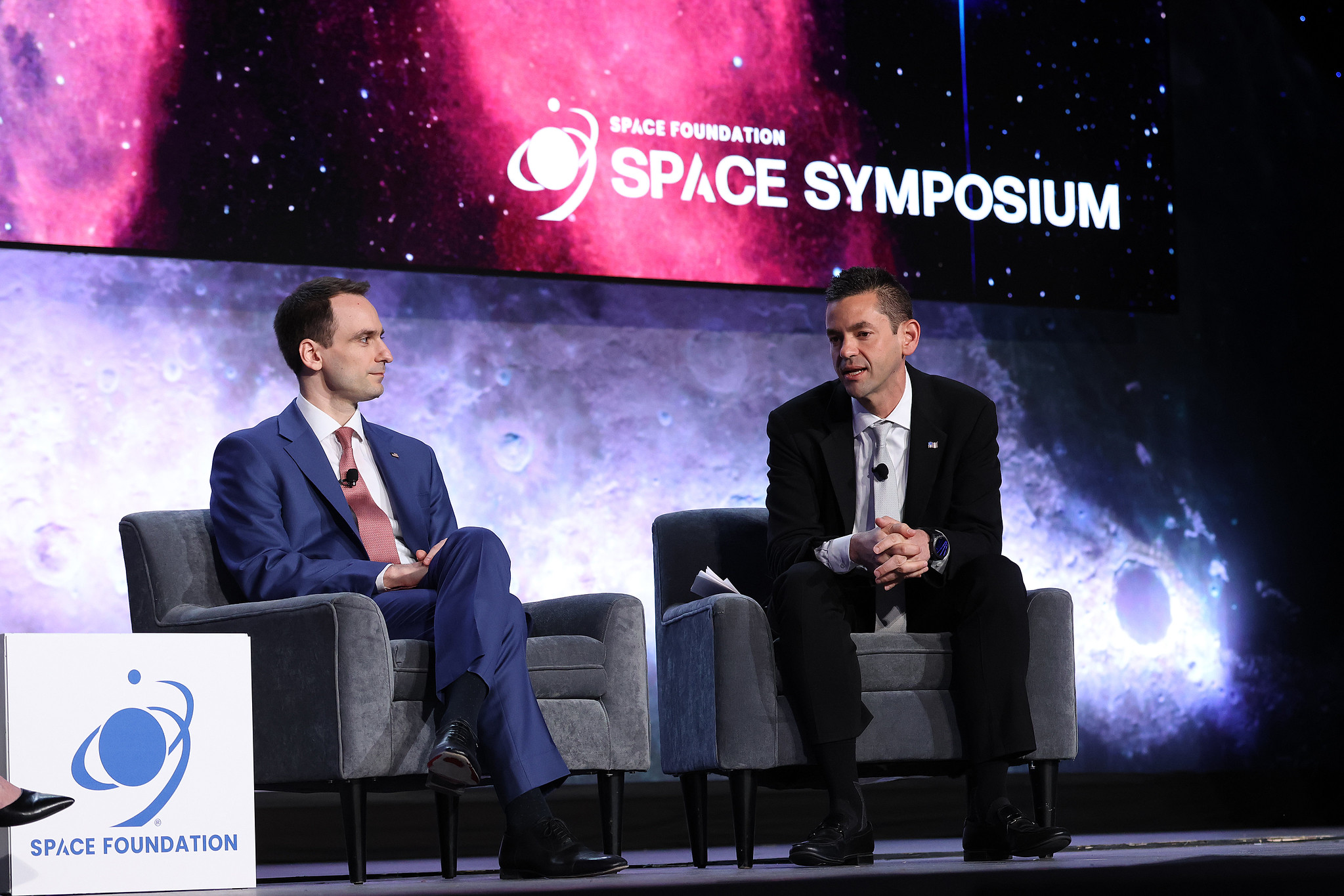
Michael Kratsios, director of the White House’s Office of Science and Technology Policy (OSTP), announced the policy in a speech at the 41st Space Symposium, describing it as part of the implementation of a space policy executive order in December.

“Nuclear power in space will give us the sustained electricity, heating and propulsion essential to a permanent robotic and eventually human presence on the moon, on Mars and beyond,” he said.

Sign up for First Up: Get the latest updates on SpaceX, Artemis, NASA and more. From Jeff Foust, First Up is a recap of the day’s space industry news, including civil, commercial, and military space developments.

By submitting this form, you agree to the SpaceNews privacy policy and terms and conditions and to receive email from us and our partners. You can opt-out at any time.

The policy, he added, “creates the roadmap for the federal government to develop and deploy nuclear reactors on the moon and in orbit.”

The six-page policy, designated NSTM-3, directs “parallel and mutually reinforcing” design competitions by NASA and the Defense Department “to enable near-term demonstration and use of low- to mid-power space reactors in orbit and on the lunar surface, and prepare to deploy high-power reactors in the 2030s.”

“For this to work, it has to be a collaboration between multiple government agencies,” Kratsios said. “That’s the way that we do the right R&D and get the right tools in place for these events to unfold over the next few years.”

NASA is directed to start work within 30 days on a “mid-power” space reactor generating at least 20 kilowatts of power, with a variant that can operate on the lunar surface. It calls on the agency to work with multiple companies on reactor designs, including for a low-power system that produces as little as one kilowatt “if doing so offers lower cost and schedule risk.”

Under the policy, NASA would pick no more than two designs in one year for development, with a preference toward systems that can be later scaled up to 100 kilowatts or more. The goal is to start flying reactors in space as soon as 2028, with a lunar surface version ready as early as 2030.

The policy calls on the Defense Department to provide a briefing to the White House in 90 days on potential uses and payloads for space nuclear systems of varying power levels. The Pentagon will, in the first year of the policy, use its space nuclear funding to support NASA’s efforts, then conduct its own competition for space nuclear power systems.

The Department of Energy will provide its expertise in nuclear power systems, including a 60-day assessment of the readiness of the nuclear industrial base. It would also conduct “cross-cutting and mission-independent” research and development of space nuclear power technologies.

NASA already started work on nuclear power technologies relevant to the policy when it announced March 24 the Space Reactor (SR) 1 Freedom mission. SR-1 Freedom will demonstrate nuclear electric propulsion using a 20-kilowatt reactor and an electric propulsion system originally developed for the Gateway.

“SR-1 Freedom will establish flight heritage for nuclear hardware, set regulatory and launch precedent and activate the industrial base for future fission power systems across propulsion, surface operations and other long-duration missions,” NASA Administrator Jared Isaacman said in a speech following Kratsios at the symposium.

“The clarity of nuclear power and propulsion policy in space is essential, because we want to ensure superiority even beyond the moon, when we get to Mars someday,” he said in a later fireside chat.

He noted that NASA has spent more than $20 billion on various nuclear power and propulsion projects over the last several decades, none of which flew. The new policy is intended to reverse that long-running trend.

“We’re taking it out of the lab,” he said, drawing on lessons from the early development of nuclear reactors for naval vessels. “We’re not trying to nail the 100% solution.”

Tags: MarsNASA
No Result
View All Result

Recent Posts

  • How to see the Lyrid meteor shower 2026: Where to look in the night sky
  • Artemis 2 and Tiangong space station astronauts set record for farthest distance between humans
  • This Week In Space podcast: Episode 206 — I Want to Believe
  • Don’t miss the moon, Venus and the Pleiades align after sunset on April 19
  • This life-hunting rover may be SpaceX’s 1st-ever Mars launch

Categories

  • Excursions
  • Kepler Mission
  • NASA
  • NASA Breaking News
  • Physical Preparation
  • Preparation
  • Space News
  • Space Station News
  • Spacewalks
  • Tours
  • Uncategorized
  • Weightlessness Training
  • What Not to Pack
  • What to Pack

Meta

  • Log in
  • Entries feed
  • Comments feed
  • WordPress.org
  • Home
  • Start Here
  • Preparing for Your Trip
  • Space Tourism Companies
  • Space Tours
  • Contact

© 2026 JNews - Premium WordPress news & magazine theme by Jegtheme.

No Result
View All Result
  • About
  • Contact
  • Feeds
  • Frequently Asked Questions
  • Preparing for Your Trip
    • Insurance and Legal Waivers
    • Physical and Medical Requirements
    • Training Programs
    • What to Expect
  • Privacy Policy
  • Space Tourism Companies
    • Axiom Space
    • Blue Origin
    • Blue Origin vs Virgin Galactic
    • Comparison Chart: Features, Pricing, Booking
    • SpaceX
    • Virgin Galactic
    • World View (stratospheric balloon flights)
  • Space Tours
    • Custom & Luxury Packages
    • Duration, Training, Costs
    • Experiences
    • Future Moon/Mars Options
    • Orbital Flights
    • Parabolic Flight Experiences
    • Private Missions
    • Stratospheric Balloon Flights
    • Suborbital Flights
    • Zero-Gravity Flights
  • Spaceflight Technologies
    • Space Tourism Balloon
  • Start Here
    • How to Book a Space Tour
    • Intro to Commercial Spaceflight
    • Is Space Tourism Safe?
    • Space Travel FAQs
    • View Earth from the Edge
    • What to Pack
  • Tours in Space is your launchpad to the world of space tourism

© 2026 JNews - Premium WordPress news & magazine theme by Jegtheme.