• Home
  • About
  • FAQ
  • Feeds
  • Glossary
  • Contact
Tours In Space
  • Home
  • Start Here
    • Intro to Commercial Spaceflight
    • How to Book a Space Tour
    • Is Space Tourism Safe?
    • Space Travel FAQs
    • View Earth from the Edge
    • What to Pack
  • Preparing for Your Trip
    • Insurance and Legal Waivers
    • Physical and Medical Requirements
    • Training Programs
    • What to Expect
  • Space Tourism Companies
    • Axiom Space
    • Blue Origin
    • SpaceX
    • Virgin Galactic
    • World View (stratospheric balloon flights)
    • Blue Origin vs Virgin Galactic
    • Comparison Chart: Features, Pricing, Booking
  • Space Tours
    • Custom & Luxury Packages
    • Duration, Training, Costs
    • Experiences
    • Future Moon/Mars Options
    • Orbital Flights
    • Parabolic Flight Experiences
    • Private Missions
    • Stratospheric Balloon Flights
    • Suborbital Flights
    • Zero-Gravity Flights
  • Spaceflight Technologies
    • Space Tourism Balloon
No Result
View All Result
  • Home
  • Start Here
    • Intro to Commercial Spaceflight
    • How to Book a Space Tour
    • Is Space Tourism Safe?
    • Space Travel FAQs
    • View Earth from the Edge
    • What to Pack
  • Preparing for Your Trip
    • Insurance and Legal Waivers
    • Physical and Medical Requirements
    • Training Programs
    • What to Expect
  • Space Tourism Companies
    • Axiom Space
    • Blue Origin
    • SpaceX
    • Virgin Galactic
    • World View (stratospheric balloon flights)
    • Blue Origin vs Virgin Galactic
    • Comparison Chart: Features, Pricing, Booking
  • Space Tours
    • Custom & Luxury Packages
    • Duration, Training, Costs
    • Experiences
    • Future Moon/Mars Options
    • Orbital Flights
    • Parabolic Flight Experiences
    • Private Missions
    • Stratospheric Balloon Flights
    • Suborbital Flights
    • Zero-Gravity Flights
  • Spaceflight Technologies
    • Space Tourism Balloon
No Result
View All Result
Tours In Space
No Result
View All Result
Home Space News

The Lyrid meteor shower 2026 has begun! Here’s what to expect

Ensign by Ensign
April 19, 2026
in Space News
0
The Lyrid meteor shower 2026 has begun! Here’s what to expect
190
SHARES
1.5k
VIEWS
Share on FacebookShare on Twitter

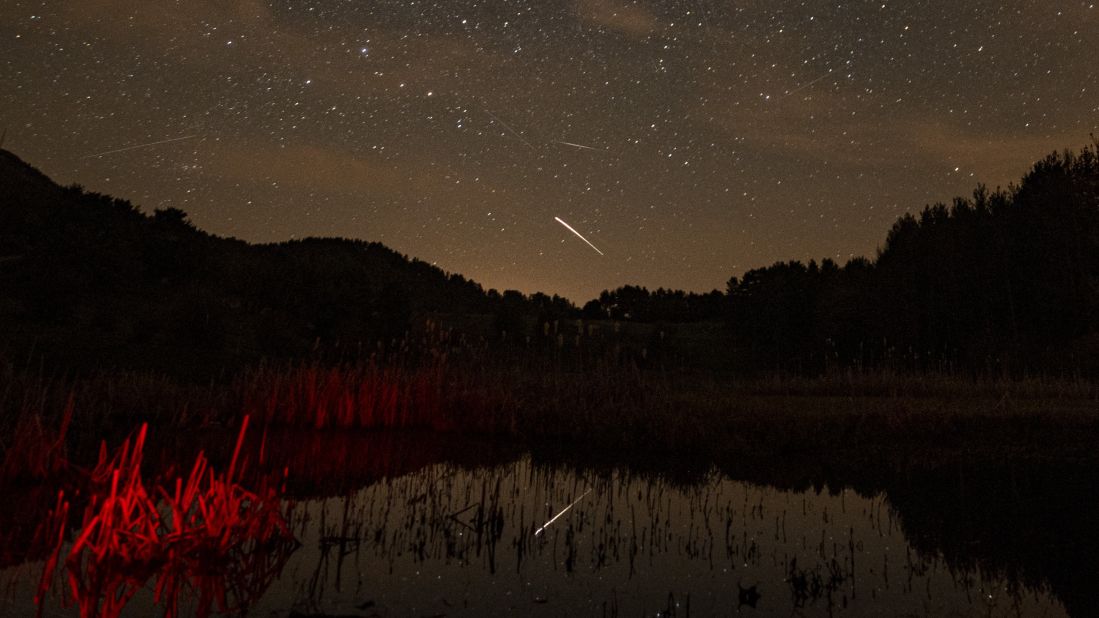
The Lyrid meteor shower has begun! Here’s what to expect as the shooting star display brightens the spring night sky, when it peaks and how to know if you’ve spotted a Lyrid, or a sporadic meteor!

Lyrid meteors are visible each year as Earth passes through the trail of debris shed by the C/1861 G1 Thatcher, a long-period comet that visits the inner solar system just once every 415 years, according to NASA.

In 2026, the Lyrids are active from April 16-25 and reach peak activity on April 22, as Earth passes through the densest region of Thatcher’s dusty trail.


You may like

Shooting stars associated with Comet Thatcher are known for producing fast-moving meteors that tend to lack long-lasting trains. The shower can also spawn impressive fireball events that outshine even the brightest planets, as bigger chunks of cometary debris — sometimes the size of a basketball, or larger — forge a flaming path through Earth’s atmosphere

Viewing conditions

The waxing moon will be 40%-lit as the Lyrid meteor shower comes to a peak on the night of April 21-22, when up to 18 shooting stars may be visible brightening the night sky each hour. The lunar disk will set below the western horizon among the stars of the constellation Gemini roughly an hour and a half after midnight, leaving the sky beautifully dark for hunting meteors.

How do I know if the shooting star I saw was a Lyrid?

Shooting stars belonging to the Lyrid meteor shower appear to streak away from a patch of sky — known as the shower’s radiant — close to the bright star Vega, whose blue-white light can be spotted shining in the constellation Lyra. This summer constellation rises to its highest point in the eastern sky in the predawn hours in mid-to-late April.
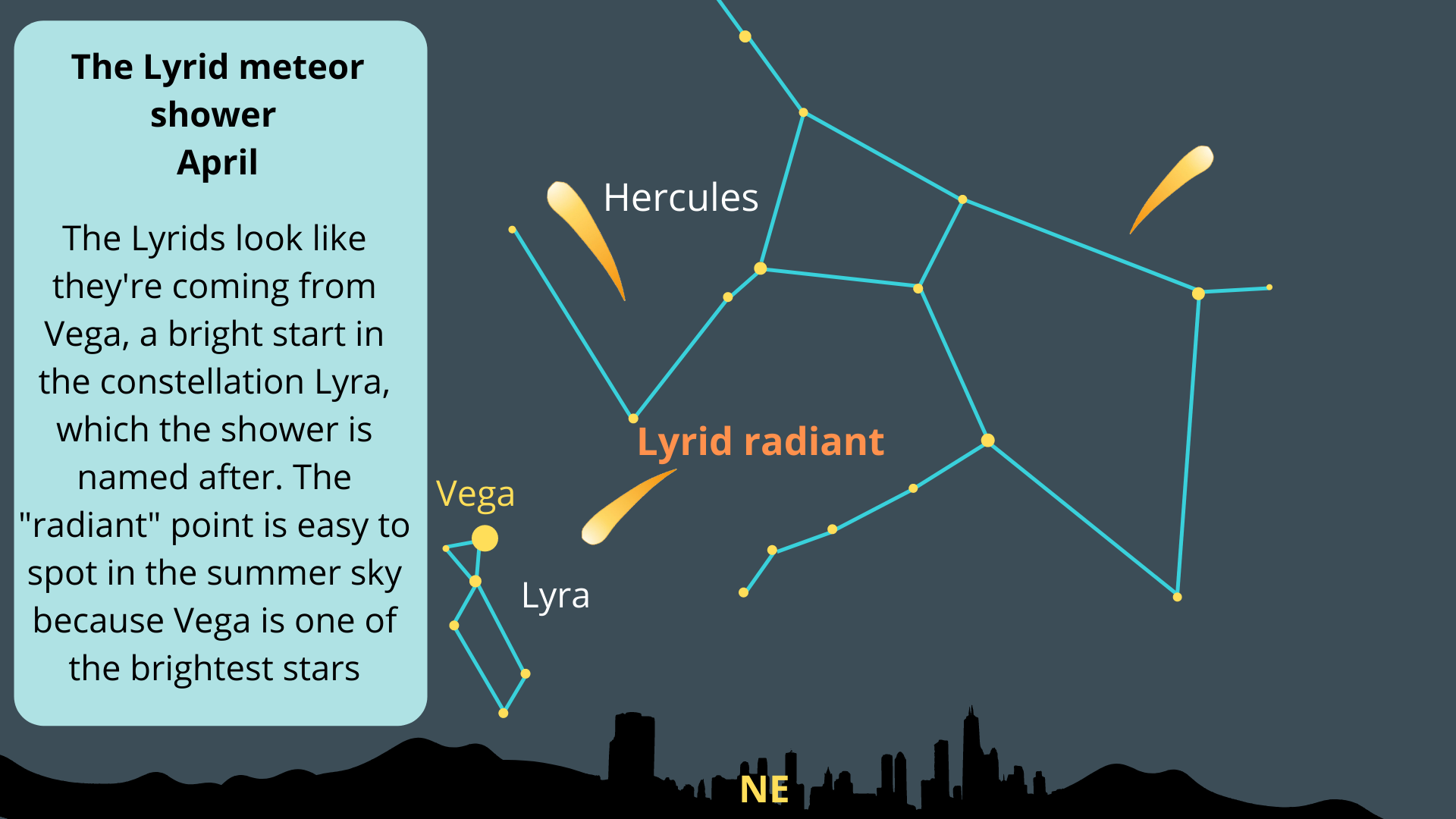
Graphic showing the Lyrid radiant and meteors appearing to originate there.

The radiant of the Lyrid meteor shower is located near the Hercules-Lyra border. (Image credit: Future)

Lyrid meteors may be seen anytime after dark when the radiant is above the horizon. However, your best chance of catching the most shooting stars is in the predawn hours of April 22, as the shower ramps up to peak activity.

Breaking space news, the latest updates on rocket launches, skywatching events and more!

Where should I look to see shooting stars?

Canon EOS R7 camera

Canon EOS R7 review photo

(Image credit: Future/Kimberley Lane)

The Canon EOS R7 is the best camera for beginners hoping to capture shooting stars. Read our full Canon EOS R7 review.

Head outside around three hours before sunrise and locate the bright star Vega in the eastern sky. If you’re unfamiliar with the night sky, you should try navigating using a stargazing smartphone app, many of which use augmented reality to point you in the right direction.

When meteor hunting, it’s never a good idea to stare directly at the radiant. Instead, try to find a patch of sky roughly 40 degrees — roughly the width of four clenched fists held at arm’s length — away from it. Here, the meteor trails will be at their longest!

You may also like: The Lyrids are coming! How I watch meteor showers from the middle of a city

If possible, try to allow 20-30 minutes for your eyes to fully adapt to the dark and to use a red light to avoid spoiling your night vision. Be sure to check out our guide to photographing meteor showers if you’re planning on capturing the event for yourself, along with our roundups of the best cameras and lenses for astrophotography.

<em>Editor’s Note: If you would like to share your Lyrid meteor shower photos with Space.com’s readers, then please send your photo(s), comments, and your name and location to spacephotos@space.com.

Tags: rocket launch
No Result
View All Result

Recent Posts

  • ‘Thor’ hammered down 15 years ago, and it’s still the only Marvel movie to do the God of Thunder justice
  • Sci-fi RPG ‘Exodus”s combat looks and feels like ‘Mass Effect’, but the dialogue system could be a big upgrade (video)
  • Nikon Action 7×50 binoculars review
  • Why does NASA’s Curiosity rover have a ‘lucky penny’ on Mars? | Space photo of the day for May 6, 2026
  • Voyager ‘very optimistic’ about Starlab amid potential NASA changes

Categories

  • Excursions
  • Kepler Mission
  • NASA
  • NASA Breaking News
  • Physical Preparation
  • Preparation
  • Space News
  • Space Station News
  • Spacewalks
  • Tours
  • Uncategorized
  • Weightlessness Training
  • What Not to Pack
  • What to Pack

Meta

  • Log in
  • Entries feed
  • Comments feed
  • WordPress.org
  • Home
  • Start Here
  • Preparing for Your Trip
  • Space Tourism Companies
  • Space Tours
  • Contact

© 2026 JNews - Premium WordPress news & magazine theme by Jegtheme.

No Result
View All Result
  • About
  • Contact
  • Feeds
  • Frequently Asked Questions
  • Preparing for Your Trip
    • Insurance and Legal Waivers
    • Physical and Medical Requirements
    • Training Programs
    • What to Expect
  • Privacy Policy
  • Space Tourism Companies
    • Axiom Space
    • Blue Origin
    • Blue Origin vs Virgin Galactic
    • Comparison Chart: Features, Pricing, Booking
    • SpaceX
    • Virgin Galactic
    • World View (stratospheric balloon flights)
  • Space Tours
    • Custom & Luxury Packages
    • Duration, Training, Costs
    • Experiences
    • Future Moon/Mars Options
    • Orbital Flights
    • Parabolic Flight Experiences
    • Private Missions
    • Stratospheric Balloon Flights
    • Suborbital Flights
    • Zero-Gravity Flights
  • Spaceflight Technologies
    • Space Tourism Balloon
  • Start Here
    • How to Book a Space Tour
    • Intro to Commercial Spaceflight
    • Is Space Tourism Safe?
    • Space Travel FAQs
    • View Earth from the Edge
    • What to Pack
  • Tours in Space is your launchpad to the world of space tourism

© 2026 JNews - Premium WordPress news & magazine theme by Jegtheme.