• Home
  • About
  • FAQ
  • Feeds
  • Glossary
  • Contact
Tours In Space
  • Home
  • Start Here
    • Intro to Commercial Spaceflight
    • How to Book a Space Tour
    • Is Space Tourism Safe?
    • Space Travel FAQs
    • View Earth from the Edge
    • What to Pack
  • Preparing for Your Trip
    • Insurance and Legal Waivers
    • Physical and Medical Requirements
    • Training Programs
    • What to Expect
  • Space Tourism Companies
    • Axiom Space
    • Blue Origin
    • SpaceX
    • Virgin Galactic
    • World View (stratospheric balloon flights)
    • Blue Origin vs Virgin Galactic
    • Comparison Chart: Features, Pricing, Booking
  • Space Tours
    • Custom & Luxury Packages
    • Duration, Training, Costs
    • Experiences
    • Future Moon/Mars Options
    • Orbital Flights
    • Parabolic Flight Experiences
    • Private Missions
    • Stratospheric Balloon Flights
    • Suborbital Flights
    • Zero-Gravity Flights
  • Spaceflight Technologies
    • Space Tourism Balloon
No Result
View All Result
  • Home
  • Start Here
    • Intro to Commercial Spaceflight
    • How to Book a Space Tour
    • Is Space Tourism Safe?
    • Space Travel FAQs
    • View Earth from the Edge
    • What to Pack
  • Preparing for Your Trip
    • Insurance and Legal Waivers
    • Physical and Medical Requirements
    • Training Programs
    • What to Expect
  • Space Tourism Companies
    • Axiom Space
    • Blue Origin
    • SpaceX
    • Virgin Galactic
    • World View (stratospheric balloon flights)
    • Blue Origin vs Virgin Galactic
    • Comparison Chart: Features, Pricing, Booking
  • Space Tours
    • Custom & Luxury Packages
    • Duration, Training, Costs
    • Experiences
    • Future Moon/Mars Options
    • Orbital Flights
    • Parabolic Flight Experiences
    • Private Missions
    • Stratospheric Balloon Flights
    • Suborbital Flights
    • Zero-Gravity Flights
  • Spaceflight Technologies
    • Space Tourism Balloon
No Result
View All Result
Tours In Space
No Result
View All Result
Home Space News

Northern lights could be visible as far south as Illinois and Oregon tonight

Ensign by Ensign
April 18, 2026
in Space News
0
Northern lights could be visible as far south as Illinois and Oregon tonight
189
SHARES
1.5k
VIEWS
Share on FacebookShare on Twitter

Head’s up, aurora chasers! A surge of speedy solar wind is currently hurtling toward Earth at speeds up to 430 miles per second (700 km/s) and the conditions could spark geomagnetic storms tonight (April 17) and tomorrow (April 18)

NOAA’s Space Weather Prediction Center has issued a moderate (G2) geomagnetic storm watch while forecasters at the U.K. Met Office say there is a chance of strong (G3) bursts if activity intensifies.

If that happens, the northern lights could push much farther south than usual, becoming visible in parts of the U.S. as far south as Illinois and Oregon.


You may like

Geomagnetic storms are ranked on a G-scale, from G1 (minor) to G5 (extreme). Stronger storms can push auroras much farther from the poles, making them visible across mid-latitudes.

Auroras form when solar wind interacts with Earth’s magnetic field, sending charged particles into the upper atmosphere. There, they collide with gases such as oxygen and nitrogen, transferring energy that is released as light, producing the colorful displays seen in the night sky. The stronger the solar wind, the more dynamic and widespread the auroras can become.
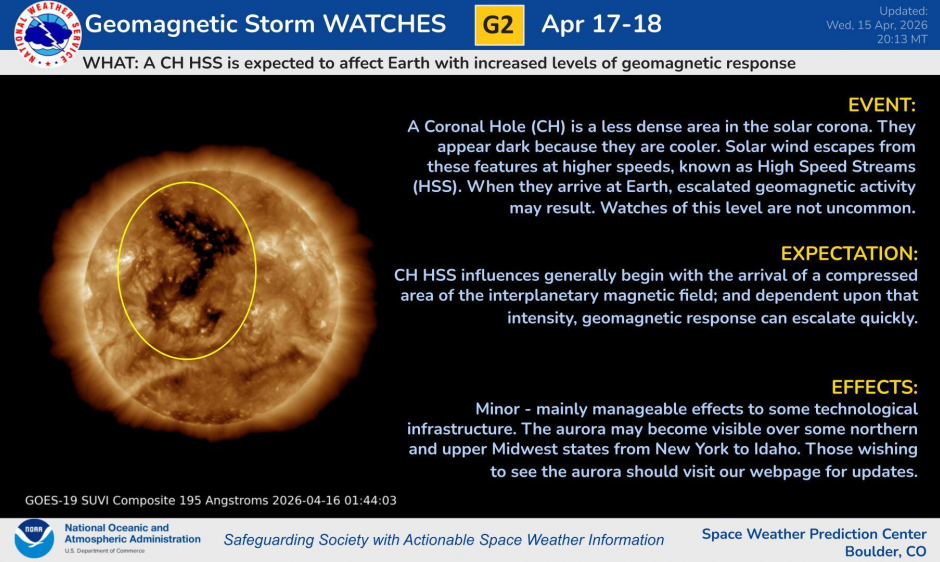
infographic detailing the geomagnetic storm watch issued for april 17-18.

NOAA’s geomagnetic storm watch for April 17-18. (Image credit: NOAA SWPC)

Where can I see the northern lights tonight?

Depending on whether conditions align and geomagnetic storms are triggered, the northern lights could become visible across the northern U.S. tonight. But remember, auroras are never guaranteed and depend on how successfully the solar wind interacts with Earth’s magnetic field.

Swipe to scroll horizontally

Geomagnetic storm

Most southern possible visibility

G3 – Strong

Illinois and Oregon

G2 – Moderate

New York and Idaho

G1 – Minor

Northern Michigan and Maine

Northern Hemisphere aurora forecast courtesy of the U.K. Met Office

What time should I look for the northern lights tonight?

The northern lights may be visible across northern U.S. states tonight and tomorrow (April 17-18).

According to NOAA’s 3-day forecast, activity is expected to peak during the following windows:

Swipe to scroll horizontally

Time (EDT)

Time (GMT)

Activity

5:00 p.m. (April 17) to 2 a.m.

2100 (April 17) to 0600 (April 18)

Moderate G2 conditions possible

2:00 a.m. to 5 a.m.

0600-0900 (April 18)

Minor G1 conditions possible

How can I see the northern lights from where I live?

Find a north-facing vantage point with a clear view of the northern horizon, as far from light pollution as possible.

  • Use your phone camera to scan the sky, as a phone camera is great at picking up faint auroras before your eyes spot them. This will give you a good idea of which direction to focus your attention.
  • Try and let your eyes adapt to the dark for at least 30 minutes; this will help your night vision develop.
  • Wear warm clothing! Part of the fun of aurora hunting is the chase. Be prepared to sit or stand for hours if conditions are looking promising, as you won’t want to miss the show when it starts!

We recommend downloading a space weather app that provides aurora forecasts based on your location. One option I use is “My Aurora Forecast & Alerts,” available for both iOS and Android. However, any similar app should work well.

While you’re at it… look for Lyrid meteors!
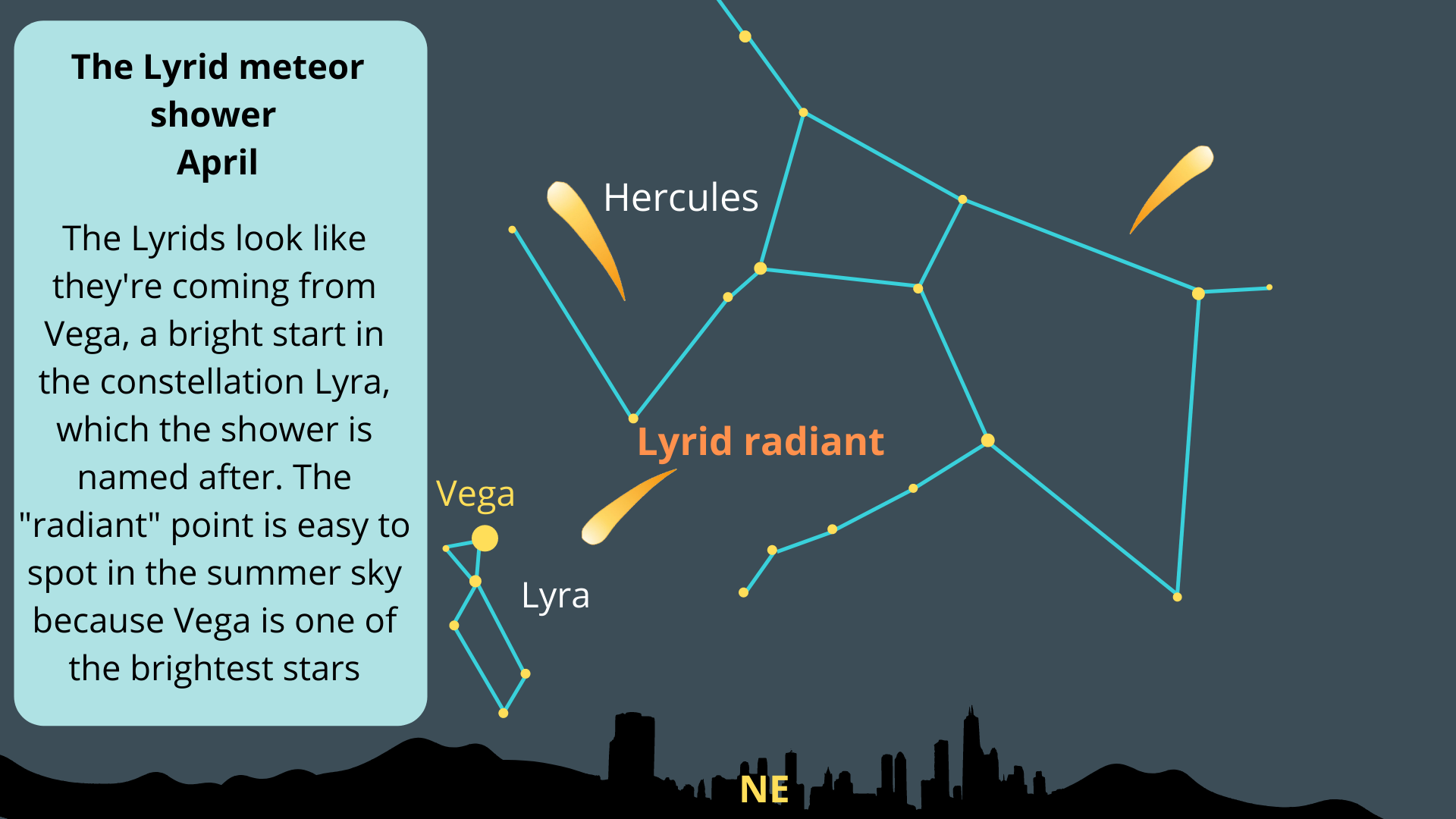
Graphic showing the Lyrid radiant and meteors appearing to originate there.

The radiant of the Lyrid meteor shower is located near the Hercules-Lyra border. (Image credit: Future)

If you’re heading outside tonight or over the weekend to hunt for auroras, keep an eye out for the Lyrid meteor shower too.

The Lyrid meteor shower is active between April 16 and April 25 and will peak in the predawn hours on April 22.

Lyrids will appear to emanate from the radiant in the Lyra constellation, which rises in the northwest and climbs higher in the sky toward the early morning hours. But make sure you don’t look directly at the radiant, as while meteors appear to originate from Lyra, the longer, more dramatic shooting stars often appear farther away, so scan as much of the sky surrounding the radiant as possible.

No Result
View All Result

Recent Posts

  • How to see the Lyrid meteor shower 2026: Where to look in the night sky
  • Artemis 2 and Tiangong space station astronauts set record for farthest distance between humans
  • This Week In Space podcast: Episode 206 — I Want to Believe
  • Don’t miss the moon, Venus and the Pleiades align after sunset on April 19
  • This life-hunting rover may be SpaceX’s 1st-ever Mars launch

Categories

  • Excursions
  • Kepler Mission
  • NASA
  • NASA Breaking News
  • Physical Preparation
  • Preparation
  • Space News
  • Space Station News
  • Spacewalks
  • Tours
  • Uncategorized
  • Weightlessness Training
  • What Not to Pack
  • What to Pack

Meta

  • Log in
  • Entries feed
  • Comments feed
  • WordPress.org
  • Home
  • Start Here
  • Preparing for Your Trip
  • Space Tourism Companies
  • Space Tours
  • Contact

© 2026 JNews - Premium WordPress news & magazine theme by Jegtheme.

No Result
View All Result
  • About
  • Contact
  • Feeds
  • Frequently Asked Questions
  • Preparing for Your Trip
    • Insurance and Legal Waivers
    • Physical and Medical Requirements
    • Training Programs
    • What to Expect
  • Privacy Policy
  • Space Tourism Companies
    • Axiom Space
    • Blue Origin
    • Blue Origin vs Virgin Galactic
    • Comparison Chart: Features, Pricing, Booking
    • SpaceX
    • Virgin Galactic
    • World View (stratospheric balloon flights)
  • Space Tours
    • Custom & Luxury Packages
    • Duration, Training, Costs
    • Experiences
    • Future Moon/Mars Options
    • Orbital Flights
    • Parabolic Flight Experiences
    • Private Missions
    • Stratospheric Balloon Flights
    • Suborbital Flights
    • Zero-Gravity Flights
  • Spaceflight Technologies
    • Space Tourism Balloon
  • Start Here
    • How to Book a Space Tour
    • Intro to Commercial Spaceflight
    • Is Space Tourism Safe?
    • Space Travel FAQs
    • View Earth from the Edge
    • What to Pack
  • Tours in Space is your launchpad to the world of space tourism

© 2026 JNews - Premium WordPress news & magazine theme by Jegtheme.