• Home
  • About
  • FAQ
  • Feeds
  • Glossary
  • Contact
Tours In Space
  • Home
  • Start Here
    • Intro to Commercial Spaceflight
    • How to Book a Space Tour
    • Is Space Tourism Safe?
    • Space Travel FAQs
    • View Earth from the Edge
    • What to Pack
  • Preparing for Your Trip
    • Insurance and Legal Waivers
    • Physical and Medical Requirements
    • Training Programs
    • What to Expect
  • Space Tourism Companies
    • Axiom Space
    • Blue Origin
    • SpaceX
    • Virgin Galactic
    • World View (stratospheric balloon flights)
    • Blue Origin vs Virgin Galactic
    • Comparison Chart: Features, Pricing, Booking
  • Space Tours
    • Custom & Luxury Packages
    • Duration, Training, Costs
    • Experiences
    • Future Moon/Mars Options
    • Orbital Flights
    • Parabolic Flight Experiences
    • Private Missions
    • Stratospheric Balloon Flights
    • Suborbital Flights
    • Zero-Gravity Flights
  • Spaceflight Technologies
    • Space Tourism Balloon
No Result
View All Result
  • Home
  • Start Here
    • Intro to Commercial Spaceflight
    • How to Book a Space Tour
    • Is Space Tourism Safe?
    • Space Travel FAQs
    • View Earth from the Edge
    • What to Pack
  • Preparing for Your Trip
    • Insurance and Legal Waivers
    • Physical and Medical Requirements
    • Training Programs
    • What to Expect
  • Space Tourism Companies
    • Axiom Space
    • Blue Origin
    • SpaceX
    • Virgin Galactic
    • World View (stratospheric balloon flights)
    • Blue Origin vs Virgin Galactic
    • Comparison Chart: Features, Pricing, Booking
  • Space Tours
    • Custom & Luxury Packages
    • Duration, Training, Costs
    • Experiences
    • Future Moon/Mars Options
    • Orbital Flights
    • Parabolic Flight Experiences
    • Private Missions
    • Stratospheric Balloon Flights
    • Suborbital Flights
    • Zero-Gravity Flights
  • Spaceflight Technologies
    • Space Tourism Balloon
No Result
View All Result
Tours In Space
No Result
View All Result
Home Space News

Interstellar invader comet 3I/ATLAS formed in a world much colder than the solar system

Ensign by Ensign
April 23, 2026
in Space News
0
Interstellar invader comet 3I/ATLAS formed in a world much colder than the solar system
190
SHARES
1.5k
VIEWS
Share on FacebookShare on Twitter

Using the Atacama Large Millimeter/submillimeter Array (ALMA), scientists have discovered that the interstellar invader comet 3I/ATLAS formed in a much colder region of the Milky Way than our solar system.

The discovery came about when scientists made the first-ever measurement of so-called semi-heavy water (or deuterated water) for an object that originated beyond the solar system. Deuterated water refers to water in which one hydrogen atom is replaced with deuterium, a heavy hydrogen isotope that has an atomic nucleus composed of one proton and one neutron. ALMA’s measurements of deuterated water revealed that 3I/ATLAS contains around 30 times as much semi-heavy water as is found in comets that originate in the solar system.

The findings indicate that 3I/ATLAS, just the third interstellar object discovered passing through the solar system, formed in a much more frigid region of space compared to our planetary backyard.


You may like

“Our new observations show that the conditions that led to the formation of our solar system are much different from how planetary systems evolved in different parts of our galaxy,” team leader Luis E. Salazar Manzano at the University of Michigan said in a statement.

Manzano and colleagues studied 3I/ATLAS as it reached its closest point to the sun, a feat made possible by the ability of ALMA’s 66 radio antennas to point toward the sun, something optical telescopes can’t do because of the glare of sunlight.

An interstellar snowball

The high water content of comets in the solar system means that they are often referred to as “dirty snowballs.” This water contains a record of the chemistry of the environment in which the comets formed at the time of their birth, which for comets in our solar system was around 4.6 billion years ago, when planets were also forming around the infant sun.

Comets don’t just contain ordinary water composed of two hydrogen atoms with nuclei composed of just one proton bonded to an oxygen atom  — they also contain molecules of deuterated water. In the comets of the solar system, one molecule of deuterated water exists for every 10,000 molecules of ordinary water, but the ratio of semi-heavy water to water is 30 times greater for 3I/ATLAS than this. This is, in turn, 40 times greater than the same ratio in the oceans of Earth.

Breaking space news, the latest updates on rocket launches, skywatching events and more!

This elevated ratio points to 3I/ATLAS having formed in an exceptionally cold and chemically distinct environment somewhere else in the Milky Way.

“The chemical processes that lead to the enhancement of deuterated water are really sensitive to temperature and usually require environments colder than about 30 Kelvin, or about minus 406 degrees Fahrenheit [207 degrees Celsius],” Manzano said.
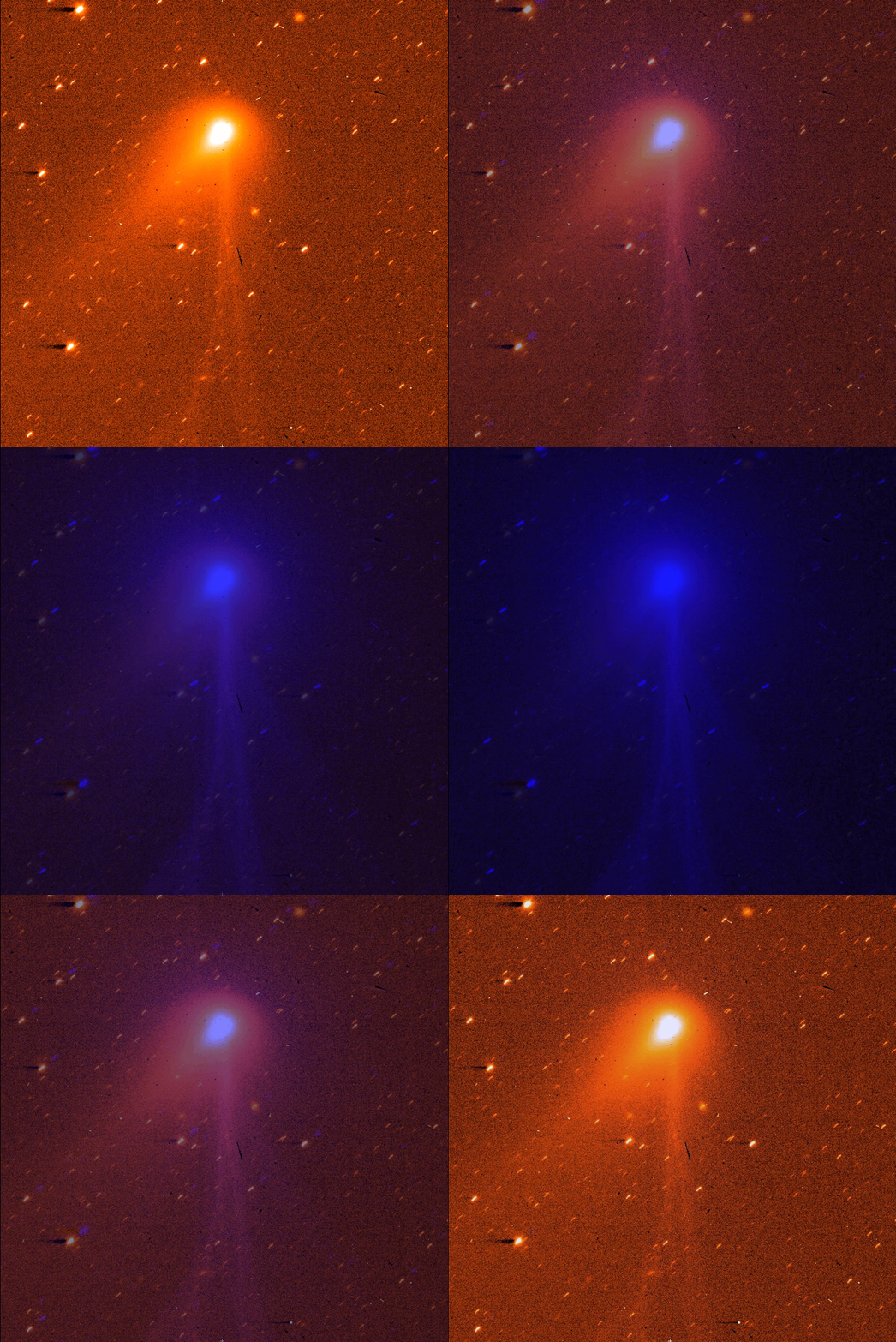
A streak against the darkness of space changes color from red to blue

3I/ATLAS as seen by JUICE instrument MAJIS. (Image credit: ESA/Juice/MAJIS)

The ratio acts as a record of the chemical environment of 3I/ATLAS’ home system, having remained intact throughout the interstellar invader’s long journey to the solar system. The ratio is also an important one because abundances of deuterium and hydrogen throughout the universe are thought to have been set during the Big Bang itself.

“Each interstellar comet brings a little bit of its history, its fossils, from elsewhere,” team member Teresa Paneque-Carreño of the University of Michigan said. “We don’t know exactly where, but with instruments like ALMA, we can begin to understand the conditions of that place and compare them to our own.”

The team’s research was published on Thursday (April 23) in the journal Nature Astronomy.

Tags: rocket launch
No Result
View All Result

Recent Posts

  • Voyager ‘very optimistic’ about Starlab amid potential NASA changes
  • Ukrainian forces test direct-to-device satellite imagery for frontline troops
  • New NGA head makes industry debut at GEOINT Symposium 2026
  • Startup develops software to help military tap commercial imaging satellites
  • Loft Orbital expands into full-service constellation deals

Categories

  • Excursions
  • Kepler Mission
  • NASA
  • NASA Breaking News
  • Physical Preparation
  • Preparation
  • Space News
  • Space Station News
  • Spacewalks
  • Tours
  • Uncategorized
  • Weightlessness Training
  • What Not to Pack
  • What to Pack

Meta

  • Log in
  • Entries feed
  • Comments feed
  • WordPress.org
  • Home
  • Start Here
  • Preparing for Your Trip
  • Space Tourism Companies
  • Space Tours
  • Contact

© 2026 JNews - Premium WordPress news & magazine theme by Jegtheme.

No Result
View All Result
  • About
  • Contact
  • Feeds
  • Frequently Asked Questions
  • Preparing for Your Trip
    • Insurance and Legal Waivers
    • Physical and Medical Requirements
    • Training Programs
    • What to Expect
  • Privacy Policy
  • Space Tourism Companies
    • Axiom Space
    • Blue Origin
    • Blue Origin vs Virgin Galactic
    • Comparison Chart: Features, Pricing, Booking
    • SpaceX
    • Virgin Galactic
    • World View (stratospheric balloon flights)
  • Space Tours
    • Custom & Luxury Packages
    • Duration, Training, Costs
    • Experiences
    • Future Moon/Mars Options
    • Orbital Flights
    • Parabolic Flight Experiences
    • Private Missions
    • Stratospheric Balloon Flights
    • Suborbital Flights
    • Zero-Gravity Flights
  • Spaceflight Technologies
    • Space Tourism Balloon
  • Start Here
    • How to Book a Space Tour
    • Intro to Commercial Spaceflight
    • Is Space Tourism Safe?
    • Space Travel FAQs
    • View Earth from the Edge
    • What to Pack
  • Tours in Space is your launchpad to the world of space tourism

© 2026 JNews - Premium WordPress news & magazine theme by Jegtheme.