• Home
  • About
  • FAQ
  • Feeds
  • Glossary
  • Contact
Tours In Space
  • Home
  • Start Here
    • Intro to Commercial Spaceflight
    • How to Book a Space Tour
    • Is Space Tourism Safe?
    • Space Travel FAQs
    • View Earth from the Edge
    • What to Pack
  • Preparing for Your Trip
    • Insurance and Legal Waivers
    • Physical and Medical Requirements
    • Training Programs
    • What to Expect
  • Space Tourism Companies
    • Axiom Space
    • Blue Origin
    • SpaceX
    • Virgin Galactic
    • World View (stratospheric balloon flights)
    • Blue Origin vs Virgin Galactic
    • Comparison Chart: Features, Pricing, Booking
  • Space Tours
    • Custom & Luxury Packages
    • Duration, Training, Costs
    • Experiences
    • Future Moon/Mars Options
    • Orbital Flights
    • Parabolic Flight Experiences
    • Private Missions
    • Stratospheric Balloon Flights
    • Suborbital Flights
    • Zero-Gravity Flights
  • Spaceflight Technologies
    • Space Tourism Balloon
No Result
View All Result
  • Home
  • Start Here
    • Intro to Commercial Spaceflight
    • How to Book a Space Tour
    • Is Space Tourism Safe?
    • Space Travel FAQs
    • View Earth from the Edge
    • What to Pack
  • Preparing for Your Trip
    • Insurance and Legal Waivers
    • Physical and Medical Requirements
    • Training Programs
    • What to Expect
  • Space Tourism Companies
    • Axiom Space
    • Blue Origin
    • SpaceX
    • Virgin Galactic
    • World View (stratospheric balloon flights)
    • Blue Origin vs Virgin Galactic
    • Comparison Chart: Features, Pricing, Booking
  • Space Tours
    • Custom & Luxury Packages
    • Duration, Training, Costs
    • Experiences
    • Future Moon/Mars Options
    • Orbital Flights
    • Parabolic Flight Experiences
    • Private Missions
    • Stratospheric Balloon Flights
    • Suborbital Flights
    • Zero-Gravity Flights
  • Spaceflight Technologies
    • Space Tourism Balloon
No Result
View All Result
Tours In Space
No Result
View All Result
Home Space News

From Apollo to alien worlds: 4 ‘firsts’ you can spot in the night sky tonight

Ensign by Ensign
April 25, 2026
in Space News
0
From Apollo to alien worlds: 4 ‘firsts’ you can spot in the night sky tonight
190
SHARES
1.5k
VIEWS
Share on FacebookShare on Twitter

Humanity’s exploration of the cosmos is a tale of incredible firsts, discoveries driven by a scientific curiosity that has shaped our understanding of the universe and, ultimately, our place within it.

Join us as we show you where four incredible scientific “firsts” unfolded in the northern hemisphere night sky, ranging from our species’ earliest steps on another world, to the first telescopic discovery of a moon by one of history’s greatest astronomers and more.

Each target is accompanied by a handy graphic to help point the way. However, if you’re unfamiliar with the post-sunset realm, then you may benefit from checking out our guide to the best astronomy smartphone apps, many of which help point the way to specific stars using augmented reality technology.


You may like

1 – The first steps on the moon

Apollo 11 set down on the moon and established Tranquility Base on July 20, 1969, marking the first time in history that humans had landed and set foot on the surface of another world. It remains one of the most impressive technological achievements in humanity’s short history — one that NASA and its partners are struggling to repeat in the modern day with its Artemis program, decades later.
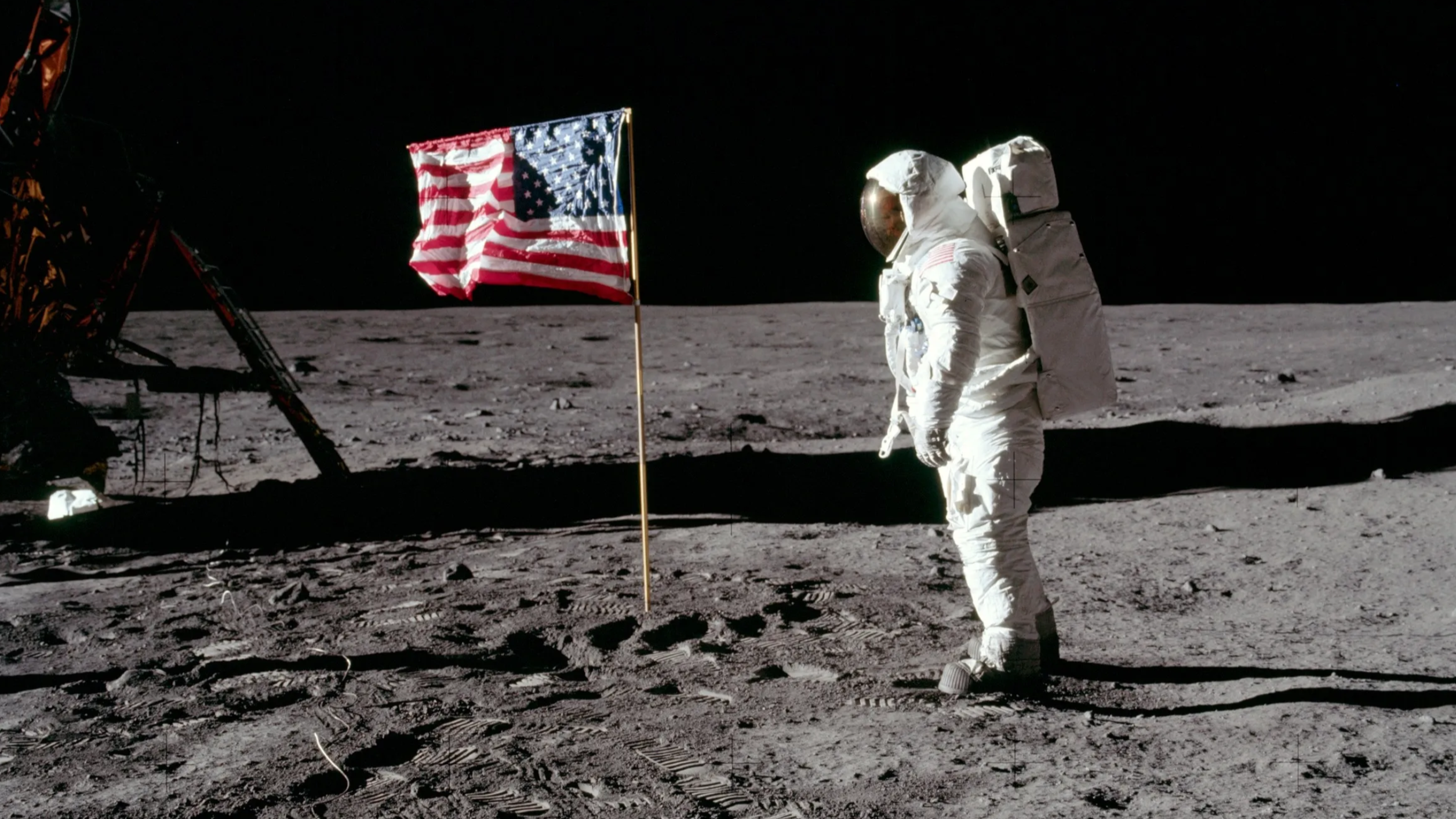
An astronaut is pictured on the moon's surface facing an American flag.

Buzz Aldrin stands in front of the U.S. flag on the surface of the moon. (Image credit: NASA)

The Apollo 11 landing site is far too small to spot from Earth. However, you <em>can find the general location of Tranquility Base with the help of a 6-inch telescope or binoculars when the vast basaltic plain of Mare Tranquillitatis (the Sea of Tranquility) is bathed in sunlight in the weeks preceding the full moon.
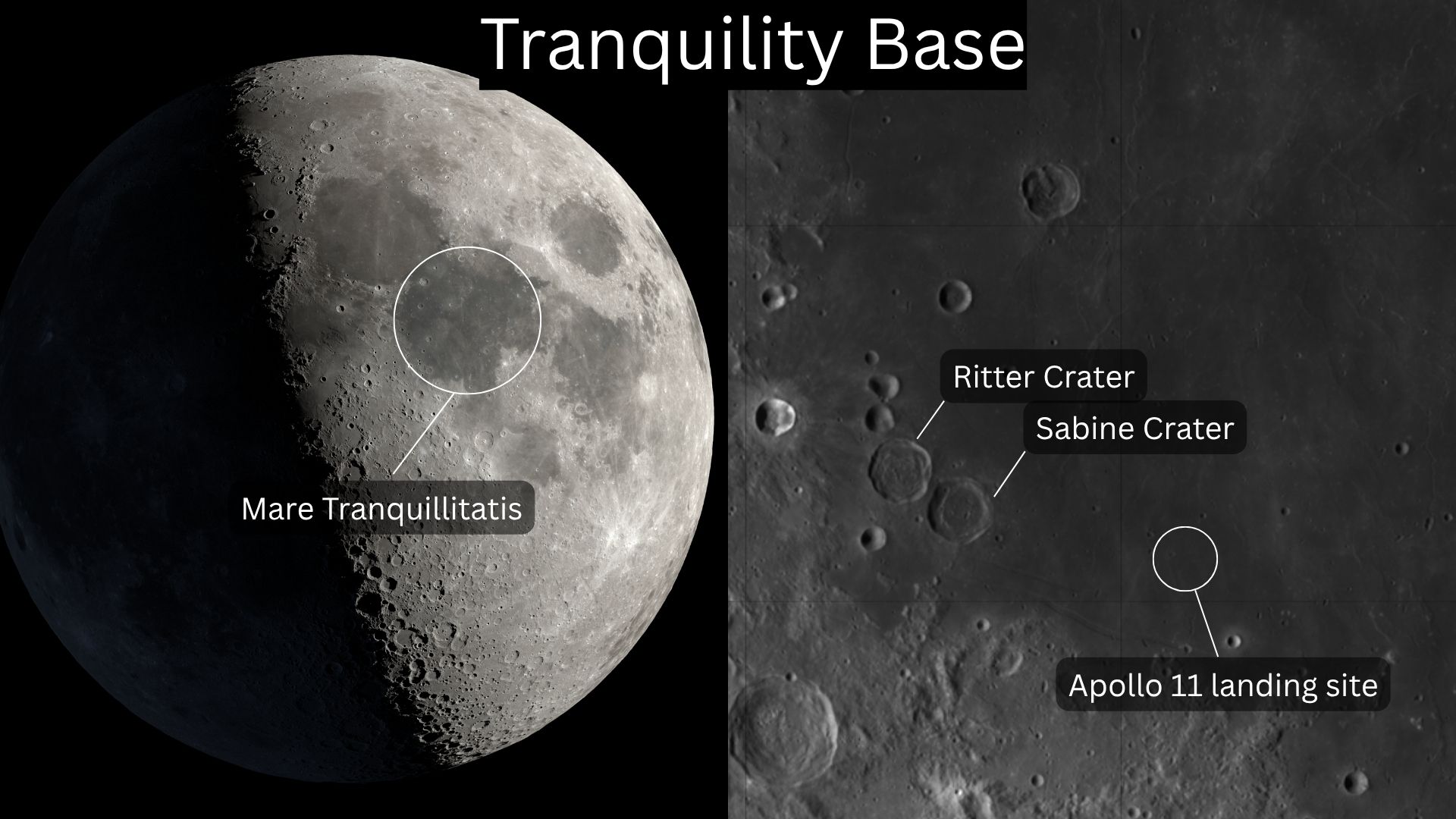
A two-panel image showing the moon on the left with a circle showing the location of Mare Tranquillitatis, and a zoomed in region of the lunar surface on the right showing the location of Apollo 11.

Here’s how to find the Apollo 11 landing site on the lunar surface. (Image credit: NASA, NASA Scientific Visualization Studio)

First, find Mare Tranquillitatis, which appears as a dark scar a little above the lunar equator on the eastern (or right) side of the moon’s surface. Next, find the Ritter and Sabine craters to the southwestern edge of the lunar sea. Trace an imaginary line from the bottom of Ritter through the middle of Sabine and follow it for roughly 2.5 times the width of the latter to find the approximate location of the Apollo 11 landing site. You can also find the other five Apollo-era landing sites using our handy observer guide!

2 – The first confirmed exoplanet orbiting a sun-like star

Michel Mayor and Didier Queloz made history in October 1995 when they announced the discovery of the first exoplanet known to orbit a sun-like star. The world, designated 51 Pegasi b, or “Dimidium”, is thought to be a “hot Jupiter” — a breed of giant exoplanets that orbit incredibly close to their parent stars.
Breaking space news, the latest updates on rocket launches, skywatching events and more!

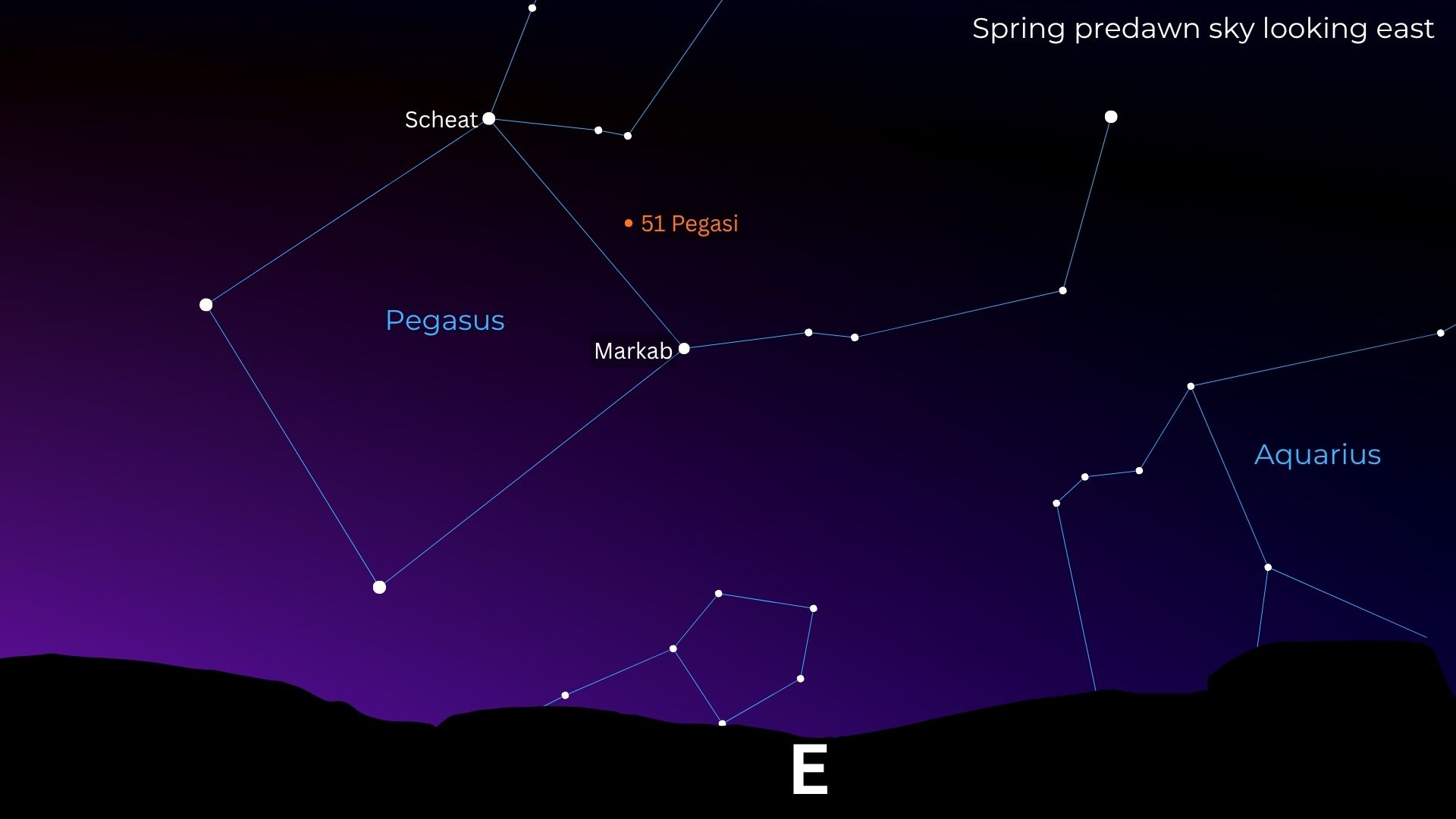
A starmap showing the location of the star 51 Pegasi in the context of prominent constellations.

A starmap showing the location of 51 Pegasi in the predawn sky. (Image credit: Created by Anthony Wood in Canva.)

Dimidium is located 50 light-years from Earth and was only discovered thanks to the minute “wobble” in light from its parent star 51 Pegasi, which arose as the exoplanet’s gravity tugged on the host star over the course of its 4-day orbit, according to NASA.

To find the ancient light of the star 51 Pegasi, you’ll first need to locate the constellation Pegasus, whose stars glow low on the eastern horizon in the hours preceding sunrise in early spring. Next, find Scheat and Markab — two of the bright stars that form part of the Great Square of Pegasus. 51 Pegasi is a dimmer point of light roughly halfway between the two.

3 – The first star photographed beyond the sun

Astronomer William Cranch Bond teamed up with early photographer J.A. Whipple to capture the first image of a star other than our sun, which they achieved using the Great Refractor telescope at Harvard University on the night of July 16-17, 1850.


What to read next

A star is pictured in a grey sky in an old photograph.

The first image of Vega captured by William Cranch Bond and J.A. Whipple. (Image credit: John Adams Whipple/William Cranch Bond via Wikimedia Commons.)

About 145 years later, the red giant Betelgeuse would become the first star beyond our sun to have its surface directly imaged by astronomers using the Hubble Space Telescope, as it glowed around 650 light-years from Earth in the constellation Orion.
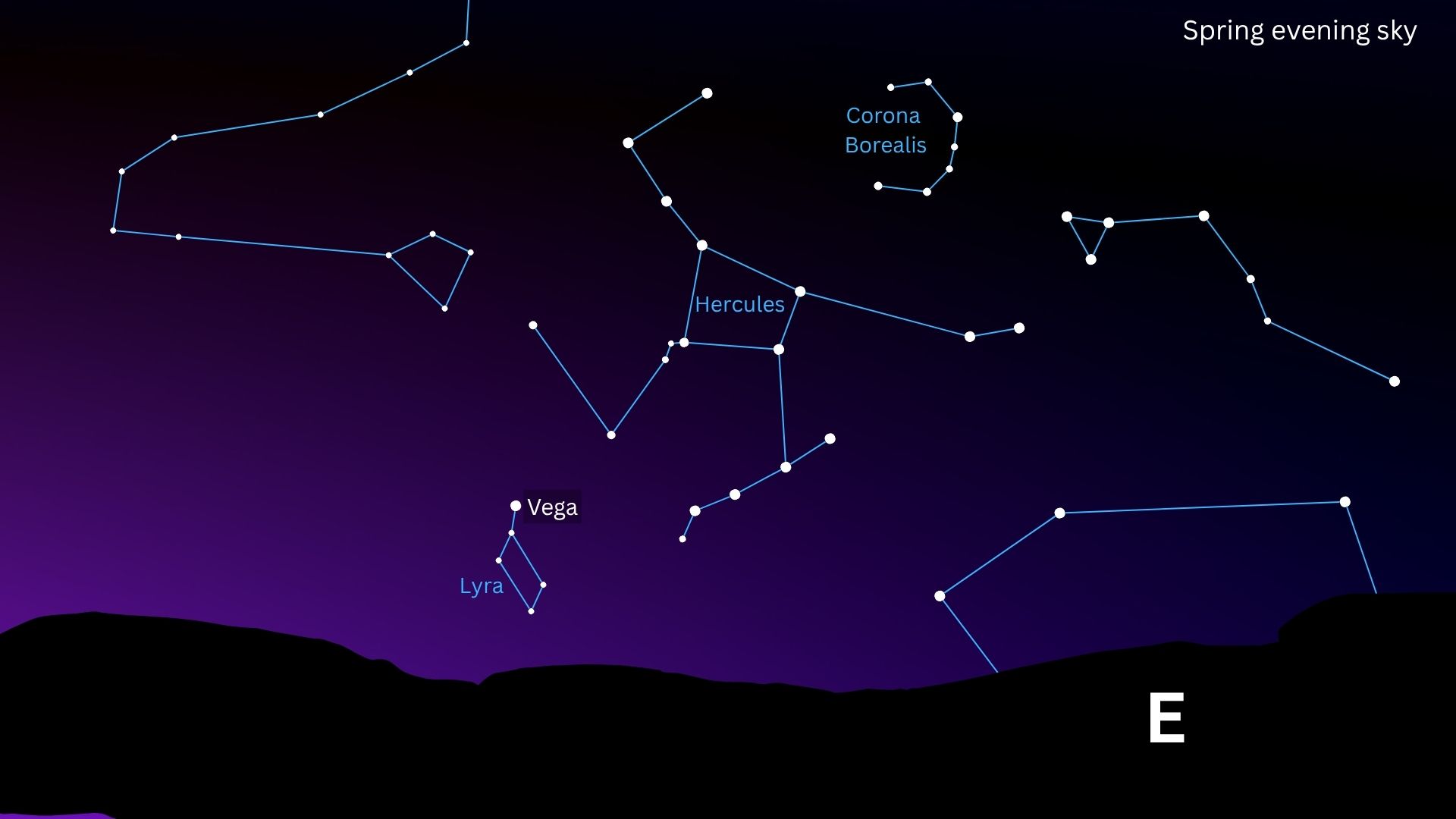
The location of the star Vega is shown in a starmap in the context of prominent constellations.

A starmap showing the location of Vega in the spring night sky. (Image credit: Created by Anthony Wood in Canva.)

Vega is found rising above the northeastern horizon in the constellation Lyra after sunset in early spring and soars high overhead as the night wears on, before finally fading from sight almost directly overhead as the sun rises.

4 – The first moons discovered with a telescope

The invention of the telescope in the early 1600s saw the discovery of hitherto unknown moons and planets orbiting within our solar system. The first such discovery was made by famed astronomer Galileo Galilei in 1609, who observed Jupiter with his own version of a “spyglass” telescope and was surprised to find four star-like objects orbiting the gas giant.

We now know those objects to be the natural satellites Io, Europa, Ganymede and Callisto, which astronomers refer to as the Galilean moons in honor of their discoverer. The moons are easy to spot with any modern-day telescope with an aperture of 4-inches or more, or a pair of binoculars!
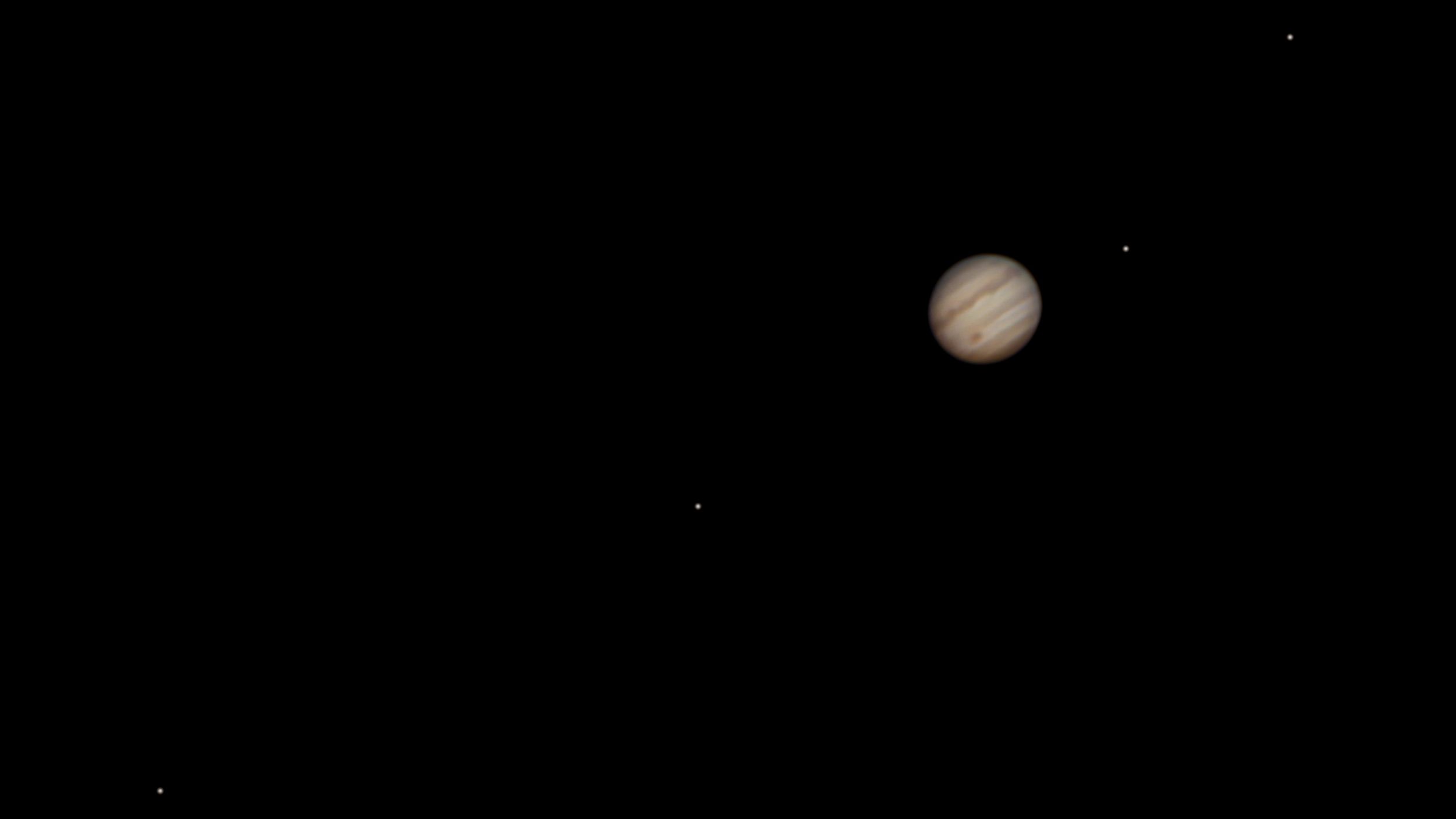
Jupiter is shown in a telescopic view in a dark sky surrounded by its brightest moons.

A telescopic shot of Jupiter with its brightest moons. (Image credit: Davidhajnal via Getty Images)

To follow in the footsteps of Galileo, you simply need to find Jupiter glowing as a steady point of light close to the dimmer stars of the constellation Gemini above the western horizon at sunset. The Galilean moons will appear as bright specks of light arrayed in a line around the gast giant’s disk through a small telescope, much like they did to the old master when he discovered them hundreds of years ago.

Feeling inspired to explore the wonders of the night sky up close? Then be sure to check out our roundups of the best telescopes and binoculars, along with our expert’s tips for new stargazers.

Editor’s Note: If you would like to share your astrophotography with Space.com’s readers, then please send your photo(s), comments, and your name and location to spacephotos@space.com.

Tags: CuriosityNASArocket launch
No Result
View All Result

Recent Posts

  • Voyager ‘very optimistic’ about Starlab amid potential NASA changes
  • Ukrainian forces test direct-to-device satellite imagery for frontline troops
  • New NGA head makes industry debut at GEOINT Symposium 2026
  • Startup develops software to help military tap commercial imaging satellites
  • Loft Orbital expands into full-service constellation deals

Categories

  • Excursions
  • Kepler Mission
  • NASA
  • NASA Breaking News
  • Physical Preparation
  • Preparation
  • Space News
  • Space Station News
  • Spacewalks
  • Tours
  • Uncategorized
  • Weightlessness Training
  • What Not to Pack
  • What to Pack

Meta

  • Log in
  • Entries feed
  • Comments feed
  • WordPress.org
  • Home
  • Start Here
  • Preparing for Your Trip
  • Space Tourism Companies
  • Space Tours
  • Contact

© 2026 JNews - Premium WordPress news & magazine theme by Jegtheme.

No Result
View All Result
  • About
  • Contact
  • Feeds
  • Frequently Asked Questions
  • Preparing for Your Trip
    • Insurance and Legal Waivers
    • Physical and Medical Requirements
    • Training Programs
    • What to Expect
  • Privacy Policy
  • Space Tourism Companies
    • Axiom Space
    • Blue Origin
    • Blue Origin vs Virgin Galactic
    • Comparison Chart: Features, Pricing, Booking
    • SpaceX
    • Virgin Galactic
    • World View (stratospheric balloon flights)
  • Space Tours
    • Custom & Luxury Packages
    • Duration, Training, Costs
    • Experiences
    • Future Moon/Mars Options
    • Orbital Flights
    • Parabolic Flight Experiences
    • Private Missions
    • Stratospheric Balloon Flights
    • Suborbital Flights
    • Zero-Gravity Flights
  • Spaceflight Technologies
    • Space Tourism Balloon
  • Start Here
    • How to Book a Space Tour
    • Intro to Commercial Spaceflight
    • Is Space Tourism Safe?
    • Space Travel FAQs
    • View Earth from the Edge
    • What to Pack
  • Tours in Space is your launchpad to the world of space tourism

© 2026 JNews - Premium WordPress news & magazine theme by Jegtheme.