• Home
  • About
  • FAQ
  • Feeds
  • Glossary
  • Contact
Tours In Space
  • Home
  • Start Here
    • Intro to Commercial Spaceflight
    • How to Book a Space Tour
    • Is Space Tourism Safe?
    • Space Travel FAQs
    • View Earth from the Edge
    • What to Pack
  • Preparing for Your Trip
    • Insurance and Legal Waivers
    • Physical and Medical Requirements
    • Training Programs
    • What to Expect
  • Space Tourism Companies
    • Axiom Space
    • Blue Origin
    • SpaceX
    • Virgin Galactic
    • World View (stratospheric balloon flights)
    • Blue Origin vs Virgin Galactic
    • Comparison Chart: Features, Pricing, Booking
  • Space Tours
    • Custom & Luxury Packages
    • Duration, Training, Costs
    • Experiences
    • Future Moon/Mars Options
    • Orbital Flights
    • Parabolic Flight Experiences
    • Private Missions
    • Stratospheric Balloon Flights
    • Suborbital Flights
    • Zero-Gravity Flights
  • Spaceflight Technologies
    • Space Tourism Balloon
No Result
View All Result
  • Home
  • Start Here
    • Intro to Commercial Spaceflight
    • How to Book a Space Tour
    • Is Space Tourism Safe?
    • Space Travel FAQs
    • View Earth from the Edge
    • What to Pack
  • Preparing for Your Trip
    • Insurance and Legal Waivers
    • Physical and Medical Requirements
    • Training Programs
    • What to Expect
  • Space Tourism Companies
    • Axiom Space
    • Blue Origin
    • SpaceX
    • Virgin Galactic
    • World View (stratospheric balloon flights)
    • Blue Origin vs Virgin Galactic
    • Comparison Chart: Features, Pricing, Booking
  • Space Tours
    • Custom & Luxury Packages
    • Duration, Training, Costs
    • Experiences
    • Future Moon/Mars Options
    • Orbital Flights
    • Parabolic Flight Experiences
    • Private Missions
    • Stratospheric Balloon Flights
    • Suborbital Flights
    • Zero-Gravity Flights
  • Spaceflight Technologies
    • Space Tourism Balloon
No Result
View All Result
Tours In Space
No Result
View All Result
Home Space News

Astrobotic fires next-generation ‘rotating detonation rocket engine’ in record-breaking test (video)

Ensign by Ensign
April 27, 2026
in Space News
0
Astrobotic fires next-generation ‘rotating detonation rocket engine’ in record-breaking test (video)
189
SHARES
1.5k
VIEWS
Share on FacebookShare on Twitter

Pittsburgh-based Astrobotic has completed a successful series of hot-fire tests of its rotating detonation rocket engine prototype Chakram, marking a key milestone toward bringing the experimental propulsion technology to flight readiness.

Rotating detonation rocket engines (RDREs) work differently from conventional designs. Typical rocket engines rely on a steady, controlled process of chemical propellant ignition inside a combustion chamber. RDREs use a continuous, circular detonation wave that travels around a ring-shaped chamber, which produces higher pressure and efficiency and results in increased thrust with less fuel. In theory, that can improve efficiency by around 10–15%, while also reducing engine size and weight — advantages that are especially important for spacecraft, where every ounce of weight needs to be accounted for. But the benefits have been difficult to realize in practice.

Astrobotic, however, thinks the tests of its new RDRE prototype could help finally bring this type of propulsion into deep space, including around the moon. “Chakram more than exceeded our expectations,“ said Bryant Avalos, Astrobotic’s Principal Investigator for Chakram.

You may like

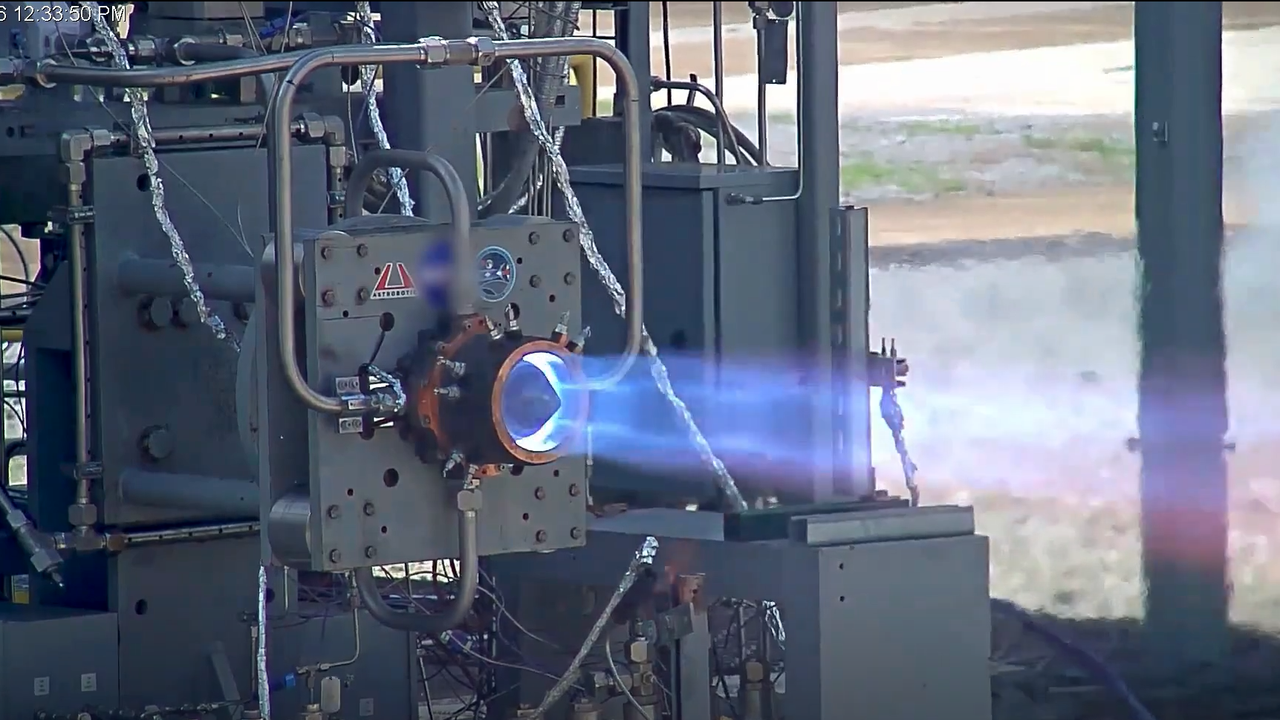
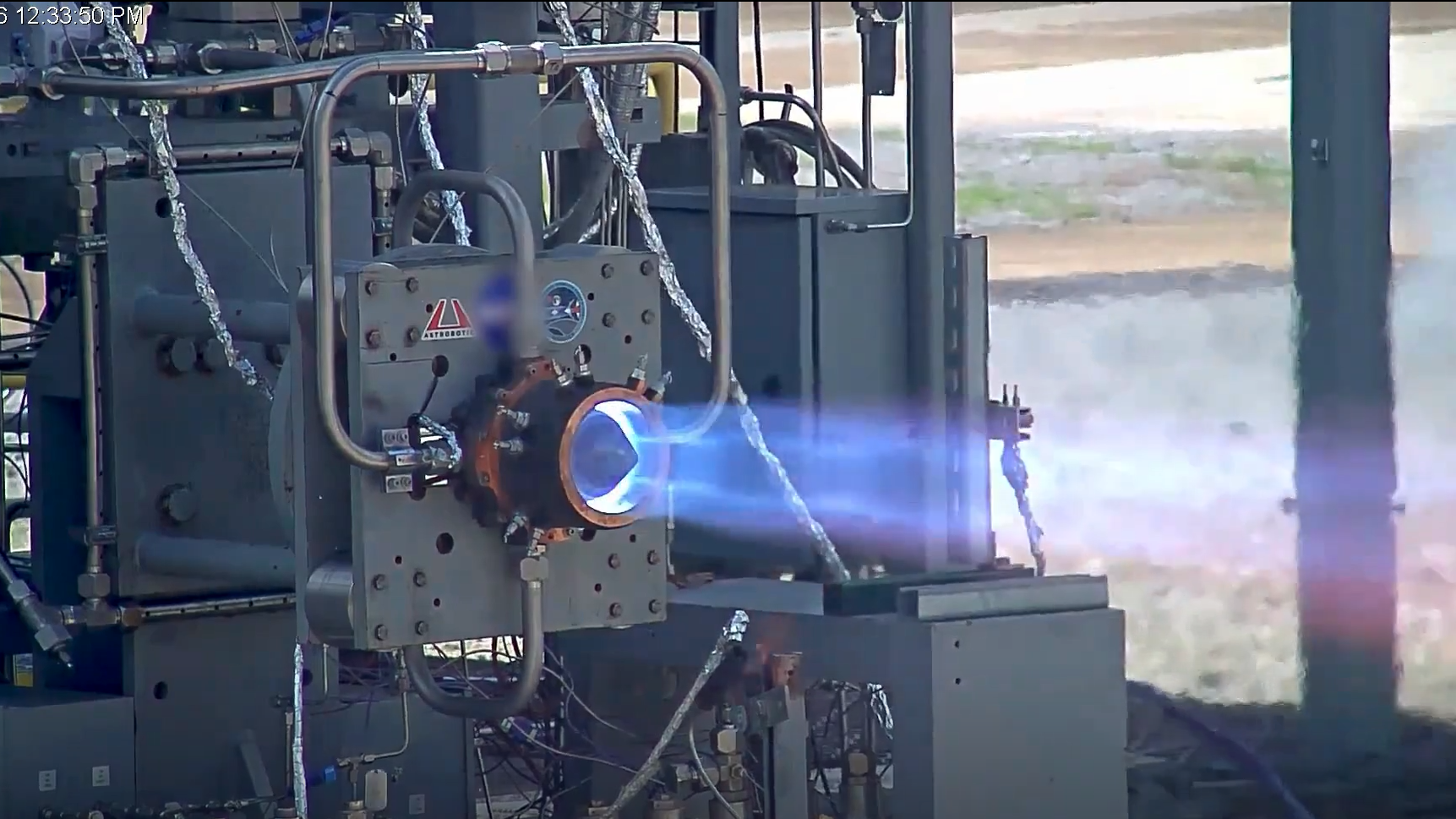
A pointy nozzle on a test stand spits diamonds of fire.

Astrobotic completed the hot fire test campaign for its Chakram RDRE at NASA’s Marshall Space Flight Center. (Image credit: Astrobotic)

“Demonstrations like this show how RDRE technology could support a wide range of Astrobotic missions, from propulsion on future lunar landers to in-space orbital transfer vehicles, and other capabilities that will help expand operations throughout cislunar space.”

The campaign took place at NASA’s Marshall Space Flight Center (MSFC) in Huntsville, Alabama, and used two rotating detonation rocket engine (RDRE) prototypes for long-duration burns that suggest the engine can operate continuously, not just in short, proof-of-concept bursts.

Together, the two Chakram engines accumulated more than 470 seconds of firing time across multiple ignitions, and, in one test, burned continuously for 300 seconds. Astrobotic says that duration is likely the longest sustained firing of a rotating detonation engine to date, and the hardware showed no visible signs of damage afterward.

That kind of performance begins to address one of the biggest open questions around RDREs, and whether the engine design can operate reliably enough for use on actual spacecraft.

Breaking space news, the latest updates on rocket launches, skywatching events and more!

During testing, each Chakram RDRE produced more than 4,000 pounds of thrust, and reached stable, “thermal steady state” conditions, according to an Astrobotic release — indicative of nominal, sustained engine operation. That combination of thrust, stability, and durability marks a meaningful step beyond earlier RDRE demonstrations, which have often been limited in duration.

“The 300-second burn was the cherry on top,“ Avalos said.

Chakram is a significant addition to Astrobotic’s portfolio, and the company is developing Chakram with future missions in mind. Chakram could eventually be used on later versions of its Griffin lunar lander, as well as on planned reusable rockets and an orbital transfer vehicle designed for cislunar operations, according to Astrobotic’s release.


What to read next

Work on the Chakram RDRE has been supported through NASA Small Business Innovation Research (SBIR) contracts and a Space Act Agreement with MSFC. Part of that effort has focused on injector design and advanced manufacturing, including “tunable porosity metal additive manufacturing” — a 3D printing technique that aims to improve thermal management and combustion stability.

The data from this campaign is expected to guide improvements in engine throttling, regenerative cooling, and reducing overall mass as Astrobotic works to transition the engine from testing to flight-ready hardware.

Controlling and maintaining a stable detonation wave over long periods has been a persistent challenge, with many early tests limited to short bursts or unstable operation, but Astrobotic isn’t the first company to take on the challenge.

Venus Aerospace completed an RDRE test flight last year using their own design, and marked the first successful test of such an engine from the U.S.

Tags: rocket launch
No Result
View All Result

Recent Posts

  • Voyager ‘very optimistic’ about Starlab amid potential NASA changes
  • Ukrainian forces test direct-to-device satellite imagery for frontline troops
  • New NGA head makes industry debut at GEOINT Symposium 2026
  • Startup develops software to help military tap commercial imaging satellites
  • Loft Orbital expands into full-service constellation deals

Categories

  • Excursions
  • Kepler Mission
  • NASA
  • NASA Breaking News
  • Physical Preparation
  • Preparation
  • Space News
  • Space Station News
  • Spacewalks
  • Tours
  • Uncategorized
  • Weightlessness Training
  • What Not to Pack
  • What to Pack

Meta

  • Log in
  • Entries feed
  • Comments feed
  • WordPress.org
  • Home
  • Start Here
  • Preparing for Your Trip
  • Space Tourism Companies
  • Space Tours
  • Contact

© 2026 JNews - Premium WordPress news & magazine theme by Jegtheme.

No Result
View All Result
  • About
  • Contact
  • Feeds
  • Frequently Asked Questions
  • Preparing for Your Trip
    • Insurance and Legal Waivers
    • Physical and Medical Requirements
    • Training Programs
    • What to Expect
  • Privacy Policy
  • Space Tourism Companies
    • Axiom Space
    • Blue Origin
    • Blue Origin vs Virgin Galactic
    • Comparison Chart: Features, Pricing, Booking
    • SpaceX
    • Virgin Galactic
    • World View (stratospheric balloon flights)
  • Space Tours
    • Custom & Luxury Packages
    • Duration, Training, Costs
    • Experiences
    • Future Moon/Mars Options
    • Orbital Flights
    • Parabolic Flight Experiences
    • Private Missions
    • Stratospheric Balloon Flights
    • Suborbital Flights
    • Zero-Gravity Flights
  • Spaceflight Technologies
    • Space Tourism Balloon
  • Start Here
    • How to Book a Space Tour
    • Intro to Commercial Spaceflight
    • Is Space Tourism Safe?
    • Space Travel FAQs
    • View Earth from the Edge
    • What to Pack
  • Tours in Space is your launchpad to the world of space tourism

© 2026 JNews - Premium WordPress news & magazine theme by Jegtheme.