• Home
  • About
  • FAQ
  • Feeds
  • Glossary
  • Contact
Tours In Space
  • Home
  • Start Here
    • Intro to Commercial Spaceflight
    • How to Book a Space Tour
    • Is Space Tourism Safe?
    • Space Travel FAQs
    • View Earth from the Edge
    • What to Pack
  • Preparing for Your Trip
    • Insurance and Legal Waivers
    • Physical and Medical Requirements
    • Training Programs
    • What to Expect
  • Space Tourism Companies
    • Axiom Space
    • Blue Origin
    • SpaceX
    • Virgin Galactic
    • World View (stratospheric balloon flights)
    • Blue Origin vs Virgin Galactic
    • Comparison Chart: Features, Pricing, Booking
  • Space Tours
    • Custom & Luxury Packages
    • Duration, Training, Costs
    • Experiences
    • Future Moon/Mars Options
    • Orbital Flights
    • Parabolic Flight Experiences
    • Private Missions
    • Stratospheric Balloon Flights
    • Suborbital Flights
    • Zero-Gravity Flights
  • Spaceflight Technologies
    • Space Tourism Balloon
No Result
View All Result
  • Home
  • Start Here
    • Intro to Commercial Spaceflight
    • How to Book a Space Tour
    • Is Space Tourism Safe?
    • Space Travel FAQs
    • View Earth from the Edge
    • What to Pack
  • Preparing for Your Trip
    • Insurance and Legal Waivers
    • Physical and Medical Requirements
    • Training Programs
    • What to Expect
  • Space Tourism Companies
    • Axiom Space
    • Blue Origin
    • SpaceX
    • Virgin Galactic
    • World View (stratospheric balloon flights)
    • Blue Origin vs Virgin Galactic
    • Comparison Chart: Features, Pricing, Booking
  • Space Tours
    • Custom & Luxury Packages
    • Duration, Training, Costs
    • Experiences
    • Future Moon/Mars Options
    • Orbital Flights
    • Parabolic Flight Experiences
    • Private Missions
    • Stratospheric Balloon Flights
    • Suborbital Flights
    • Zero-Gravity Flights
  • Spaceflight Technologies
    • Space Tourism Balloon
No Result
View All Result
Tours In Space
No Result
View All Result
Home Space News

Scientists learn how much baby stars in Orion weigh — by watching their dance moves

Ensign by Ensign
April 28, 2026
in Space News
0
Scientists learn how much baby stars in Orion weigh — by watching their dance moves
189
SHARES
1.5k
VIEWS
Share on FacebookShare on Twitter

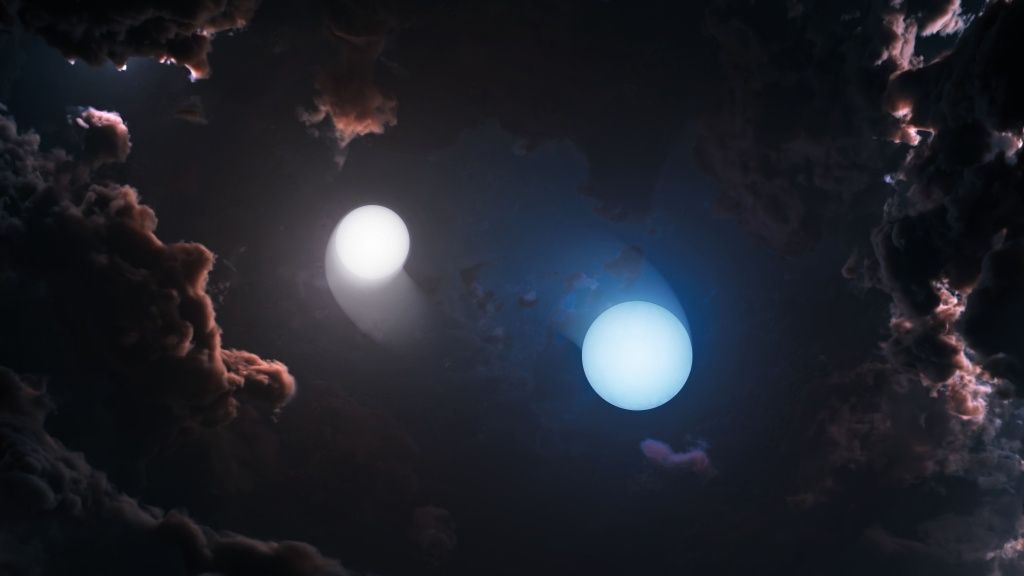
By peering through thick veils of gas and dust, radio astronomers have been able to watch young binary stars orbit around one another in the heart of star-forming clouds — and, in the process, have revealed the stars’ masses.

Stars are born in vast clouds of molecular hydrogen gas laced with heavy elements. When one of these clouds fragments into parts, gravity causes pockets within the fragments to collapse, with the density and temperature at the core of each pocket rising. This births a star that continually accretes more gas and becomes more massive.

But what exactly happens to these baby stars next isn’t always clear (literally) because they are buried deep within clouds of dark, dusty gas that obscure them. This makes it difficult to observe stars at young ages of perhaps just a few hundred thousand to a million or so years old.


You may like

That has been a persistent problem for astronomers seeking to understand how young stars grow and evolve as well as what controls how massive stars become before they switch on, blow away the surrounding gas and stop growing. A star’s mass is perhaps the most crucial property that a star has. Its future evolution depends on its mass, which controls its luminosity, temperature and even overall lifetime. Low-mass stars such as red dwarfs vastly outnumber high-mass stars, a distribution astronomers call the ‘initial mass function’, but why this should be weighted towards lower-mass stars is uncertain — and certainly not helped by the difficulties in observing their growth.

“Stellar mass is the most fundamental property of a star, yet it is notoriously difficult to measure for young, embedded systems,” said lead researcher Sergio A. Dzib Quijano, of the Max Planck Institute for Radio Astronomy in Germany, in a statement.

While visible light and, to an extent, infrared light is blocked by these gas clouds, radio waves can pass through unhindered. So, Quijano’s team used the Very Long Baseline Array (VLBA) — a network of giant radio telescopes spanning the United States — to resolve young stars in the Orion Molecular Complex. This is a huge region of star formation about 1,300 light years away on average. It includes the famous Orion Nebula as well as the Flame Nebula and the Horsehead Nebula, plus Barnard’s Loop, which is a huge arc of molecular gas that spans much of the constellation of Orion as seen in our night sky.

Many stars are formed in binary systems, in which two stars orbit one another around a common center of mass. The VLBA was able to lock onto radio waves from 15 young binary systems within the Orion molecular complex. How the stars in a binary system orbit one another — their orbital period and velocity — depends on the masses of the two stars. Therefore, tracing the orbits of the stars allows astronomers to calculate the masses of the stars, and then compare these to what theoretical work describing the evolution of young protostars says their masses should be.

Space

Quijano’s team was able to track the orbits of the 15 binary systems to millisecond accuracy. This enabled the accurate determination of the masses of the stars in seven of the binary systems. For four of these systems, the observations were sensitive enough to allow the astronomers to measure the masses of the component stars from first principles, independent of any guidance from theoretical models. Of these four systems, the team found that all but one had masses that matched what theory said they should be. This tells us that our models are close, but they could still do with some refining.

“These accurate mass measurements now turn Orion into a precision laboratory for testing how young stars form and evolve,” said Jazmin Ordonez-Toro of the Universidad Nacional Autónoma de México, who is the second author on the paper describing these findings. “These measurements vastly expand our understanding of how stellar neighborhoods like our own are built.”

The findings were published on April 24 in the journal Astronomy & Astrophysics.

No Result
View All Result

Recent Posts

  • Voyager ‘very optimistic’ about Starlab amid potential NASA changes
  • Ukrainian forces test direct-to-device satellite imagery for frontline troops
  • New NGA head makes industry debut at GEOINT Symposium 2026
  • Startup develops software to help military tap commercial imaging satellites
  • Loft Orbital expands into full-service constellation deals

Categories

  • Excursions
  • Kepler Mission
  • NASA
  • NASA Breaking News
  • Physical Preparation
  • Preparation
  • Space News
  • Space Station News
  • Spacewalks
  • Tours
  • Uncategorized
  • Weightlessness Training
  • What Not to Pack
  • What to Pack

Meta

  • Log in
  • Entries feed
  • Comments feed
  • WordPress.org
  • Home
  • Start Here
  • Preparing for Your Trip
  • Space Tourism Companies
  • Space Tours
  • Contact

© 2026 JNews - Premium WordPress news & magazine theme by Jegtheme.

No Result
View All Result
  • About
  • Contact
  • Feeds
  • Frequently Asked Questions
  • Preparing for Your Trip
    • Insurance and Legal Waivers
    • Physical and Medical Requirements
    • Training Programs
    • What to Expect
  • Privacy Policy
  • Space Tourism Companies
    • Axiom Space
    • Blue Origin
    • Blue Origin vs Virgin Galactic
    • Comparison Chart: Features, Pricing, Booking
    • SpaceX
    • Virgin Galactic
    • World View (stratospheric balloon flights)
  • Space Tours
    • Custom & Luxury Packages
    • Duration, Training, Costs
    • Experiences
    • Future Moon/Mars Options
    • Orbital Flights
    • Parabolic Flight Experiences
    • Private Missions
    • Stratospheric Balloon Flights
    • Suborbital Flights
    • Zero-Gravity Flights
  • Spaceflight Technologies
    • Space Tourism Balloon
  • Start Here
    • How to Book a Space Tour
    • Intro to Commercial Spaceflight
    • Is Space Tourism Safe?
    • Space Travel FAQs
    • View Earth from the Edge
    • What to Pack
  • Tours in Space is your launchpad to the world of space tourism

© 2026 JNews - Premium WordPress news & magazine theme by Jegtheme.