• Home
  • About
  • FAQ
  • Feeds
  • Glossary
  • Contact
Tours In Space
  • Home
  • Start Here
    • Intro to Commercial Spaceflight
    • How to Book a Space Tour
    • Is Space Tourism Safe?
    • Space Travel FAQs
    • View Earth from the Edge
    • What to Pack
  • Preparing for Your Trip
    • Insurance and Legal Waivers
    • Physical and Medical Requirements
    • Training Programs
    • What to Expect
  • Space Tourism Companies
    • Axiom Space
    • Blue Origin
    • SpaceX
    • Virgin Galactic
    • World View (stratospheric balloon flights)
    • Blue Origin vs Virgin Galactic
    • Comparison Chart: Features, Pricing, Booking
  • Space Tours
    • Custom & Luxury Packages
    • Duration, Training, Costs
    • Experiences
    • Future Moon/Mars Options
    • Orbital Flights
    • Parabolic Flight Experiences
    • Private Missions
    • Stratospheric Balloon Flights
    • Suborbital Flights
    • Zero-Gravity Flights
  • Spaceflight Technologies
    • Space Tourism Balloon
No Result
View All Result
  • Home
  • Start Here
    • Intro to Commercial Spaceflight
    • How to Book a Space Tour
    • Is Space Tourism Safe?
    • Space Travel FAQs
    • View Earth from the Edge
    • What to Pack
  • Preparing for Your Trip
    • Insurance and Legal Waivers
    • Physical and Medical Requirements
    • Training Programs
    • What to Expect
  • Space Tourism Companies
    • Axiom Space
    • Blue Origin
    • SpaceX
    • Virgin Galactic
    • World View (stratospheric balloon flights)
    • Blue Origin vs Virgin Galactic
    • Comparison Chart: Features, Pricing, Booking
  • Space Tours
    • Custom & Luxury Packages
    • Duration, Training, Costs
    • Experiences
    • Future Moon/Mars Options
    • Orbital Flights
    • Parabolic Flight Experiences
    • Private Missions
    • Stratospheric Balloon Flights
    • Suborbital Flights
    • Zero-Gravity Flights
  • Spaceflight Technologies
    • Space Tourism Balloon
No Result
View All Result
Tours In Space
No Result
View All Result
Home Uncategorized

Space Force taps K2 satellites to test laser communications for missile-defense

Ensign by Ensign
May 1, 2026
in Uncategorized
0
Space Force taps K2 satellites to test laser communications for missile-defense
189
SHARES
1.5k
VIEWS
Share on FacebookShare on Twitter
image

WASHINGTON — The U.S. Space Force plans to use satellites built by K2 Space to test a critical but unresolved piece of future missile-defense systems: how to move large volumes of data quickly between spacecraft and down to Earth.

The California-based company has been selected for the Pentagon’s “OPIR Space Modernization Initiative,” or SMI, a research-and-development program aimed at advancing technologies that could eventually underpin operational missile-detection systems. OPIR, short for overhead persistent infrared, refers to satellites that detect missile launches by tracking heat signatures from space.

“The flagship investment for SMI demonstrations in FY 2026 matures into FY 2027 as the orbital vehicles manufactured by K2 Space complete integration and are launched into MEO,” the Pentagon said in recently released budget documents.

Sign up for First Up: Get the latest updates on SpaceX, Artemis, NASA and more. From Jeff Foust, First Up is a recap of the day’s space industry news, including civil, commercial, and military space developments.

By submitting this form, you agree to the SpaceNews privacy policy and terms and conditions and to receive email from us and our partners. You can opt-out at any time.

At the center of the effort are optical intersatellite crosslinks, laser-based communications designed to transmit data between satellites in low Earth orbit (LEO) and medium Earth orbit (MEO), as well as down to ground stations. “Space-to-space, space-to-ground, and high-throughput long-distance communication links will be tested,” the document said.

Missile-warning systems depend on rapidly moving data from sensors to decision-makers and interceptors, but existing architectures weren’t built for large, distributed constellations. The SMI program has a $180 million budget for fiscal 2027, including $7.3 million earmarked for crosslink demonstrations.

The work would support Golden Dome, a planned missile-defense architecture that relies on a large network of space-based sensors and interceptors to track threats continuously and share targeting data in near real time.

John Plumb, K2’s head of strategy who was previously in charge of space policy at the Defense Department, said the crosslink experiments are “absolutely key to Golden Dome, or any other missile defense architecture that relies on space sensors.” He added that testing in MEO is particularly significant. “That’s a sweet spot for K2.”

Reliable links are essential for missile defense. “You need to move the information that the sensors get fast enough to get it to a shooter, whether that shooter is on the ground, on a ship or in space,” Plumb said.

Crosslinks a technical challenge

While optical crosslinks are already in use in low Earth orbit, most notably by SpaceX, extending the technology to MEO introduces new challenges. “The distances are longer, the radiation environment is different. So it’s a different, harder problem, and we’re going to be the first ones there, really testing it out,” Plumb said.

Commercial interest is also building. “No one has solved the space-to-space data links in MEO,” Plumb said.

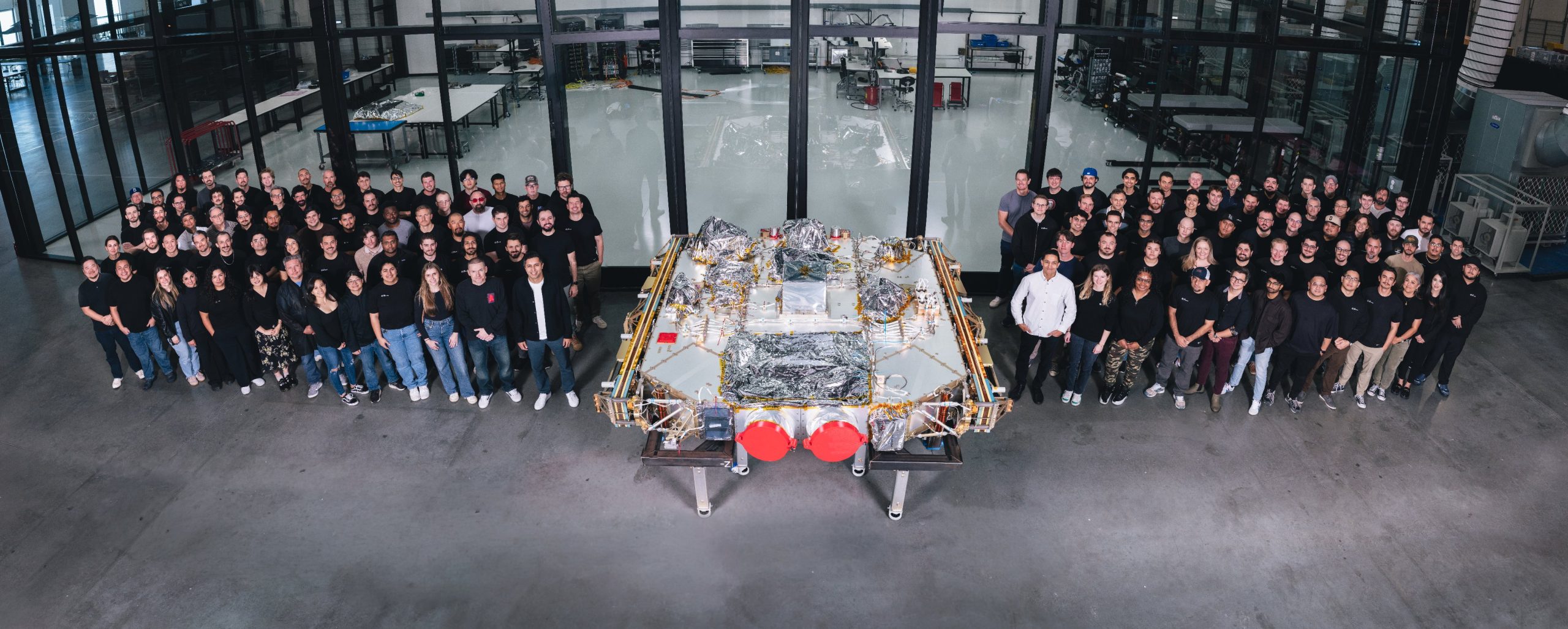
The crosslink tests will be one of several missions K2 plans as it builds out a fleet of satellites. Its first spacecraft, Gravitas, launched March 30. The roughly two-ton satellite, with a 20-kilowatt power system, is designed to demonstrate the company’s “Mega” class platform for high-power, large-aperture payloads. It carried 12 undisclosed payloads and a 20 kW electric thruster intended to raise the spacecraft from LEO to MEO.

“We’re going to launch 10 more of these same things next year,” Plumb said. The satellites will carry government and commercial customer payloads as well as internal research projects.

Plumb said K2 is looking to build flight heritage as it positions itself for military work and prepares to build a commercial constellation for satellite operator SES.

For the Pentagon, the appeal of using commercial platforms is obvious given the financial benefits, he said. “The government is able to test out technologies on satellites that we’re sending up and does not have to spend a whole lot of money.”

The same applies to building satellites, he added. In traditional missile-warning programs, individual satellites can cost $1 billion or more. “For a billion dollars, we can get you a constellation,” Plumb said.

Large, complex satellites still have a role, Plumb said, but there is less appetite for these systems. “Sometimes you need a really exquisite thing, but now, in this world of space as a warfighting domain, one large, exquisite satellite is very vulnerable,” he said. “And I think we’re going to see less and less of these very large, exquisite, expensive satellites.”

Tags: SpaceX
No Result
View All Result

Recent Posts

  • ‘Thor’ hammered down 15 years ago, and it’s still the only Marvel movie to do the God of Thunder justice
  • Sci-fi RPG ‘Exodus”s combat looks and feels like ‘Mass Effect’, but the dialogue system could be a big upgrade (video)
  • Nikon Action 7×50 binoculars review
  • Why does NASA’s Curiosity rover have a ‘lucky penny’ on Mars? | Space photo of the day for May 6, 2026
  • Voyager ‘very optimistic’ about Starlab amid potential NASA changes

Categories

  • Excursions
  • Kepler Mission
  • NASA
  • NASA Breaking News
  • Physical Preparation
  • Preparation
  • Space News
  • Space Station News
  • Spacewalks
  • Tours
  • Uncategorized
  • Weightlessness Training
  • What Not to Pack
  • What to Pack

Meta

  • Log in
  • Entries feed
  • Comments feed
  • WordPress.org
  • Home
  • Start Here
  • Preparing for Your Trip
  • Space Tourism Companies
  • Space Tours
  • Contact

© 2026 JNews - Premium WordPress news & magazine theme by Jegtheme.

No Result
View All Result
  • About
  • Contact
  • Feeds
  • Frequently Asked Questions
  • Preparing for Your Trip
    • Insurance and Legal Waivers
    • Physical and Medical Requirements
    • Training Programs
    • What to Expect
  • Privacy Policy
  • Space Tourism Companies
    • Axiom Space
    • Blue Origin
    • Blue Origin vs Virgin Galactic
    • Comparison Chart: Features, Pricing, Booking
    • SpaceX
    • Virgin Galactic
    • World View (stratospheric balloon flights)
  • Space Tours
    • Custom & Luxury Packages
    • Duration, Training, Costs
    • Experiences
    • Future Moon/Mars Options
    • Orbital Flights
    • Parabolic Flight Experiences
    • Private Missions
    • Stratospheric Balloon Flights
    • Suborbital Flights
    • Zero-Gravity Flights
  • Spaceflight Technologies
    • Space Tourism Balloon
  • Start Here
    • How to Book a Space Tour
    • Intro to Commercial Spaceflight
    • Is Space Tourism Safe?
    • Space Travel FAQs
    • View Earth from the Edge
    • What to Pack
  • Tours in Space is your launchpad to the world of space tourism

© 2026 JNews - Premium WordPress news & magazine theme by Jegtheme.