

by Robert Schreiber
Berlin, Germany (SPX) May 01, 2026
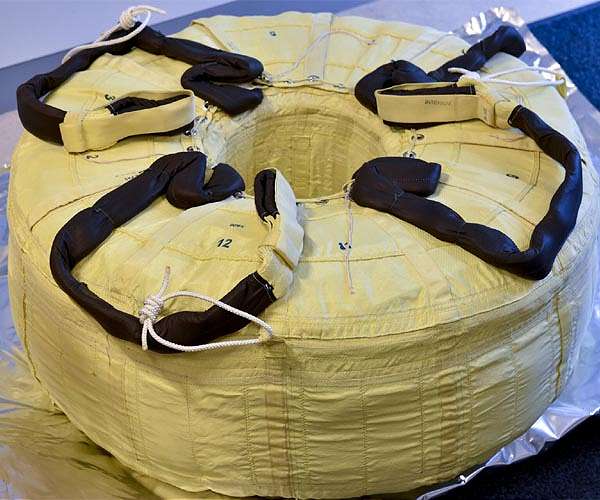
A 35-metre diameter parachute destined to slow the ExoMars Rosalind Franklin rover during its descent through the Martian atmosphere has undergone heat sterilisation at the European Space Agency’s technical centre in the Netherlands, completing a critical planetary protection milestone ahead of the mission’s 2028 launch.
The parachute, weighing 74 kilograms and constructed primarily from nylon and Kevlar fabrics, will be the largest ever flown on Mars – or anywhere else in the Solar System outside of Earth. During entry, it must endure a six-minute dive through the thin Martian atmosphere before delivering the rover safely to the surface.
Sterilisation was carried out in a specialised dry heater oven at ESA’s Life Support and Physical Sciences Laboratory at ESTEC in Noordwijk. The process required the parachute to reach 125 degrees Celsius and hold that temperature for 36 hours, preceded by a 50-hour preheating phase to ensure the heat penetrated the innermost folds of the tightly packed canopy. The parameters were established through multiple rounds of testing on exact replica parachutes, as no established procedure existed for the task.
The sterilisation standard imposed on the parachute is exceptionally stringent. Under international planetary protection requirements, the hardware must be at least 10,000 times cleaner than a typical smartphone. The concern is twofold: terrestrial microbes hardy enough to survive interplanetary transit could interfere with the rover’s search for signs of life by causing false-positive detections, and planetary protection obligations require that Mars itself be shielded from biological contamination originating on Earth.
The oven used for baking is housed inside an ISO Class 1 cleanroom at ESTEC – among the most contamination-controlled environments in Europe. All air in the facility is continuously processed through a two-stage filter system, and personnel entering the room must follow gowning procedures more rigorous than surgical standards and pass through an air shower to remove particulates.
After cooling for several hours inside the cleanroom, the parachute was packaged by suited technicians and sealed inside a protective wrapping. It was then transported to Thales Alenia Space in Turin, Italy, where it will await integration with the spacecraft.
The flight parachute passed a key deployment test the previous year, when a precise copy was released from a high-altitude balloon and successfully decelerated an ExoMars mock-up landing platform to a safe touchdown on Earth.
The ExoMars Rosalind Franklin mission is scheduled for launch in 2028. The rover will spend more than 25 months in transit before arriving at Mars, where its primary objective is to drill beneath the Martian surface in search of chemical or biological indicators of past or present life.
Related Links
European Space Agency
Mars News and Information at MarsDaily.com
Lunar Dreams and more