• Home
  • About
  • FAQ
  • Feeds
  • Glossary
  • Contact
Tours In Space
  • Home
  • Start Here
    • Intro to Commercial Spaceflight
    • How to Book a Space Tour
    • Is Space Tourism Safe?
    • Space Travel FAQs
    • View Earth from the Edge
    • What to Pack
  • Preparing for Your Trip
    • Insurance and Legal Waivers
    • Physical and Medical Requirements
    • Training Programs
    • What to Expect
  • Space Tourism Companies
    • Axiom Space
    • Blue Origin
    • SpaceX
    • Virgin Galactic
    • World View (stratospheric balloon flights)
    • Blue Origin vs Virgin Galactic
    • Comparison Chart: Features, Pricing, Booking
  • Space Tours
    • Custom & Luxury Packages
    • Duration, Training, Costs
    • Experiences
    • Future Moon/Mars Options
    • Orbital Flights
    • Parabolic Flight Experiences
    • Private Missions
    • Stratospheric Balloon Flights
    • Suborbital Flights
    • Zero-Gravity Flights
  • Spaceflight Technologies
    • Space Tourism Balloon
No Result
View All Result
  • Home
  • Start Here
    • Intro to Commercial Spaceflight
    • How to Book a Space Tour
    • Is Space Tourism Safe?
    • Space Travel FAQs
    • View Earth from the Edge
    • What to Pack
  • Preparing for Your Trip
    • Insurance and Legal Waivers
    • Physical and Medical Requirements
    • Training Programs
    • What to Expect
  • Space Tourism Companies
    • Axiom Space
    • Blue Origin
    • SpaceX
    • Virgin Galactic
    • World View (stratospheric balloon flights)
    • Blue Origin vs Virgin Galactic
    • Comparison Chart: Features, Pricing, Booking
  • Space Tours
    • Custom & Luxury Packages
    • Duration, Training, Costs
    • Experiences
    • Future Moon/Mars Options
    • Orbital Flights
    • Parabolic Flight Experiences
    • Private Missions
    • Stratospheric Balloon Flights
    • Suborbital Flights
    • Zero-Gravity Flights
  • Spaceflight Technologies
    • Space Tourism Balloon
No Result
View All Result
Tours In Space
No Result
View All Result
Home Uncategorized

Interlune wins NASA contract for helium-3 extraction payload

Ensign by Ensign
May 5, 2026
in Uncategorized
0
Interlune wins NASA contract for helium-3 extraction payload
189
SHARES
1.5k
VIEWS
Share on FacebookShare on Twitter
image

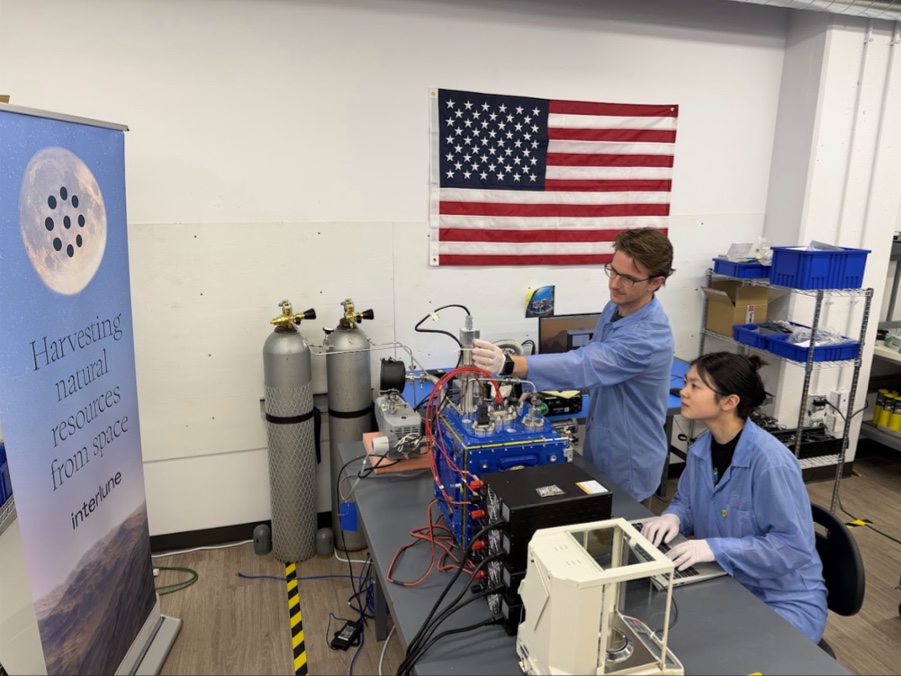
WASHINGTON — Interlune, a startup with plans to harvest helium-3 from the moon, has won a NASA contract to develop a payload to test ways to extract the valuable isotope from lunar regolith.

The company announced May 4 it won a Small Business Innovation Research Phase 3 contract from the agency worth $6.9 million. The contract, from NASA’s Space Technology Mission Directorate’s Game Changing Development program, funds development of a payload to be flown on a future lander mission.

“This is going to be the first time that solar wind volatiles have been extracted from lunar regolith in situ on the moon,” Rob Meyerson, chief executive of Interlune, said in an interview.

Sign up for First Up: Get the latest updates on SpaceX, Artemis, NASA and more. From Jeff Foust, First Up is a recap of the day’s space industry news, including civil, commercial, and military space developments.

By submitting this form, you agree to the SpaceNews privacy policy and terms and conditions and to receive email from us and our partners. You can opt-out at any time.

The payload, called Prospect Moon, will include a robotic arm that scoops regolith into the instrument. One sample will be heated to measure volatile gases, such as helium-3 and hydrogen, that are released. Other samples will be subjected to mechanical processing, including size sorting as well as agitation and crushing.

“We’ll calibrate the processes that we eventually want to use on the moon for a full-scale resource extraction operation,” he said. “It will measure the efficiency of our process so that we can use that to go build larger-scale hardware.”

Prospect Moon will be ready to be integrated onto a lunar lander in the fall of 2027 for a 2028 launch. Meyerson said the company is evaluating several lander mission options, with a preference for missions going to the lunar equatorial regions.

Interlune wants to take advantage of a proposed surge of lander missions NASA announced in March as part of a revised lunar exploration plan that includes development of a lunar base. He said the payload is relatively inexpensive to build, enabling the company to produce several copies of it that could be flown on different landers.

“It’s directly related to so many of the things that NASA has as objectives for Artemis and the moon base,” he said. “We think we have a good shot at getting a flight selected as part of the new program.”

This payload will not be Interlune’s first to go to the moon. The company announced last year an agreement to fly a camera on Astrolab’s FLIP rover. The camera will look for concentrations of ilmenite, a mineral considered a proxy for helium-3.

That camera, called Crescent Moon, was delivered to Astrolab, Meyerson said, and is being integrated onto the FLIP rover scheduled to launch later this year on Astrobotic’s Griffin-1 lander.

He said Interlune has seen strong demand for helium-3, with contracts from the Department of Energy as well as quantum computing companies Maybell Quantum and Bluefors worth about $500 million. “It is a strong signal that there is a market for helium-3,” he said. “We have letters of intent for quite a bit more that we’re working to convert to contracts.”

Some of those contracts require starting deliveries of helium-3 in 2028, well before Interlune is ready to harvest the isotope from the moon. The company is working on terrestrial sources of helium-3, including technology to extract the trace amounts of helium-3 present in industrial-grade, or “Grade A,” helium commercially available.

He acknowledged “it’s going to take a few years” to start extracting helium-3 from the moon even if the 2028 Prospect Moon mission is successful. “It’s going to be in the early 2030s when we’re up and operating,” he said. “No earlier than that.”

Meyerson said he does not expect Interlune’s helium-3 mining operations on the moon to be directly a part of NASA’s proposed lunar base because of its location at the south polar region of the moon, which is not a preferred location for the company. However, he said Interlune could leverage many of the technologies and capabilities that would be developed for the base, while the base could make use of Interlune’s technologies.

“The moon base is going to be essential to us, whether we’re operating adjacent to the moon base or not,” he said. “We can serve, and we do serve, as a commercial partner and commercial use case for anyone that’s building infrastructure on the moon.”

Tags: NASA
No Result
View All Result

Recent Posts

  • ‘Thor’ hammered down 15 years ago, and it’s still the only Marvel movie to do the God of Thunder justice
  • Sci-fi RPG ‘Exodus”s combat looks and feels like ‘Mass Effect’, but the dialogue system could be a big upgrade (video)
  • Nikon Action 7×50 binoculars review
  • Why does NASA’s Curiosity rover have a ‘lucky penny’ on Mars? | Space photo of the day for May 6, 2026
  • Voyager ‘very optimistic’ about Starlab amid potential NASA changes

Categories

  • Excursions
  • Kepler Mission
  • NASA
  • NASA Breaking News
  • Physical Preparation
  • Preparation
  • Space News
  • Space Station News
  • Spacewalks
  • Tours
  • Uncategorized
  • Weightlessness Training
  • What Not to Pack
  • What to Pack

Meta

  • Log in
  • Entries feed
  • Comments feed
  • WordPress.org
  • Home
  • Start Here
  • Preparing for Your Trip
  • Space Tourism Companies
  • Space Tours
  • Contact

© 2026 JNews - Premium WordPress news & magazine theme by Jegtheme.

No Result
View All Result
  • About
  • Contact
  • Feeds
  • Frequently Asked Questions
  • Preparing for Your Trip
    • Insurance and Legal Waivers
    • Physical and Medical Requirements
    • Training Programs
    • What to Expect
  • Privacy Policy
  • Space Tourism Companies
    • Axiom Space
    • Blue Origin
    • Blue Origin vs Virgin Galactic
    • Comparison Chart: Features, Pricing, Booking
    • SpaceX
    • Virgin Galactic
    • World View (stratospheric balloon flights)
  • Space Tours
    • Custom & Luxury Packages
    • Duration, Training, Costs
    • Experiences
    • Future Moon/Mars Options
    • Orbital Flights
    • Parabolic Flight Experiences
    • Private Missions
    • Stratospheric Balloon Flights
    • Suborbital Flights
    • Zero-Gravity Flights
  • Spaceflight Technologies
    • Space Tourism Balloon
  • Start Here
    • How to Book a Space Tour
    • Intro to Commercial Spaceflight
    • Is Space Tourism Safe?
    • Space Travel FAQs
    • View Earth from the Edge
    • What to Pack
  • Tours in Space is your launchpad to the world of space tourism

© 2026 JNews - Premium WordPress news & magazine theme by Jegtheme.