
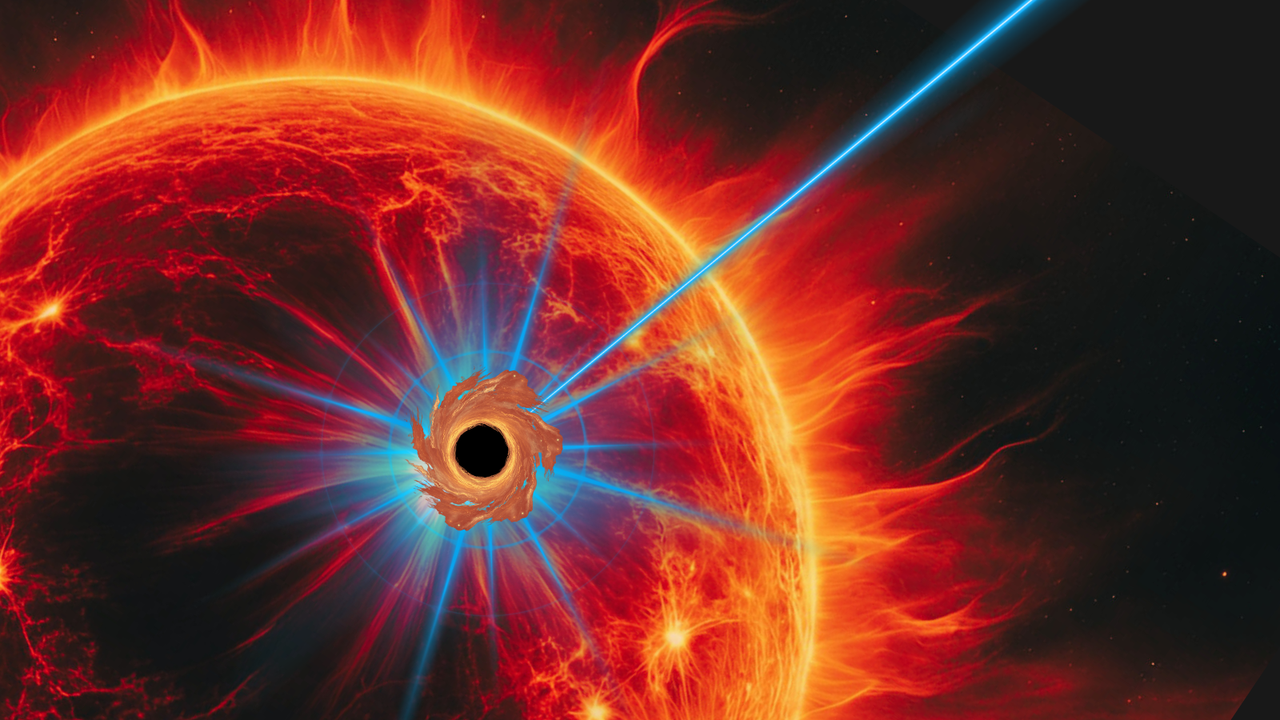

Out in the universe, there exist mysterious and powerful bright blue cosmic explosions called Luminous Fast Blue Optical Transients (LFBOT) — and new research may finally have some answers as to where these strange blasts come from.
The first of these explosions was spotted in 2018, and only 14 have been detected since, leading to a solid mystery for astronomers. Now, however, the team behind the new research believes the events are caused when a compact stellar remnant, like a black hole or a neutron star, slams into the universe’s hottest class of star, massive stellar bodies called Wolf-Rayet stars.
Those other proposed potential origins for LFBOTs range from the death of massive stars in so-called core-collapse supernovas to extreme tidal disruption events (TDEs), involving very massive black holes ripping up and devouring stars. To get to the bottom of things, though, the team behind the new research examined the host galaxies and environments of LFBOTs to try to pin down what the progenitors of these explosive events could really be. This analysis revealed that LFBOTs emerge from very different environments than those generated by some of those suggested supernova scenarios, and do not occur in the environments generally expected for tidal disruption events.
“Because LFBOTs are so rare and their light-curve properties are so different than many other transients, it is hard to pin down what their progenitors are! They obviously represent some unique astrophysical phenomena, but what that could be has remained an open question,” research team leader Anya Nugent of Harvard University’s Center for Astrophysics (CfA) told Space.com. The model Nugent and colleagues have homed in on for LFBOTs is the collision of a compact stellar remnant with the leftover helium core from a massive star that has had its outer hydrogen envelope ripped off — a Wolf-Rayet star.
“We think that describes both the transient and host properties well,” she explained.
What leaves Wolf-Rayet stars feeling blue?
As opposed to the other models meant to explain LFBOTs like TDEs and core-collapse supernovas, the team’s proposed compact object and Wolf-Rayet merger model does appear to easily justify all of the LFBOT transient and environmental properties, Nugent pointed out.
Nugent explained that the mergers may prefer more star-forming and less massive galaxies as host environments, unlike core collapse supernovas which tend to occur in more stellar-dense massive galaxies. These, she said, are perfect for creating binary systems that begin as two massive stars with one stripping the other of stellar matter, turning the “donor” into a Wolf-Rayet star. That donor star eventually pushes the “cannibal” star toward the core-collapse supernova that will turn it into a black hole or neutron star. Eventually, the Wolf-Rayet star and its stellar remnant companion will merge to launch an LFBOT. That’s important because though binary stars are common, not just any binary system could launch an LFBOT.
“Many massive stars are in binary systems, but these mergers occur in just the right conditions that they don’t merge with each other too early on in their evolution, but the stars are still close enough together that they can merge,” Nugent said.
In the team’s binary merger model, the compact object is close enough to its stellar companion to rip off its outer hydrogen layer without completely destroying the star. After hundreds to thousands of years, the feeding black hole or neutron star falls into the stellar core and destroys it, creating a luminous emission.
“This merger model will be rare, similar to the rate of LFBOTs, but not so rare that we would never expect it to happen,” she added. “Essentially, these environments are perfect for creating the binary systems that will merge in this way.”
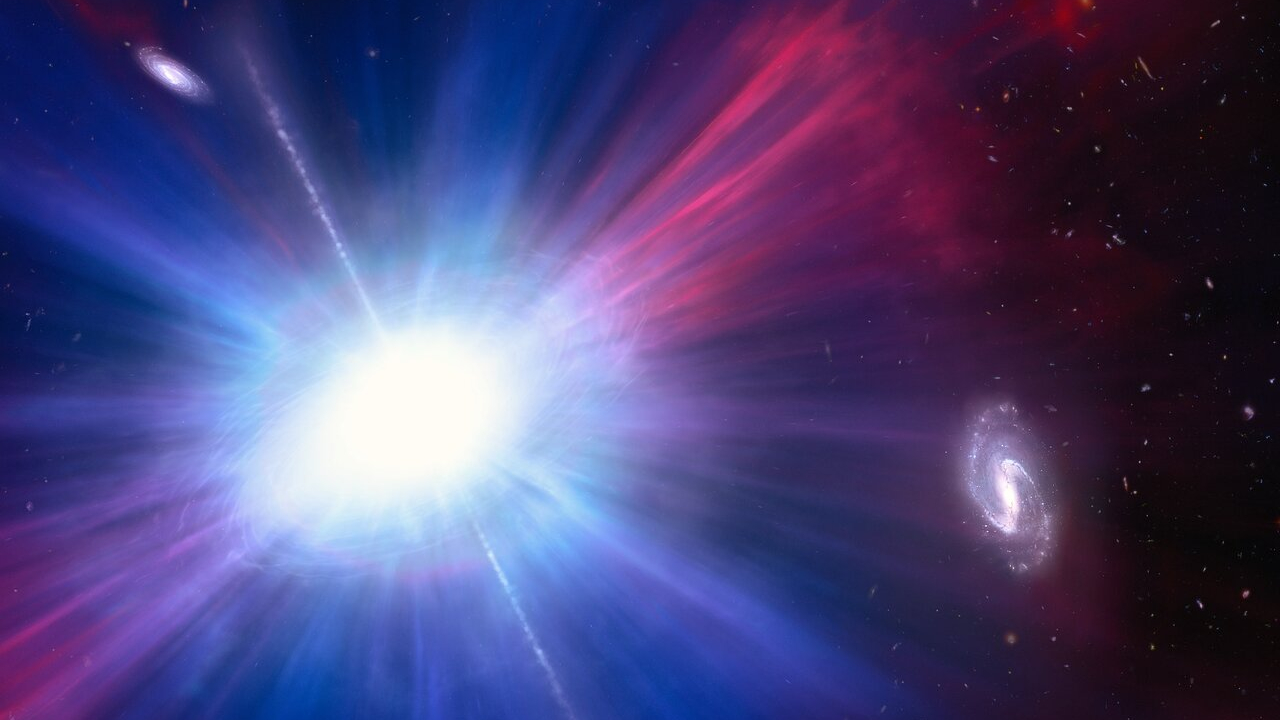
The team also theorizes why LFBOTs don’t seem to originate in densely packed star fields where black hole or neutron star collisions with Wolf-Rayet stars would more commonly occur.
Nugent and the team justify this by assuming the collapse of the first star in a binary system that forms the compact object, be it a black hole or a neutron star, may give the entire system a “kick” that serves to push it away from densely packed star-forming regions to more sparsely populated regions of galaxies.
“Thus, we also have justification for why LFBOTs appear to be more offset from their hosts, exploding in regions where there are very few stars, away from their birthsite, than core-collapse supernovas,” Nugent said.
The team favors their Wolf-Rayet meets stellar remnant collision LFBOT origin model because they reason that the TDE and supernova models have struggled to explain all of the observed properties of these blasts. For example, LFBOTs occur in very dense “circumstellar environments.” These are regions in which stars are looped by loose material, which is likely the result of the progenitor star blasting off material in the past.
“This cannot be explained easily with the TDE model or even some of the supernova models,” Nugent said. “Moreover, LFBOTs have different properties and occur in different environments than TDEs and supernovas, so the big question is, if they are all coming from the same things, what is causing this distinction?”
Nugent reasons the most plausible explanation is that LFBOTs come from an entirely different channel and for the team, a neutron star or black hole slamming into a Wolf-Rayet star seems to a good fit for all the observed properties of LFBOTs.
Nugent acknowledges, however, that this origin model can only be robustly investigated once astronomers have grown the population of known LFBOTs. That discovery operation is something that Nugent expects the Vera C. Rubin Observatory and its newly begun decade-long Legacy Survey of Space and Time (LSST) to play a major role in.
“Rubin will be amazing for discovering fainter LFBOTs out to even further cosmological distances, which will not only give us a larger population but will show us how LFBOTs and their progenitors have evolved over cosmic time,” she concluded.
A pre-peer-reviewed version of the team’s results is available on the research repository site arXiv.