


WASHINGTON — Since SpaceX disrupted the satellite communications market with low-latency broadband from low Earth orbit, traditional satellite operators have promoted “multi-orbit” architectures that combine low Earth orbit, medium Earth orbit and geostationary satellites into integrated communications systems designed to survive outages, attacks and congestion. The Pentagon has largely embraced the concept as it looks for ways to reduce dependence on any single commercial provider.
Now a San Francisco startup is arguing the industry may have overcomplicated the problem.
Contrivian, a telecommunications software company founded in 2023, is arguing that stitching together satellites operating at vastly different altitudes introduces technical complications that degrade performance for modern internet applications. Instead, the company says future military communications networks should rely primarily on multiple LEO constellations operating together.
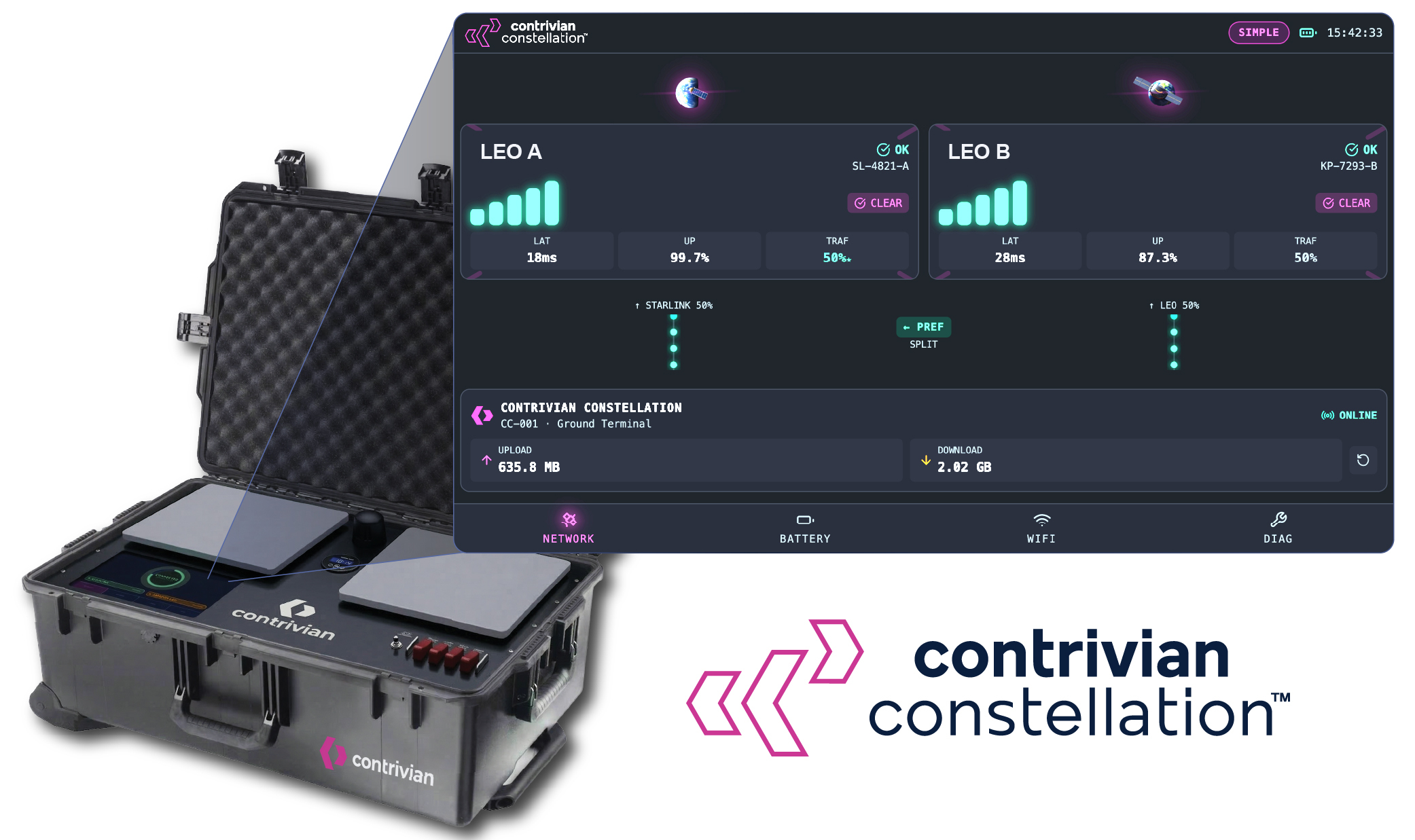
The company recently launched a platform called Contrivian Constellation that dynamically routes traffic among different LEO providers, including Starlink and Amazon, under a single managed service. The system is now being tested with U.S. Special Operations Forces, whose missions often depend on maintaining communications in contested environments.
The debate gets at a larger question of whether resilience comes from layering together every available orbit or from making proliferated LEO systems interchangeable enough that users no longer depend on any one provider.
Global satellite operators have largely aligned around the multi-orbit approach. Companies across the industry are integrating newer LEO capabilities with existing fleets of medium-orbit and geostationary satellites, which orbit roughly 22,000 miles above Earth.
Contrivian’s chief executive Grant Kirkwood argues those architectures create performance problems rooted in basic physics.
A LEO broadband system typically delivers round-trip latency near 40 milliseconds, close enough to terrestrial internet speeds that users generally don’t notice delays. GEO systems can exceed 600 milliseconds because signals must travel much farther.
That difference becomes significant when applications suddenly switch between orbital layers during what network engineers call failover events, when traffic automatically moves from one connection path to another after degradation or interruption.
“When traffic suddenly shifts from a low-latency LEO path to a high-latency GEO path during failover, applications can break or degrade abruptly because the network characteristics change,” Kirkwood said.
The issue affects the TCP/IP networking framework that underpins most internet traffic. Applications optimized for low-latency connections can behave unpredictably when delays increase sharply. Video calls freeze, cloud applications slow and some network sessions reset entirely.
“There is no TCP-based application that works better with more latency,” Kirkwood said.
Mapping network from ground sensors
Contrivian’s argument is that combining multiple LEO systems avoids those disruptions because all operate within roughly similar latency ranges. The company says a network shifting between Starlink, Amazon Leo or future LEO constellations can maintain consistent performance without forcing applications to adapt to radically different network conditions.
The company’s software relies on distributed monitoring points on the ground that continuously measure latency and network behavior across available links. The system builds a real-time map of network conditions and routes traffic accordingly.
For military customers, Contrivian packages the technology into a ruggedized case slightly larger than a carry-on suitcase. Inside are terminals for multiple constellations, batteries, routers and a computer running the company’s orchestration software.
“You push the power button and wait three or four minutes while it connects to the different constellations, and then it starts routing the traffic,” Kirkwood said.
The company’s thesis depends heavily on how the LEO broadband market develops over the next several years.
Today, Starlink dominates the sector. Eutelsat operates a smaller network focused more heavily on enterprise and government customers. In many regions there still aren’t enough mature LEO alternatives for dynamic multi-constellation networking to deliver its full promise.
That could change as Amazon expands its constellation and Telesat prepares to launch Lightspeed service in 2027.
As more constellations come online, Kirkwood believes the value in satellite communications will shift away from individual operators toward software platforms capable of managing traffic across many networks behind the scenes.
The Pentagon’s growing use of commercial broadband gives the argument added urgency. Military officials have increasingly worried about concentration risk around Starlink even as the service becomes deeply embedded in defense operations.
Contrivian is betting that the solution is not more orbital diversity, but more provider diversity inside the same orbital layer.
Not everyone is likely to agree. GEO satellites remain valuable for applications requiring broad persistent coverage, and their stationary position means they avoid the constant handoffs inherent in LEO networks. Military users are expected to continue relying on GEO systems for communications and broadcasting.
The deeper question now confronting the industry, Kirkwood said, is whether greater resilience comes from layering together every available orbit or from making proliferated LEO networks interchangeable enough that users no longer care which constellation carries the traffic.