

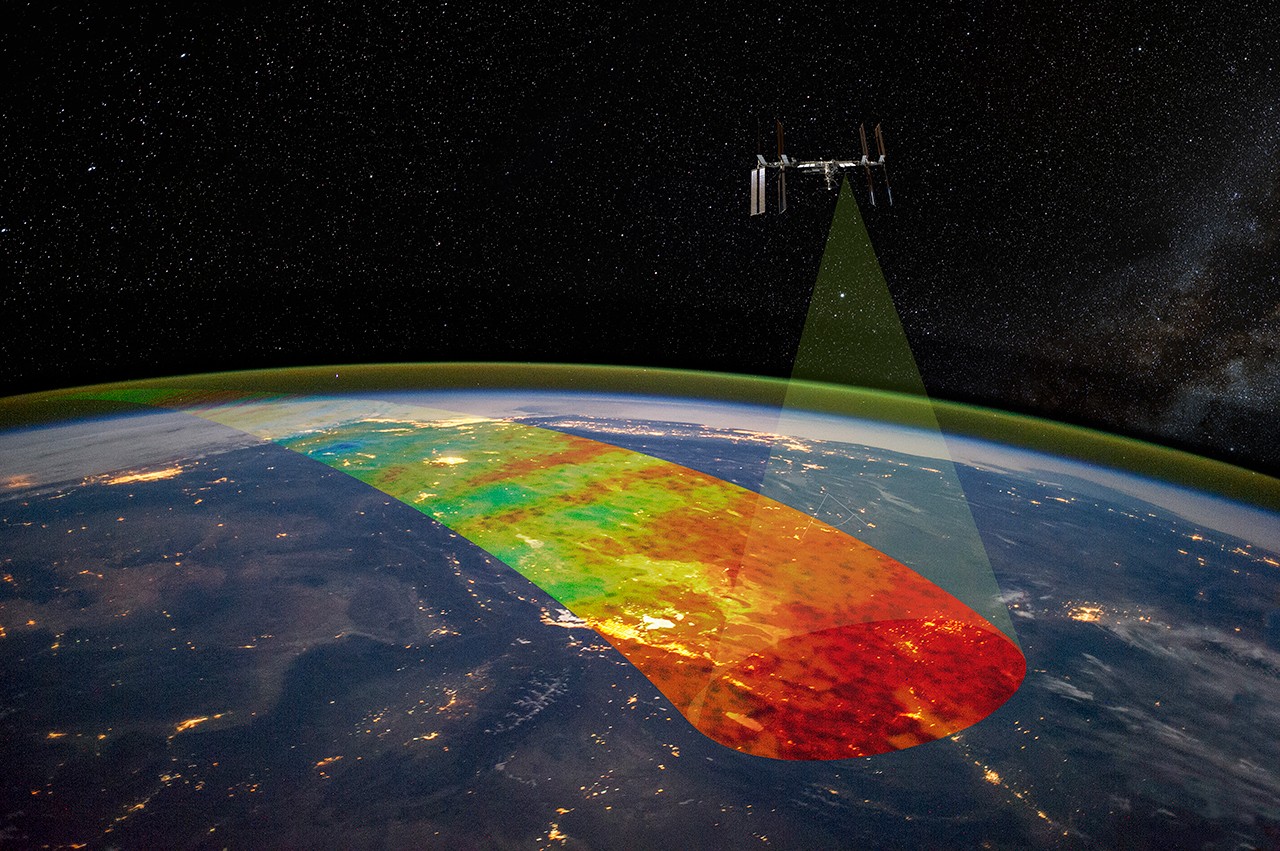
On May 21, ground controllers powered down NASA’s AWE (Atmospheric Waves Experiment) instrument, bringing the data collection phase of the mission to a successful and scheduled end, surpassing its planned two-year mission.
Installed on the exterior of the International Space Station since November 2023, AWE studied atmospheric gravity waves, which are giant ripples in the atmosphere caused by strong winds flowing over tall mountains or by violent weather events, such as tornadoes, thunderstorms, and hurricanes. The AWE instrument looked for these waves in colorful bands of light in Earth’s atmosphere, called airglow. Funded by NASA’s Heliophysics Division, AWE investigated how atmospheric gravity waves propagate upward to space and contribute to space weather — conditions in space that can disrupt satellites, as well as navigation and communications signals.
“The AWE mission has proven that our atmosphere is not a ceiling, but a living, breathing ocean in the sky,” said Joe Westlake, director of NASA’s Heliophysics Division at NASA Headquarters in Washington. “For the first time, we can see how a thunderstorm in the Midwest, a hurricane over Florida, or a wind gust over the Andes sends invisible ripples — atmospheric gravity waves — crashing into the edge of space like waves hitting a shoreline. By mapping these ripples from the International Space Station, we’ve discovered that Earth’s weather doesn’t just end at the clouds, instead it reaches out beyond our planet, shaping the space weather that impacts our orbital economy.”
During AWE’s 30-month residency on the station, the instrument captured four infrared images every second, tallying more than 80 million nighttime images, which is when airglow can be seen. It observed atmospheric gravity waves from numerous extreme weather events, including a tornado outbreak across the central U.S. in May 2024 and Hurricane Helene impacting the gulf coast of Florida in September 2024.
“We’ve seen atmospheric wave signatures associated with major terrestrial events, which provided a clear example of how intense weather systems can generate measurable upper-atmospheric responses,” said AWE’s principal investigator, Ludger Scherliess of Utah State University in Logan.
These events revealed variations in the types of atmospheric gravity waves created by different kinds of storms. For example, when AWE viewed atmospheric gravity waves generated by a thunderstorm in north Texas on May 26, 2024, it saw they were smaller and more irregular, with a notable asymmetry from north to south, compared to waves created by storms in the same part of the country earlier that month.
It is important to understand variations in the density of plasma, which is electrically charged gas, in Earth’s upper atmosphere instigated by atmospheric gravity waves, because these variations can disrupt radio signals traveling between satellites and the ground, and from satellite to satellite, degrading the accuracy and reliability of systems used for navigation, timing, and communications.
In a recent study, AWE measurements also revealed the gravity waves with the greatest influence on the upper atmosphere have small horizontal wavelengths, ranging from 30 to 300 kilometers, which AWE was specifically designed to measure.
With its data-collection phase complete, the AWE instrument was turned off to make way for another science experiment that will take its place on the outside of the space station. Called CLARREO Pathfinder (Calibration Absolute Radiance and Refractivity Observatory Pathfinder), the new instrument will take measurements of sunlight reflected by Earth and the Moon that are five to 10 times more accurate than those from existing sensors. The exchange of instruments is a key part of the space station’s mission and versatility as an orbiting laboratory for various types of research.
In the coming days, a robotic arm on the space station, called Canadarm2, will remove the AWE instrument from its location. Soon afterward, the AWE instrument will be loaded into part of a SpaceX Dragon cargo spacecraft that will deorbit and burn up as it re-enters the atmosphere. However, all of AWE’s observations will ultimately become available to the public and the scientific community for ongoing research and discovery.
“Data from AWE will continue to be made public for both professional researchers and citizen scientists,” Scherliess said.
Some of this data already is available, including interactive, online visualizations on Utah State University’s website, where AWE’s observations are “painted” in swaths onto a globe or on a map as the space station orbits the planet. Users can rotate the visualizations to view atmospheric gravity waves from different angles.
Launched on Nov. 9, 2023, AWE is managed by the Explorers Program Office at NASA’s Goddard Space Flight Center in Greenbelt, Maryland. Utah State University’s Space Dynamics Laboratory built the AWE instrument and provided the mission operations center.
Hear more about AWE by listening to episode 334 of NASA’s Houston We Have a Podcast, recorded on Jan. 26, 2024.
By Vanessa Thomas
NASA’s Goddard Space Flight Center, Greenbelt, Md.