

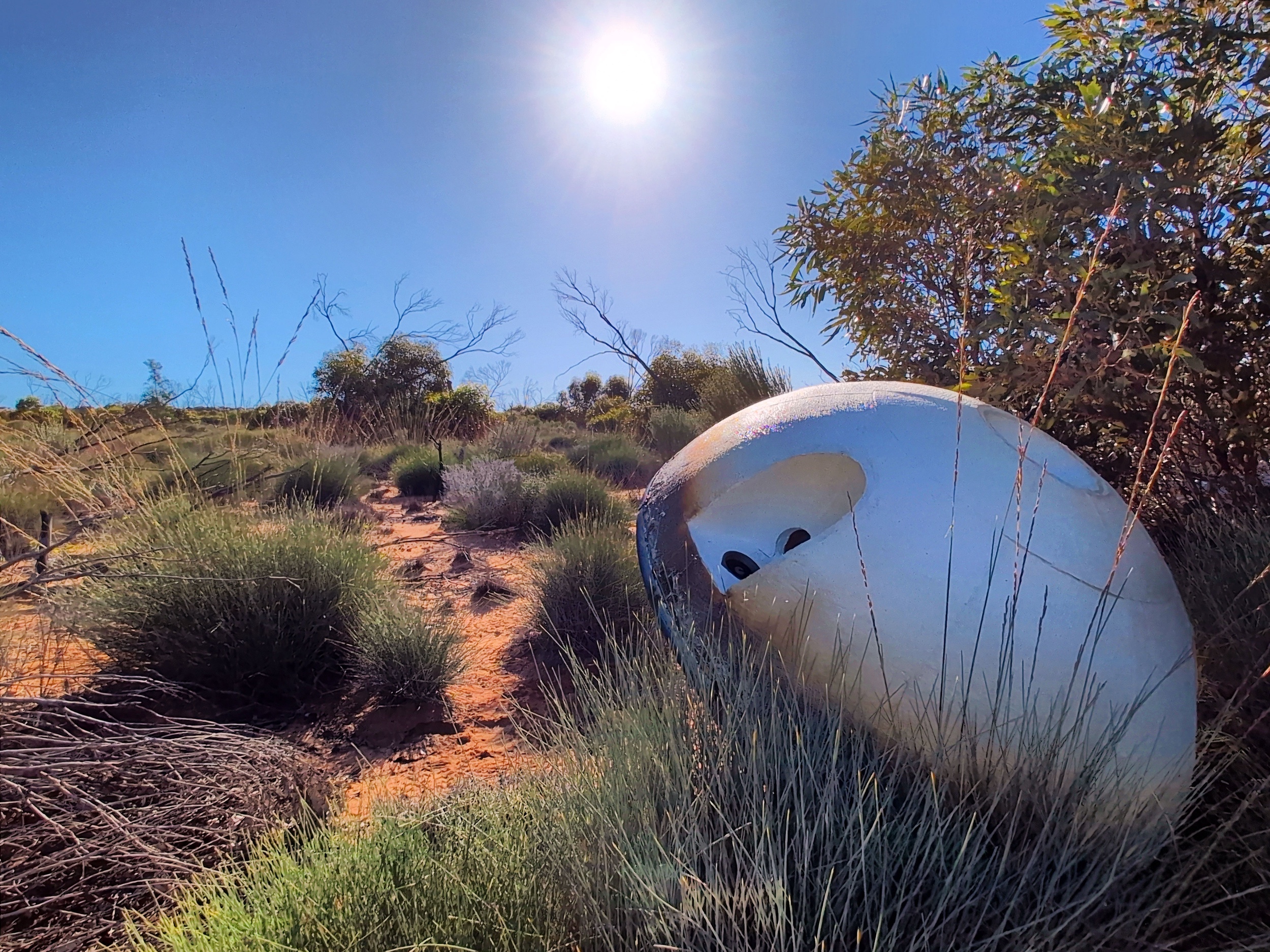
WASHINGTON — Varda Space Industries completed its latest reentry mission May 18 as the company balances supporting pharmaceutical research and hypersonic testing.
The capsule from Varda’s W-6 mission reentered early May 20, landing at the Koonibba Test Range in South Australia operated by Southern Launch. This was the fourth Varda capsule to land there in 15 months. The spacecraft launched on the SpaceX Transporter-16 rideshare mission March 30.
This mission was funded by the Air Force Research Laboratory through its Prometheus program to test hypersonic technology using commercial spacecraft. One investigation tested the ability to conduct autonomous navigation during reentry by observing positions of stars and low Earth orbit satellites. A second featured temperature sensors embedded in the nose of the capsule to collect data that will be compared with models. The capsule also flew two instrumented tiles provided by NASA made using new production techniques.
“Every reentry builds on the last. W-6 is another demonstration that frequent, low-cost, reliable return is easily accessible,” said Dave McFarland, vice president of hypersonic test and targets at Varda, in a statement. “The data our partners are taking home from this mission would have taken years to collect through traditional testing methods.”
Varda has found success in hypersonics because, it argues, it offers the ability to do testing less expensively than using missiles or rockets.
“The way to describe our defense business is delta-v arbitrage,” said Will Bruey, chief executive of Varda, during a session of the ASCEND conference here May 20. “We buy speed for cheap from Falcon 9, and we then sell it into a market that’s used to buying dedicated launches.”
The company uses the same spacecraft for missions to conduct microgravity research, notably pharmaceuticals. “Every vehicle that comes off the line can be used either for a commercial pharma mission or a defense mission,” he said. He estimated 80% of Varda’s capital allocation has gone into developing that spacecraft assembly line, with the other 20% going into its pharma lab.
Varda announced May 13 an agreement with pharmaceutical company United Therapeutics to study development of novel formulations of drugs in microgravity, starting with treatments for rare pulmonary disease.
Bruey said the companies started working together around the beginning of the year. Scientists at both companies have been reviewing United Therapeutics’ portfolio of drugs to see which ones would benefit from reformulation in microgravity and, of those, which would make economic sense.
“The way our customers think about Varda is they think the space part is cool, but they really ultimately don’t care,” he said. “They’re in it for the better drugs. So, we’re not really a space company to them, we’re a drug company.”
Bruey said he expected Varda to fly its first drug for United Therapeutics in 2027. If that leads to positive results, the company would move into clinical testing. “The best-case scenario is that it’s 2030 when we inject the first person with the microgravity-enabled pharmaceutical,” he said. “It could be anywhere between 2030 and 2035.”
Once that happens, he said, “it’s impossible to ignore at that point. Space drugs are officially a thing,” with the promise that what is effective for one drug could work for many others.
“It’s very much ‘go big or go home’ at Varda,“ he said. “Either we revolutionize the pharma industry or we become a boring hypersonics company. There’s really no in-between.”