

WASHINGTON — SpaceX launched the newest version of its Starship vehicle for the first time May 22, completing most of the test objectives planned for the suborbital flight.
Starship lifted off from the company’s facility at Starbase, Texas, at 6:30 p.m. Eastern on a mission designated Flight 12. The launch took place one day after SpaceX scrubbed the first Flight 12 launch attempt after a hydraulic pin in the launch tower failed to retract, preventing an arm with propellant lines from swinging away from the vehicle.
The Super Heavy booster fired its 33 Raptor 3 engines for the initial ascent, although one of the engines shut down about one minute and 40 seconds after liftoff. Two and a half minutes after liftoff, the Starship upper stage ignited its six engines and separated from Super Heavy.
Super Heavy was then scheduled to perform a “boostback” burn to prepare for a targeted splashdown in the Gulf of Mexico. However, only a handful of engines ignited, and those that did shut down less than 20 seconds into the minute-long burn. The booster made a hard splashdown in the Gulf, with onscreen telemetry showing it was going nearly 1,500 kilometers per hour 100 meters above the surface.
One of six Starship upper-stage engines also shut down about half a minute after stage separation. SpaceX noted the vehicle has engine-out capability, and the other five engines fired about a minute longer than planned to place Starship close to its planned suborbital trajectory.
“It does look like we are within bounds of what we analyzed” if one of the vacuum-optimized Raptor engines failed, SpaceX’s Dan Huot said on the company’s webcast of the mission. “I wouldn’t call it nominal orbital insertion, but we’re on a trajectory that we had analyzed, and it’s within bounds.”
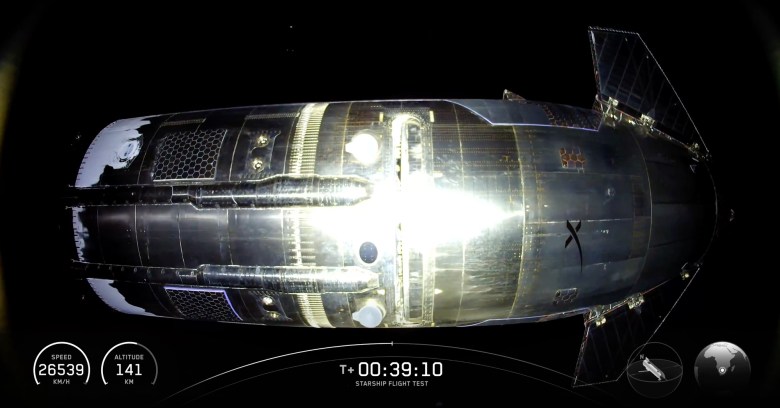
Once in space, SpaceX opened the “Pez” payload bay door on Starship. The vehicle then deployed 20 Starlink mass simulators followed by two other spacecraft dubbed “Dodger Dogs” because of stretched propellant tanks that extend beyond the body.

Those two spacecraft included components planned for future V3 Starlink satellites to be tested in their brief time in space. They also carried cameras to inspect Starship’s heat shield. Shortly after those spacecraft deployed, SpaceX released some video footage of Starship from them.
SpaceX skipped a planned engine relight test because of the earlier engine problem, but the vehicle went through reentry without incident. The vehicle made a soft splashdown in the planned landing zone in the Indian Ocean about 66½ minutes after liftoff, tipping over and exploding as expected.
The vehicle appeared to achieve most of its planned test objectives on the flight, the first for version 3 of the vehicle. SpaceX made significant changes to both the Super Heavy booster and Starship upper stage and also built a new launch pad for the vehicle at Starbase. The upgrades are designed to improve the performance and reliability of Starship V3, the version SpaceX plans to use for orbital missions, including Starlink satellite deployments and the Artemis lunar lander it is developing for NASA.
“An incredible day for Starship,” Kate Tice, one of the hosts of SpaceX’s launch webcast, said after the splashdown as company employees cheered in the background. “That was the first flight of that completely redesigned vehicle and, as you can tell, the teams are incredibly proud of what we just saw.”

SpaceX did not immediately disclose a timeline for the next Starship launch or when the company would be ready for the first orbital flight after 12 suborbital test flights. SpaceX said in the prospectus it filed with the Securities and Exchange Commission May 20 for its initial public offering that it expected to begin orbital payload delivery missions with Starship in the second half of this year.
Among those watching the launch at Starbase was NASA Administrator Jared Isaacman. “I know a lot of hard work leads up to a moment like this, so we’re all rooting for you, and we’re looking forward to meeting up next year in Earth orbit,” he said before launch on the SpaceX webcast, referring to plans for the Artemis 3 mission, where NASA’s Orion spacecraft will rendezvous with SpaceX’s Starship lunar lander and Blue Origin’s Blue Moon Mark 2 lander in low Earth orbit.
“Congrats @SpaceX team and @elonmusk on a hell of a V3 Starship launch. One step closer to the moon … one step closer to Mars,” Isaacman posted on social media after the flight.