
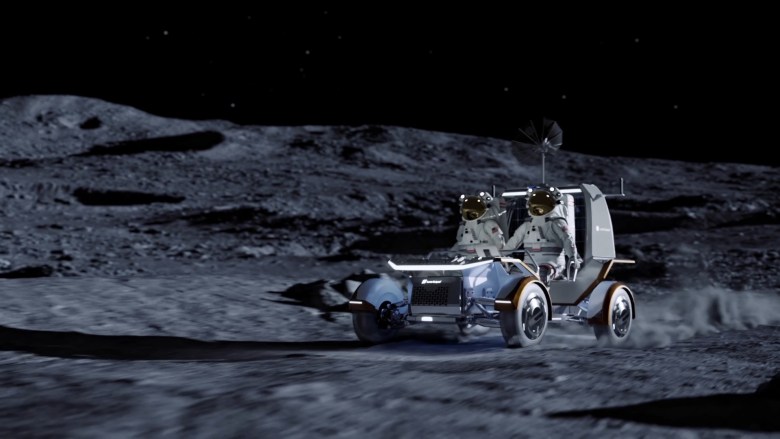

AMSTERDAM — NASA announced May 26 the first contracts associated with its plans to develop a lunar base, picking four companies to develop and deliver landers and drones to the moon.
At a NASA Headquarters briefing, the agency announced it selected lunar rover designs from Astrolab and Lunar Outpost for development. Those rovers will be sent to the moon on Blue Moon Mark 1 robotic landers by Blue Origin, with the goal of having either or both rovers on the moon before the Artemis 4 crewed lunar landing in 2028.
The landers are revised, simpler designs of concepts that Astrolab and Lunar Outpost proposed to NASA last year as part of the Lunar Terrain Vehicle, or LTV, program. At the Ignition event two months ago, NASA announced it was asking companies to submit revised designs that would be simpler and cheaper to operate and could be ready sooner.
The rovers are designed to be used by Artemis astronauts but also operate autonomously or be teleoperated when astronauts are not present. “We need them to be on the surface, doing things that basically prospect the surface,” said Carlos Garcia-Galan, program manager for Moon Base at NASA, including scouting potential landing sites and performing science. “They are a mix between the Apollo Lunar Roving Vehicle and a Mars-style rover.”
Astrolab’s design is called the Crewed Lunar Vehicle 1, or CLV-1. It is based on the FLEX rover concept the company had originally adapted for the LTV program, but scaled down to meet NASA’s revised requirements.
“CLV-1 reflects the adaptability of our FLEX architecture and the years of testing our team has already completed,” Jaret Matthews, chief executive of Astrolab, said in a statement. “We look forward to putting that work to use for Artemis astronauts and helping establish a lasting human presence on the moon.”
Lunar Outpost, which raised $30 million May 7, offered NASA Pegasus, a rover that used much of the design for its larger Eagle rover originally proposed for LTV. Pegasus uses a design the company says is inspired by the Apollo Lunar Roving Vehicle.
“Pegasus gives astronauts the range, reliability and flexibility needed to thrive in new terrain as we identify and prepare the sites that will become the first permanent lunar outpost,” Justin Cyrus, chief executive of Lunar Outpost, said in a statement.
NASA said the award to Astrolab is worth $219 million and the award to Lunar Outpost is worth $220 million.
Under the original LTV program, NASA required the rover developers to arrange their own transportation to the moon. However, under the new approach, NASA is using the Commercial Lunar Payload Services, or CLPS, program to deliver the rovers, requiring the rover developers to fit into mass and volume constraints, including a mass of no more than one metric ton.
NASA announced at the briefing it selected Blue Origin’s Blue Moon Mark 1 lander to deliver the Astrolab and Lunar Outpost rovers. It includes a $188 million base period to finalize mission design and procure long-lead hardware, among other related activities. Options worth $280.4 million cover the lander missions themselves.
The rover deliveries will come after the first Blue Moon Mark 1 mission, scheduled for launch this fall, and the second mission, which will carry NASA’s VIPER rover for scouting lunar volatiles, planned for 2027.
Notably absent from the awards was Intuitive Machines. It was the third company involved in the LTV program, alongside Astrolab and Lunar Outpost, and also has developed lunar landers. The company’s share price, which rose nearly 20% during trading May 26 before the NASA announcement in anticipation of an award, dropped dramatically when NASA revealed it was not selected. Shares closed at $34.86, down nearly 9% for the day.
In a statement, Steve Altemus, chief executive of Intuitive Machines, argued that the company would be eligible for later task orders in the LTV program for additional rovers and related services.
“Today’s first LTV task orders are the opening phase of a broader Moon Base buildout, a structured campaign where Intuitive Machines is continuing to execute its current business, work with Moon Base partners, and pursue additional opportunities as NASA expands lunar surface operations,” he wrote.

MoonFall award
The other major award announced at the briefing was for MoonFall, a program announced at Ignition to develop drone-like spacecraft that will be able to hop across the lunar surface, serving as scouts for later missions. Those spacecraft are being designed at the Jet Propulsion Laboratory.
NASA announced it selected Firefly Aerospace to deliver the MoonFall drones to the moon using the company’s Elytra Dark spacecraft. That spacecraft will carry the drones to lunar orbit, deploying them at an altitude of 50 kilometers. The drones will descend to the lunar surface on their own to carry out their missions.
“These drones will allow us to go cover a broader range of areas that we can prospect and get that ground truth,” Garcia-Galan said. “It can demonstrate the ability to take off and land in multiple locations with precision under south pole lighting conditions and terrain features.”
He said NASA is still studying whether that mission, planned for launch in 2028, will carry three drones or four.
NASA did not disclose the value of the award to Firefly for delivering the MoonFall drones, but the company said it received a $75 million subcontract from JPL for the mission.
“This subcontract underscores our commitment to executing challenging missions that push the boundaries of lunar exploration,” Jason Kim, chief executive of Firefly, said in a statement. “Built upon the same proven systems that landed Blue Ghost on the moon, our Elytra spacecraft are equipped to deploy critical high-mass payloads across cislunar space.”

Other updates
NASA billed the briefing as the first update on its plans for a lunar base since announcing it at the Ignition event March 24. The agency is still working through responses to the requests for information from that event but is moving ahead with contracts in other areas, like a new CLPS contract vehicle called CLPS 2.0 released May 15.
“We have been working to align all the agency resources across NASA to basically deliver on this objective of building a moon base,” Garcia-Galan said. That includes meetings at NASA centers to solicit input and also see what capabilities are available to support those plans.
He added there is planning underway on other requirements for a lunar base, including power, logistics and habitats. Those will be enabled by what he called “mid-sized cargo delivery” from CLPS 2.0 landers.
NASA also announced at the briefing that it has rechristened three CLPS landers under a new “Moon Base” line of missions. The first Blue Moon Mark 1 lander mission is now called Moon Base 1, Astrobotic’s Griffin-1 lander is now called Moon Base 2 and Intuitive Machines’ IM-3 mission is now called Moon Base 3.
The change in names for those missions, which in some cases were awarded years ago under CLPS, is more than cosmetic. “We’re doing things a little bit differently with those. We want to make sure that the reliability is there,” Garcia-Galan said. “We’re putting all the resources of NASA, including test facilities if they need them, in play here.”