• Home
  • About
  • FAQ
  • Feeds
  • Glossary
  • Contact
Tours In Space
  • Home
  • Start Here
    • Intro to Commercial Spaceflight
    • How to Book a Space Tour
    • Is Space Tourism Safe?
    • Space Travel FAQs
    • View Earth from the Edge
    • What to Pack
  • Preparing for Your Trip
    • Insurance and Legal Waivers
    • Physical and Medical Requirements
    • Training Programs
    • What to Expect
  • Space Tourism Companies
    • Axiom Space
    • Blue Origin
    • SpaceX
    • Virgin Galactic
    • World View (stratospheric balloon flights)
    • Blue Origin vs Virgin Galactic
    • Comparison Chart: Features, Pricing, Booking
  • Space Tours
    • Custom & Luxury Packages
    • Duration, Training, Costs
    • Experiences
    • Future Moon/Mars Options
    • Orbital Flights
    • Parabolic Flight Experiences
    • Private Missions
    • Stratospheric Balloon Flights
    • Suborbital Flights
    • Zero-Gravity Flights
  • Spaceflight Technologies
    • Space Tourism Balloon
No Result
View All Result
  • Home
  • Start Here
    • Intro to Commercial Spaceflight
    • How to Book a Space Tour
    • Is Space Tourism Safe?
    • Space Travel FAQs
    • View Earth from the Edge
    • What to Pack
  • Preparing for Your Trip
    • Insurance and Legal Waivers
    • Physical and Medical Requirements
    • Training Programs
    • What to Expect
  • Space Tourism Companies
    • Axiom Space
    • Blue Origin
    • SpaceX
    • Virgin Galactic
    • World View (stratospheric balloon flights)
    • Blue Origin vs Virgin Galactic
    • Comparison Chart: Features, Pricing, Booking
  • Space Tours
    • Custom & Luxury Packages
    • Duration, Training, Costs
    • Experiences
    • Future Moon/Mars Options
    • Orbital Flights
    • Parabolic Flight Experiences
    • Private Missions
    • Stratospheric Balloon Flights
    • Suborbital Flights
    • Zero-Gravity Flights
  • Spaceflight Technologies
    • Space Tourism Balloon
No Result
View All Result
Tours In Space
No Result
View All Result
Home Uncategorized

China launches PRSC-EO3 for Pakistan, lofts internet test and environment monitoring satellites

Ensign by Ensign
April 27, 2026
in Uncategorized
0
China launches PRSC-EO3 for Pakistan, lofts internet test and environment monitoring satellites
190
SHARES
1.5k
VIEWS
Share on FacebookShare on Twitter
image

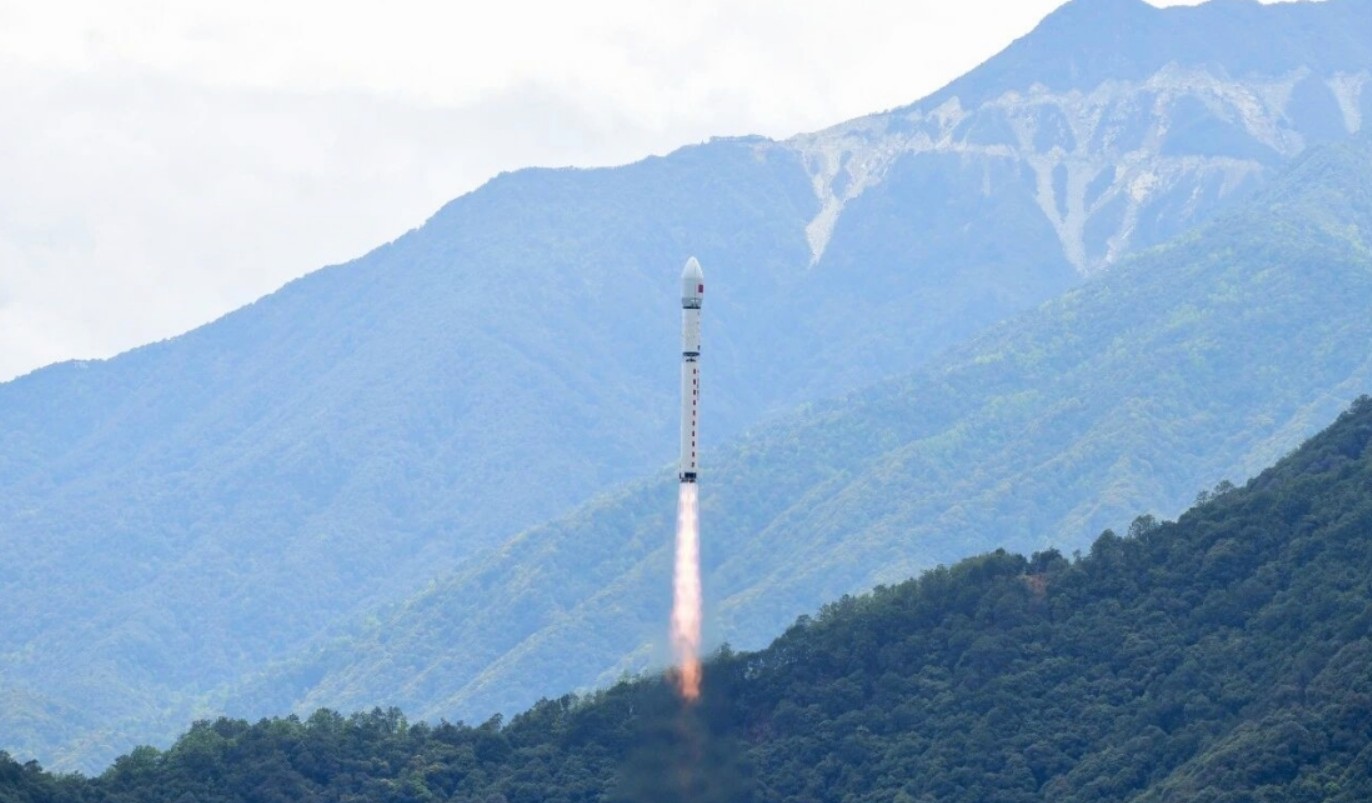
HELSINKI — China took its total launches this year to 26 over the weekend, with a trio of flights of legacy and newer Long March rocket models.

The activity saw the launch of a remote sensing satellite for Pakistan, the lofting of four new satellite internet technology test satellites, and a further launch carrying an environment monitoring satellite.

A Long March 6 rocket lifted off at 8:15 a.m. Eastern (1215 UTC) April 25 from Taiyuan Satellite Launch Center, northern China. Aboard was the PRSC-EO3 satellite equipped with a high-resolution optical payload, developed by the Pakistan Space and Upper Atmosphere Research Commission (SUPARCO). Propulsion systems were provided by the Beijing Institute of Control Engineering (BICE) under China Academy of Space Technology (CAST).

Sign up for First Up: Get the latest updates on SpaceX, Artemis, NASA and more. From Jeff Foust, First Up is a recap of the day’s space industry news, including civil, commercial, and military space developments.

By submitting this form, you agree to the SpaceNews privacy policy and terms and conditions and to receive email from us and our partners. You can opt-out at any time.

The launch was facilitated by China Great Wall Industry Corporation (CGWIC), a subsidiary of the China Aerospace Science and Technology Corporation (CASC), as part of a multi-launch service agreement with SUPARCO. China launched the PRSC-EO1 and PRSC-EO2 remote sensing satellites for Pakistan in January 2025 and February 2026 respectively.

The mission is also indicative of deepening China–Pakistan space cooperation, with the latter participating in China’s moon exploration plans, including signing up to the International Lunar Research Station (ILRS) moon base project in October 2023, and an agreement which will see one Pakistani astronaut make a short term visit to the Tiangong space station. Two candidate astronauts, Muhammad Zeeshan Ali and Khurram Daud, arrived in Beijing for training April 24.

The mission was the 15th launch of the Long March 6, which had its debut flight in 2015, marking the debut of China’s new generation of kerosene-liquid oxygen launch vehicles, developed in parallel with the Long March 5 and 7 series. It is based in part on the boosters for the Long March 5, using a YF-100 engine and was designed to provide a fast response option. The much larger Long March 6A uses a pair of YF-100s on its first stage and features four solid side boosters.

Satellite internet test satellites

The PRSC-EO3 launch followed another just over a day earlier. A Long March 2D rocket lifted off at 2:35 a.m. Eastern (0635 UTC) April 24 from Xichang Satellite Launch Center, southwest China.

The satellite internet technology test satellite is mainly used to conduct technical experiments and verifications on technologies such as direct broadband connection to satellites for mobile phones and the convergence of space and ground networks, according to the CASC statement.

Further statements reveal that the launch carried four satellites, with one developed by commercial satellite maker GalaxySpace and another two from Changguang Satellite Technology (CGST), a remote sensing satellite maker and constellation operator, with participation of the Beijing University of Posts and Telecommunications, and another developed by the Harbin Institute of Technology Satellite Technology Co., Ltd.

Four satellites were tracked in near-circular, 505-kilometer-altitude orbits inclined by 55 degrees.

The launch is part of a series of satellite internet technology test satellite launches dating back to 2023, and including a satellite launched by a Jielong-3 rocket earlier this month. The test satellites relate to China’s plans to build its own communications megaconstellations in low Earth orbit.

The test satellite launch also coincided with China’s national space day, first held in 2016, which was chosen for the anniversary of China’s first orbital launch on April 24, 1970, when a Long March 1 sent the DFH-1 satellite into orbit.

Daqi-2 greenhouse gas monitoring satellite

China’s previous launch saw a Long March 4C lift off at 12:10 Eastern (0410 UTC) April 17 from Jiuquan Satellite Launch Center, northwest China. 

CASC confirmed launch success, revealing the payload to be the Daqi-2 satellite, also called Atmospheric Environment Monitoring Satellite-2 (AEMS-2) for monitoring atmospheric aerosol and carbon dioxide. Daqi-2 carries five payloads, including an Aerosol and Carbon Detection Lidar, and follows the launch of Daqi-1 in April 2022. That LIDAR was observed from the ground. Daqi-2 was sent into a near-polar, 700-km altitude orbit.

ハワイ山頂に緑のレーザー 中国の環境衛星から? NASAが解析

レーザーが撮影されたまさにその時刻に、中国の地球環境観測衛星Daqi―1がハワイ上空を通過していたのを確認した。

Daqi-1 には大気中のエアロゾルと二酸化炭素を検出するためのLIDAR が装備されている。https://t.co/34bXgNwrKT pic.twitter.com/tktLpNnFBI

— AruK1m (@shiroibousi) February 13, 2023

The Long March 2D and 4C are part of China’s older, hypergolic series of launch vehicles. China has since developed a range of larger cryogenic, kerosene and methane-fueled launchers and is attempting to recover and reuse first stages. 

The launches were China’s 24th, 25th and 26th orbital launch attempts of 2026, including three failures. The country could be aiming to conduct as many as 140 launches this year, far surpassing last year’s national record of 92, including the launch of the Chang’e-7 lunar south pole lander. The debut of China’s reusable Long March 10B rocket, initially set for a window of April 28-30, appears to have been pushed back into May.

[embedded content]
Tags: NASAspace station
No Result
View All Result

Recent Posts

  • SpaceX wins $2.29 billion Space Force contract for military data network
  • NASA selects four companies for initial moon base awards
  • Artemis moon base will cover ‘hundreds of square miles’ with hopping drones and new lunar rovers, NASA says
  • Open Cosmos’ CEO on what it takes to bring IoT to space
  • NASA Astronauts to Answer Questions from Students in New York

Categories

  • Excursions
  • Kepler Mission
  • NASA
  • NASA Breaking News
  • Physical Preparation
  • Preparation
  • Space News
  • Space Station News
  • Spacewalks
  • Tours
  • Uncategorized
  • Weightlessness Training
  • What Not to Pack
  • What to Pack

Meta

  • Log in
  • Entries feed
  • Comments feed
  • WordPress.org
  • Home
  • Start Here
  • Preparing for Your Trip
  • Space Tourism Companies
  • Space Tours
  • Contact

© 2026 JNews - Premium WordPress news & magazine theme by Jegtheme.

No Result
View All Result
  • About
  • Contact
  • Feeds
  • Frequently Asked Questions
  • Preparing for Your Trip
    • Insurance and Legal Waivers
    • Physical and Medical Requirements
    • Training Programs
    • What to Expect
  • Privacy Policy
  • Space Tourism Companies
    • Axiom Space
    • Blue Origin
    • Blue Origin vs Virgin Galactic
    • Comparison Chart: Features, Pricing, Booking
    • SpaceX
    • Virgin Galactic
    • World View (stratospheric balloon flights)
  • Space Tours
    • Custom & Luxury Packages
    • Duration, Training, Costs
    • Experiences
    • Future Moon/Mars Options
    • Orbital Flights
    • Parabolic Flight Experiences
    • Private Missions
    • Stratospheric Balloon Flights
    • Suborbital Flights
    • Zero-Gravity Flights
  • Spaceflight Technologies
    • Space Tourism Balloon
  • Start Here
    • How to Book a Space Tour
    • Intro to Commercial Spaceflight
    • Is Space Tourism Safe?
    • Space Travel FAQs
    • View Earth from the Edge
    • What to Pack
  • Tours in Space is your launchpad to the world of space tourism

© 2026 JNews - Premium WordPress news & magazine theme by Jegtheme.