

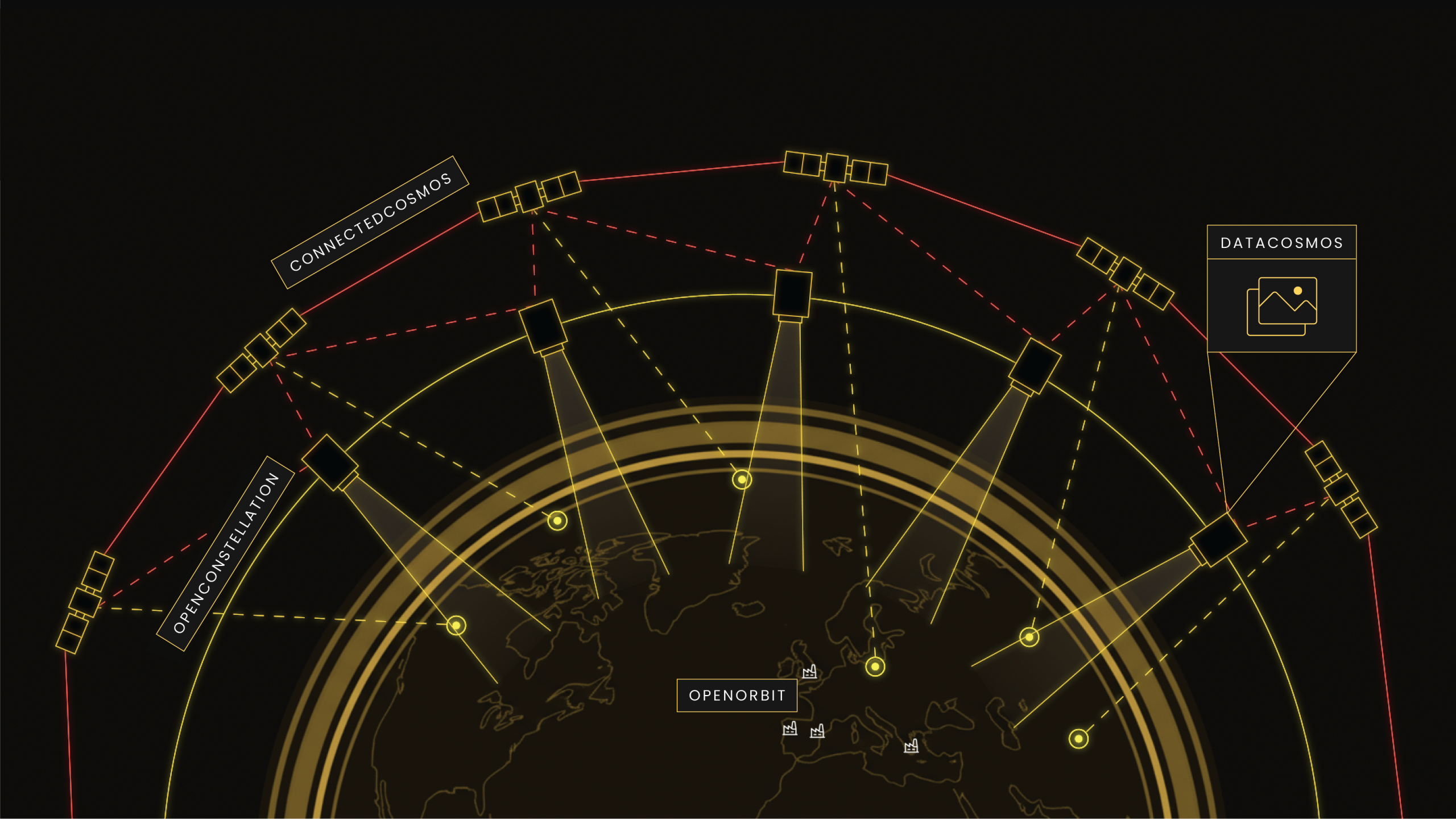
Open Cosmos, based in the United Kingdom, is facing a 2028 deadline to field an ambitious broadband constellation for Europe. That system, ConnectedCosmos, aims to reduce reliance on undersea cables and Earth-based hubs. CEO Rafel Jorda Siquier sat down with SpaceNews to talk about the project, and the broad impact he envisions for low-latency satellite data transfer.
This interview has been edited for space and clarity.
SpaceNews: The [Internet of Things] arena has been around for 10 years or so. Why is it just starting to get more traction with space?
Rafel Jorda Siquier: Many people look at the IoT only as a way to connect small devices, when in reality it’s another sensing source, so you have another set of data sets that enable you to understand the ground truth, combining that with in-orbit observation, so Earth observation and remote sensing through a diverse range of sensors empowers that much more. It enables automatic tasking, it enables calibrating better the information that you gather from orbit and then it also enables automation on the ground by delivering the insight in real time exactly at the point where it needs to be actioned.
We’ve heard about this idea of integrated data; we’ve heard about end-to-end solutions. But what’s different about putting these capabilities on the same satellites versus integrating them on the ground? What’s the advantage there?
Non-terrestrial networks enable much wider coverages; global capabilities, rather than just working at local terrestrial network levels. And being able to connect those local networks with a global infrastructure just brings a whole new scale.
Can you give an example of one of the advantages might be?
When you are monitoring climate, for instance, you do not necessarily want to look only at the impact that it’s having on a particular region, but also on the wider continent, and what’s the situation over time. Some of the sensors that you put on board the satellites can have that recurrent measurement happening at a larger scale than if you just deploy a local network of IoT devices in a very particular range. So there are a whole set of abstractions into wider areas that you can do if you have the right data source. This is a clear example on a clear domain where the capabilities of the two systems really compound to something greater.
You’ve talked about near real-time data delivery, and we hear from customers around the world: they want faster, faster, faster, faster. In practical terms, how much faster are we talking?
From the intelligence or from the information perspective, there are multiple layers of value. First is the type of data that you gather. And this might be remote sensing data, or might also be IoT data. Then there is how frequently you can capture that data, and this usually depends on how many satellites you have in low Earth orbit and what sort of revisit you have of them. And then there is the latency, the time that happens between taking that sample of data and being able to deliver to the user the actionable information. That’s what really matters, and there are many examples where we have seen that applications are totally dependent on that: wildfires, floods. If you are able to respond in near-real time, the impact that you can have on solving some of those issues, it’s an order of magnitude greater.
You mentioned floods or wildfires. How quickly can you get that information?
We have one satellite called HAMMER that we developed for the U.K. government that has an infraspectral camera on board, AI and analytics and then an intersatellite link capability. With that system, we can already take images, process them on board and identify things like vessels, then communicate that anywhere in the world where there is internet in under three minutes.
That’s astonishing.
With the IoT capabilities, we should be able to do that in seconds, right? So, capturing the data from the ground, whether it is from imagery sensors or from the IoT devices themselves, processing them onboard the satellite on the edge, and then passing that down through kilobytes of bandwidth in order to be able to deliver that information where it matters. And this can help you save lives in climate hazards, in hurricanes, under different situations where timely information is critical.
Are your customers saying, ‘we need this even quicker?’ What’s the signal demand?
There’s such a big difference between delivering images, unprocessed, several hours later and delivering information already processed in minutes. The amount of applications that can emerge in between those two ranges in all of those domains that we have been talking about before, it’s enormous. And I do think that a big chunk of the global gross domestic product is going to come from the automation of a lot of these things happening in the ground seamlessly, without people realizing the data was provided from a satellite.
You have a pretty ambitious architecture and timeline, but you’re also pretty early in deployment. What are some of the factors that are pointing in favor of feeling good about meeting these deadlines?
For the IoT and Earth observation satellites, we already have these systems flying. Now it’s a matter of scaling it. We have 48 satellites on delivery for Earth observation customers, part of the OpenConstellation, where we are already embedding and have been embedding all of these IoT capabilities already, so it’s just a matter of a switch, getting the right spectrum on the bands required in order to be able to provide those IoT services, and we will be able to serve. For the broadband, which is the other part of the architecture, what we call ConnectedCosmos, we already launched the first two satellites in January on a dedicated rocket. Those satellites have been hugely successful. Now we have all four factories, one in the U.K., one in Spain, one in Portugal, one in Greece, working on three shifts, working nonstop, producing satellites in an industrial manner. Our capacity to manufacture satellites across those factories is close to 200 satellites a year, so we are really ramping up in terms of production and getting the system up before 2028.
What’s the number of the total constellation?
There is no minimum, there is no maximum. It’s a race now on how much of the world can we cover and can we serve with the high priority Ka-band spectrum. We are deploying the system in months’ time rather than in years’ time. So it’s pushing us to the limit, but it’s a lot of fun. It’s a race we don’t want to avoid.
The LEO space right now is very crowded. There are a good number of Earth observation companies. Where do you see your competitive edge?
I think having that full control over the data traceability, the delivery directly to where it’s going to have the impact — it’s transformational. And I don’t know any other company that has brought those two sides of the same coin together, the telecom and the telecom spectrum capability together with the advanced multi-sensor Earth observation capabilities all under the same systems. I think that’s our competitive edge.
<em>Hope Hodge Seck also contributed to this article.