• Home
  • About
  • FAQ
  • Feeds
  • Glossary
  • Contact
Tours In Space
  • Home
  • Start Here
    • Intro to Commercial Spaceflight
    • How to Book a Space Tour
    • Is Space Tourism Safe?
    • Space Travel FAQs
    • View Earth from the Edge
    • What to Pack
  • Preparing for Your Trip
    • Insurance and Legal Waivers
    • Physical and Medical Requirements
    • Training Programs
    • What to Expect
  • Space Tourism Companies
    • Axiom Space
    • Blue Origin
    • SpaceX
    • Virgin Galactic
    • World View (stratospheric balloon flights)
    • Blue Origin vs Virgin Galactic
    • Comparison Chart: Features, Pricing, Booking
  • Space Tours
    • Custom & Luxury Packages
    • Duration, Training, Costs
    • Experiences
    • Future Moon/Mars Options
    • Orbital Flights
    • Parabolic Flight Experiences
    • Private Missions
    • Stratospheric Balloon Flights
    • Suborbital Flights
    • Zero-Gravity Flights
  • Spaceflight Technologies
    • Space Tourism Balloon
No Result
View All Result
  • Home
  • Start Here
    • Intro to Commercial Spaceflight
    • How to Book a Space Tour
    • Is Space Tourism Safe?
    • Space Travel FAQs
    • View Earth from the Edge
    • What to Pack
  • Preparing for Your Trip
    • Insurance and Legal Waivers
    • Physical and Medical Requirements
    • Training Programs
    • What to Expect
  • Space Tourism Companies
    • Axiom Space
    • Blue Origin
    • SpaceX
    • Virgin Galactic
    • World View (stratospheric balloon flights)
    • Blue Origin vs Virgin Galactic
    • Comparison Chart: Features, Pricing, Booking
  • Space Tours
    • Custom & Luxury Packages
    • Duration, Training, Costs
    • Experiences
    • Future Moon/Mars Options
    • Orbital Flights
    • Parabolic Flight Experiences
    • Private Missions
    • Stratospheric Balloon Flights
    • Suborbital Flights
    • Zero-Gravity Flights
  • Spaceflight Technologies
    • Space Tourism Balloon
No Result
View All Result
Tours In Space
No Result
View All Result
Home Uncategorized

India’s TakeMe2Space sets sights on 50-kilowatt data center

Ensign by Ensign
April 17, 2026
in Uncategorized
0
India’s TakeMe2Space sets sights on 50-kilowatt data center
190
SHARES
1.5k
VIEWS
Share on FacebookShare on Twitter
image

COLORADO SPRINGS – After announcing a $5 million seed round in January, Indian startup TakeMe2Space seeks to raise $55 million to establish a 50-kilowatt orbital data center.

“What is key for us is to demonstrate that we can play the orbital data center game globally,” TakeMe2Space founder Ronak Kumar Samantray told <em>SpaceNews. “There’s a lot of liquidity around 50- to 100-kilowatt compute scale, because that’s what will become the building block for a gigawatt orbital data center.”

Samantray established TakeMe2Space after his previous software-as-a-service startup NowFloats Technologies was acquired in 2019 by Reliance Industries. Before founding TakeMe2Space in late 2024, Samantray and colleagues performed spaceflight testing on a proprietary material to protect GPUs from solar radiation.

Sign up for First Up: Get the latest updates on SpaceX, Artemis, NASA and more. From Jeff Foust, First Up is a recap of the day’s space industry news, including civil, commercial, and military space developments.

By submitting this form, you agree to the SpaceNews privacy policy and terms and conditions and to receive email from us and our partners. You can opt-out at any time.

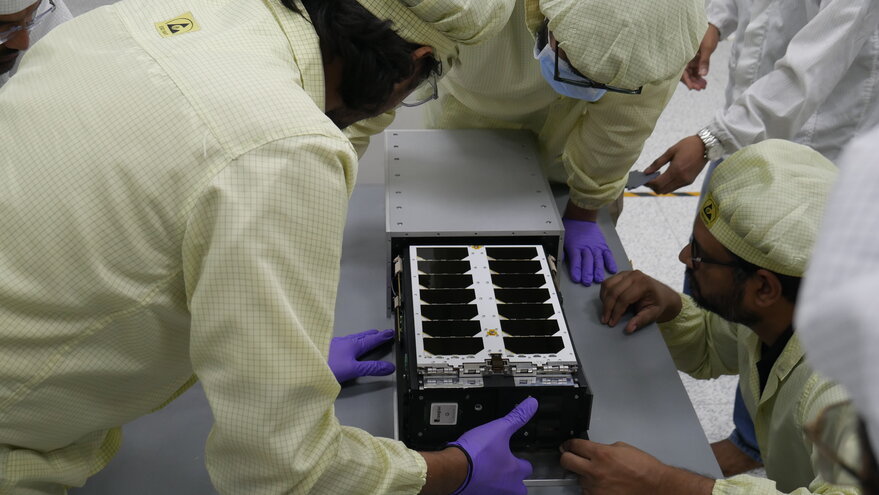
TakeMe2Space sent its first satellite aloft in December 2024 on India’s Polar Satellite Launch Vehicle (PSLV). The one-unit cubesat, called My Orbital Infrastructure-Tech Demonstration, provided flight heritage for the startup’s onboard computer, edge processor and attitude determination and control system, while remaining attached to PSLV’s fourth stage.

“Three customers uploaded their AI model, did inferencing and got the results,” Samantray said.

Tiered Approach

In October, TakeMe2Space will launch a six-unit cubesat equipped with an Nvidia Jetson module on a SpaceX Falcon 9 rideshare. Customers who plan to upload data and task the Earth-imaging cubesat are testing AI models on the satellite’s physical twin.

The following mission, launching in 2027 with funding from the recent investment round, will be a constellation of four satellites with a mass of roughly 100 kilograms apiece sharing data through optical inter-satellite links.

“There, the aim is to get to $15 million annual revenue with five kilowatts of compute in orbit,” Samantray said.

Market Analysis

While developing space infrastructure, TakeMe2Space has been evaluating the emerging market for on-orbit compute and data storage. Samantray sees agriculture and insurance firms as early customers because they demand access to inference engines that can ingest Earth-observation data and quickly draw conclusions.  

“Of late, there also has been demand for storage in orbit,” Samantray said. “People want to store mission-critical data on satellites as a backup because data centers, unfortunately, have become military targets.”

As a result, TakeMe2Space satellites will provide 100 terabytes of storage capacity.

By 2029 or 2030, Samantray anticipates launch costs will decrease, improving the economic picture for orbital data center infrastructure and prompting customers to begin uploading large datasets for AI training.

Vertical Integration

“Anything that flies in a satellite, except for solar cells and propulsion, is designed and built by us,” Samantray said. “That ensures that our cost of manufacturing the satellite is extremely low.”

Samantray began focusing on space-based computing infrastructure in 2021.

“My idea was very simple. If humans are to become a spacefaring species, there will be a large-scale compute infrastructure,” Samantray said.

Tags: SpaceX
No Result
View All Result

Recent Posts

  • ‘For All Mankind’ alternative timeline vs reality: How Apple TV’s sci-fi show diverges from history
  • India’s TakeMe2Space sets sights on 50-kilowatt data center
  • Countering missile threats ‘left of launch’
  • Taiwan floats shared satcom constellation amid calls for more space collaboration
  • Companies make the case for commercial space station markets

Categories

  • Excursions
  • Kepler Mission
  • NASA
  • NASA Breaking News
  • Physical Preparation
  • Preparation
  • Space News
  • Space Station News
  • Spacewalks
  • Tours
  • Uncategorized
  • Weightlessness Training
  • What Not to Pack
  • What to Pack

Meta

  • Log in
  • Entries feed
  • Comments feed
  • WordPress.org
  • Home
  • Start Here
  • Preparing for Your Trip
  • Space Tourism Companies
  • Space Tours
  • Contact

© 2026 JNews - Premium WordPress news & magazine theme by Jegtheme.

No Result
View All Result
  • About
  • Contact
  • Feeds
  • Frequently Asked Questions
  • Preparing for Your Trip
    • Insurance and Legal Waivers
    • Physical and Medical Requirements
    • Training Programs
    • What to Expect
  • Privacy Policy
  • Space Tourism Companies
    • Axiom Space
    • Blue Origin
    • Blue Origin vs Virgin Galactic
    • Comparison Chart: Features, Pricing, Booking
    • SpaceX
    • Virgin Galactic
    • World View (stratospheric balloon flights)
  • Space Tours
    • Custom & Luxury Packages
    • Duration, Training, Costs
    • Experiences
    • Future Moon/Mars Options
    • Orbital Flights
    • Parabolic Flight Experiences
    • Private Missions
    • Stratospheric Balloon Flights
    • Suborbital Flights
    • Zero-Gravity Flights
  • Spaceflight Technologies
    • Space Tourism Balloon
  • Start Here
    • How to Book a Space Tour
    • Intro to Commercial Spaceflight
    • Is Space Tourism Safe?
    • Space Travel FAQs
    • View Earth from the Edge
    • What to Pack
  • Tours in Space is your launchpad to the world of space tourism

© 2026 JNews - Premium WordPress news & magazine theme by Jegtheme.