

GREENBELT, Md. — NASA’s Nancy Grace Roman Space Telescope is now scheduled for launch in early September as agency officials hail its early completion despite ongoing budget uncertainty for its science programs.
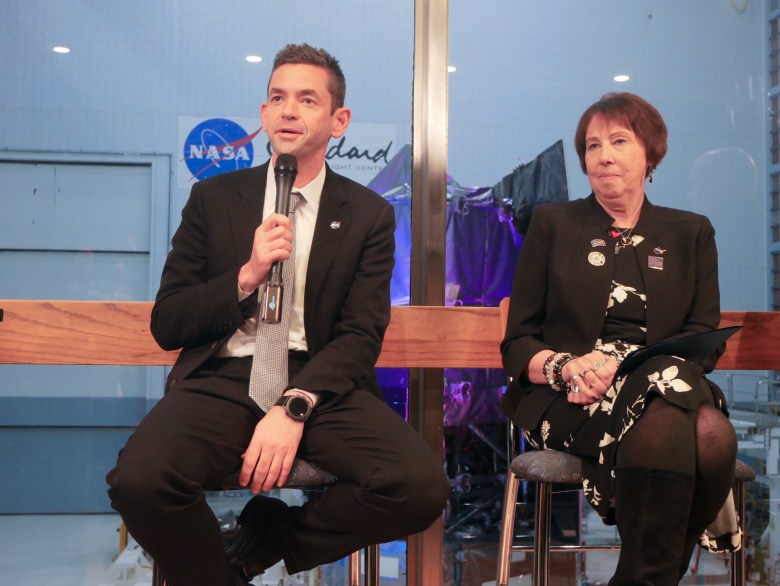
NASA announced at a media event at the Goddard Space Flight Center April 21 that the space telescope had completed final assembly and testing ahead of shipment to the Kennedy Space Center for launch preparations.
“We just finished our comprehensive performance test that happens after environmental testing, and that all went really well,” Jackie Townsend, Roman deputy project manager, said in an interview. After some final closeouts, the spacecraft will be ready by mid-June to ship to KSC.
Roman, the top priority of the 2010 astrophysics decadal survey, features a 2.4-meter primary mirror with a wide field of view. It carries an imager as well as a coronagraph, an instrument designed to block light from individual stars to directly image planets orbiting them.
Astronomers plan to use Roman to perform extensive surveys of the universe, addressing scientific questions ranging from exoplanets to cosmology.
“Current observations hint that our standard model of the universe is incorrect. Roman will be able to confirm these and set us on the path to understanding what’s right,” Julie McEnery, Roman telescope senior project scientist, said at a briefing. “We’re going to perform a revolutionary census of planets around other stars in our galaxy. We’re going to conduct ambitious surveys that will transform and impact every area of astronomy.”
While Roman promises revolutionary science, what has been groundbreaking about the telescope’s development is that it has avoided the cost and schedule overruns of other major science missions. The mission’s launch on a SpaceX Falcon Heavy is eight months ahead of its formal launch readiness date of May 2027. The mission has also remained within its total lifecycle cost of $4.3 billion.
“Roman’s accelerated development is a true success story of what we can achieve when public investment, institutional expertise and private enterprise come together to take on the near-impossible missions that change the world,” NASA Administrator Jared Isaacman said at the event.
Project officials said several factors contributed to completing Roman ahead of schedule. One is adding programmatic considerations to technical assessments of risk during the mission’s development.
“Something that we’ve done on Roman is we added the programmatics to that balancing equation, so everybody from the project manager all the way down to the techs on the floor understand how the cost and the schedule and the technical all have to come together on Roman,” said Townsend.
Another factor was that the mission had a cost cap since its early development and that the funding was “forward-phased” to prevent cash flow problems in its development. “That combination of a cost cap and forward-phased funding allows for smart decisions all the way through the life cycle,” she said.
Shawn Domagal-Goldman, director of NASA’s astrophysics division, also credited the project team. “The power of a good team to overcome challenges is huge,” he said in an interview.

NASA hopes to use Roman’s development as a model for future missions, including the Habitable Worlds Observatory, a large space telescope recommended by the most recent astrophysics decadal survey in 2021.
“When we get things right and have success stories like Nancy Grace Roman, let’s learn from some of the magic that created that outcome and try and apply it to other programs,” Isaacman said.
The success of Roman, though, comes amid concerns about the agency’s overall science portfolio. NASA’s fiscal year 2027 budget proposal seeks to cut science funding by 47% from 2026 levels, canceling more than 50 science missions in development or extended operations. That includes about a dozen missions in astrophysics alone, from the Chandra X-Ray Observatory to contributions to international missions.
Isaacman, who will begin defending the budget proposal to Congress April 22 at a House Science Committee hearing, said he remained committed to doing flagship-class missions despite the proposed constrained budget.
“Nancy Grace Roman is not the last flagship mission for us,” he said. “I expect there’ll be plenty of flagship missions in the future.”
Such cancellation threats are not new. The first Trump administration proposed in three consecutive budgets to cancel Roman, then known as the Wide-Field Infrared Survey Telescope. In each case, Congress rejected the proposal and kept the mission funded.
“Right now, everybody is working on the appropriations bill that was signed into law by the President and that, for astrophysics, gives us the funding we need to bring Roman to the launch pad” and work on other missions, Domagal-Goldman said in an interview.
His advice to those working on astrophysics missions, including those threatened with cancellation? “I’m telling them to keep their heads down and focus on executing the budget that the President signed into law.”