
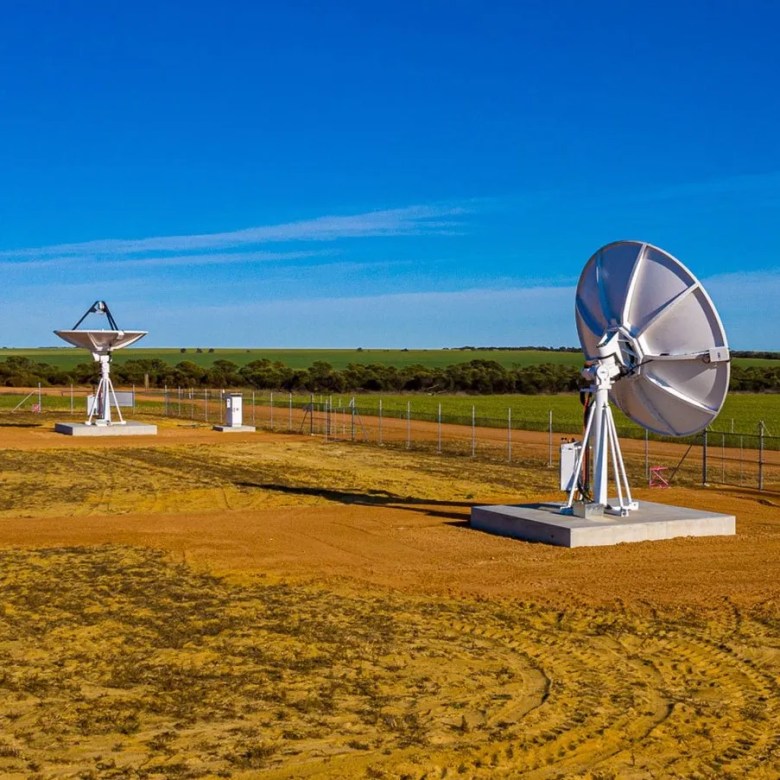

Recent strikes on cloud facilities and satellite ground infrastructure are sharpening concerns that some of the space industry’s most critical assets are becoming targets in modern conflict.
Despite being the essential link between satellites and users, ground stations have largely operated outside the limelight enjoyed by assets in orbit and the rockets that launch them there.
That started to change in 2022 with a high-profile cyberattack on Viasat’s KA-SAT satellite internet network at the onset of Russia’s invasion of Ukraine.
Hackers deployed malware via ground-based systems that disrupted tens of thousands of residential broadband terminals across Europe, mostly in Ukraine, while the high-throughput geostationary telecoms satellite itself was untouched.
More recently, a March missile strike hit a commercial teleport owned by Luxembourg-based satellite operator SES in Israel, damaging part of the facility’s antenna field following Israeli and U.S. military operations against Iran.
Amazon Web Services, the U.S.-based data center giant, has reported drone strikes on its infrastructure in the United Arab Emirates and Bahrain.
Meanwhile, satellite imagery has shown the aftermath of strikes in the region on radar systems the U.S. uses to detect incoming missiles and drones, further highlighting how infrastructure used to process, transport or act on satellite data is also in the firing range.
Taken together, the incidents underscore a broader shift: In an era when commercial space and cloud networks are increasingly woven into military operations, the infrastructure that receives, processes and distributes satellite data is drawing new scrutiny as a vulnerable point of attack. For satellite and ground station operators, that is prompting a harder look at redundancy, hardening and whether assets once viewed as commercial support systems must now be treated as part of the battlespace.
More resilience, less latency
French startup Skynopy and other ground station providers say geographically diverse infrastructure is becoming increasingly important for operational resilience, particularly as the space industry moves toward more dual-use systems that support both commercial and defense applications.
Skynopy has developed software to help route satellite data through a growing network of 17 ground stations, enabling traffic to be rerouted to an alternative site when disruptions occur.
Distributed networks also help reduce latency for time-sensitive applications such as Earth observation.
In an upcoming white paper shared with SpaceNews, Skynopy points to how satellite imagery quickly captured a 64-kilometer military convoy advancing toward Ukraine’s capital in the early hours of Russia’s invasion.
But getting that data to analysts on the ground took time as low Earth orbit spacecraft without inter-satellite links must wait until they pass over an approved ground station before downloading data.
For architectures relying on a limited number of sites, Skynopy says the delay is typically around 90 minutes or more, not counting the processing needed to turn that data into actionable intelligence.
However, the startup says satellite operators can cut downlink latency to roughly 20-40 minutes by tapping into a more geographically diverse ground station network.
“In the opening hours of a blitzkrieg-style invasion, 90 minutes is an eternity,” the white paper reads.
“Tanks have advanced. Positions have been overrun. The intelligence is valuable for analysis, but has lost its operational urgency. We would have wanted to detect the column of tanks entering Ukraine’s border in near-real-time — not discover it orbit-lengths later.”
Pierre Bertrand, Skynopy’s cofounder and CEO, said the company has not faced a real-world disruption event since being founded in 2023, but said customers are increasingly asking how to ensure continuity in the event of an outage.
Preparing for disruption
Founded in 2015, U.S.-based Atlas Space Operations is taking a similar approach to resiliency, using software to connect operators to a federated network of more than 34 ground sites worldwide.
While Atlas founder and chief technology officer Brad Bode said the company has also not experienced direct attacks on ground infrastructure, he noted clear signs of a changing operating environment.
“What we are seeing, particularly in the Middle East, is a more active RF environment with interference and GPS jamming,” he said.
“That introduces a small but noticeable impact on performance and is driving more focus on resilience.”
Bode said rerouting traffic is not the primary challenge if a site is disrupted, as software-defined networks can redirect satellite links in near real time across distributed infrastructure.
“The main constraint is regulatory,” he said. “Ground stations must be licensed to transmit to specific spacecraft, and those licenses are geographically limited.”
Federated networks enable satellite operators to tap into capacity from idle, pre-licensed ground stations, providing them with more backups without needing to own additional sites.
“Satellite operators should plan for more licensed sites than they expect to use,” Bode continued, “and regulators will need to move faster to support more flexible, responsive licensing models.”
Underwater dangers
Even sprawling ground station networks remain exposed to disruption from other terrestrial points of failure, not least the fiber and subsea cables that are critical for connectivity.
Ask state-run Space Norway, which in 2022 suffered damage to one of two undersea cables it runs between the mainland and a ground station on the Svalbard archipelago, temporarily removing backup connectivity for more than 100 antennas used to download data from polar-orbiting satellites.
Poor weather subsided enough for repairs to restore the cable 11 days later, underlining the importance of resilient backhaul infrastructure.
While early speculation pointed to potential sabotage from Russia amid heightened geopolitical tensions in the Arctic region, investigators found no evidence of criminal activity. Undersea tremors, anchors trailing from ships and other non-malicious causes have historically been primarily to blame for severed undersea cables.
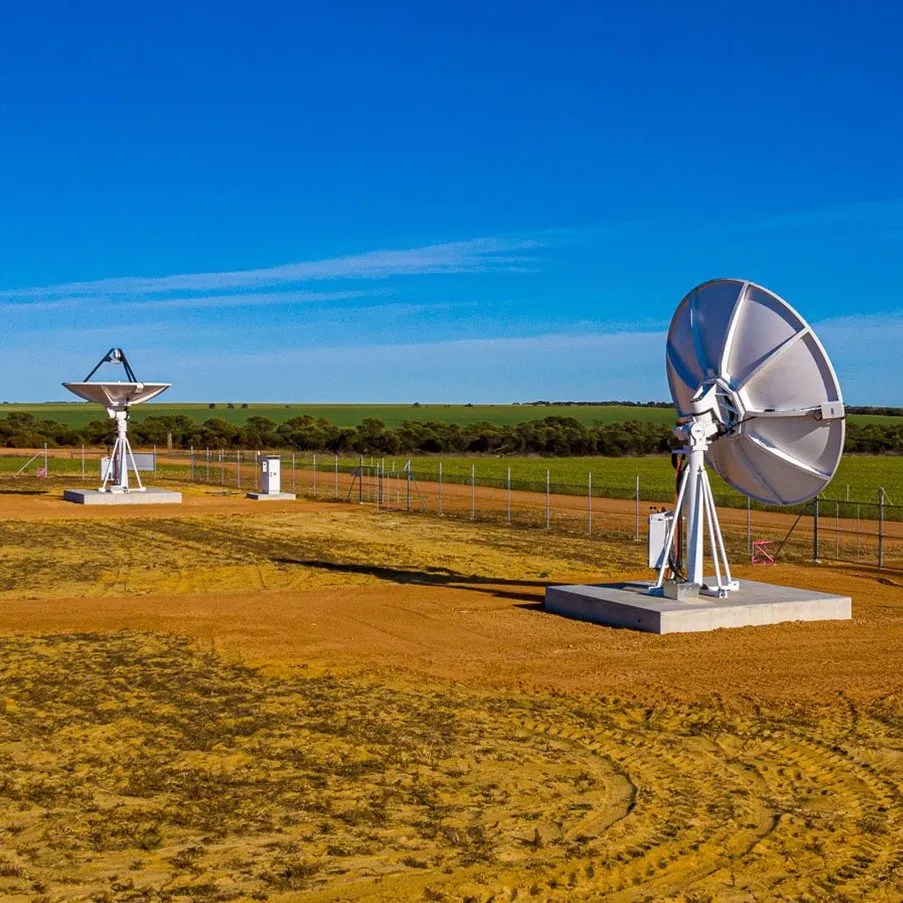
Norway’s Kongsberg Satellite Services, which Space Norway partly owns, operates the Svalbard satellite station as part of a network of more than 30 sites worldwide.
Dan Adams, head of KSAT’s U.S. unit, said the company is actively scaling that network to meet customer demand and improve resiliency.
“This is not a new consideration for us,” he said, “our distributed, network-based approach inherently provides resilience by allowing customers to downlink across multiple regions.”
Adams said KSAT is also working with industry partners to improve standardization and network-based architectures, as well as operational planning to maintain continuity of service.
“Regulatory and licensing processes can be a challenge without pre-planning and coordination,” he said.
“However, planning ahead and collaboration between spacecraft and ground network operators can significantly improve flexibility. With volume continuing to increase and complexity of space missions growing, the burden of regulatory processes is not likely to get better any time soon.”
The case for in-orbit relay
Large constellations such as SpaceX’s Starlink are increasingly turning to inter-satellite links to relay data across space and reduce reliance on ground infrastructure more generally.
There are also commercial data-relay constellations in the works to give smaller operators a similar capability.
However, as nations invest in anti-satellite weapons and other counterspace capabilities, shifting more of the network into orbit could move the risk rather than eliminate it.
Even limited attacks in orbit could generate cascading debris that has the potential to harm broader space operations and the services that rely on them.
Keeping data flowing in a crisis may depend as much on how well nodes can survive disruption as on how many are built and where.
<em>This article first appeared in the May 2026 issue of SpaceNews Magazine with the title “Ground stations in the crosshairs.”